Биологические науки/7. зоология
D. Yu.
Rogatnykh, E.V. Aistova
Amur Branch of Botanical
Institute-Garden, Far Eastern Branch of Russian Academy of Sciences, 2-nd km of Ignatyevskoye highway, city of Blagoveschensk, 675000, Russia. E-mail: rogatnykh@yandex.ru
Consortium of insect pests and weeds
in potato agrocoenosis in the Amur region
The
potato (Solanum tuberosum L.) is one of the most important food, feed
and industrial crops, which was first taken by the Europeans from the Indian
island of Chiloé [1]. However, the potato, cultivated nowadays, does not
occur in the wild. The story of the
potato in Russia is controversial and knows different versions. The mass production
of potato in Russia was launched in 1765, when a decree of the Senate "to
initiate potato growing in the country” was issued [2]. The spread of potato in
Russia increased in the middle of the 19th century. Currently, the potato is cultivated in large areas, both
on a global scale- it is cultivated in
130 countries on about 20 million hectares [2], and in Russia, where it takes
about 3.2 million hectares. Since its
consumption per capita is one of the highest, this culture was rightly called
"alternative bread" to cereal crops in our country. In the Amur
region potato is cultivated in 15 areas. The main ones are Blagoveschensk,
Tambovsky and Svobodny counties. Total area of potato crops as of 2011 in the
Amur region amounted to 21.5 thousand hectares (http://agroamur.ru/2/2.html).
An
integral component of any agrocoenosis
are plants, such as weed, insect pests and diseases. In agro-ecosystems of
artificial character the relationship between cultivated plants, weed plants
and insects is very specific.
Evolutionarily, plants produce more biomass to "feed"
phytophages. In this sense, the cultivated plants are no exception. However, in
the course of a long breeding and careful attendance, cultivated plants have
reduced resistance to certain groups of blight and competitiveness to the weeds.
The
objective of our research is the study of species of both insect-pests of
potato crops and weed.

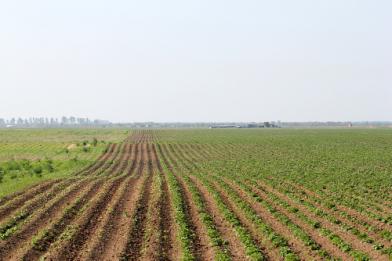 During the summer season of 2012 we examined eight potato fields (fig.
1) in Blagoveschensk and Tambovsky counties in the Amur region. The research was conducted by
through-method. We inspected the margins of the fields, as well as row- spacing
from the headland to the center. The description of the weeds’ and insects’
species was made. Census of insects was carried out after inspecting the leaves
and stems of plants on the headland, margins and in the center of fields.
Photos of pests and the sustained defects were taken.
During the summer season of 2012 we examined eight potato fields (fig.
1) in Blagoveschensk and Tambovsky counties in the Amur region. The research was conducted by
through-method. We inspected the margins of the fields, as well as row- spacing
from the headland to the center. The description of the weeds’ and insects’
species was made. Census of insects was carried out after inspecting the leaves
and stems of plants on the headland, margins and in the center of fields.
Photos of pests and the sustained defects were taken.
Weed
is the reservoir for the insect's development, which subsequently move on
cultivated plants. Therefore, the species composition of the weed is essential
for detailed comprehension of insect-plant relationships.
In
a potato crop we detected 32 species of weeds belonging to 15 families.
Asteraceae (9 species), Poaceae (4
species) and Polygonaceae (4 species) families
dominate by the number of species . Malvaceae and Convolvulaceae
families are represented by 2 species
each; other families (Chenopodiaceae, Lamiaceae, Equisetaceae,
Euphorbiaceae, Cannabaceae, Amaranthaceae, Fabaceae, Solanaceae, Commelinaceae,
Portulacaceae) – by one species. A significant amount of weeds was observed in
the interrow. In some rare cases potato
plant was choked by such species as Artemisia stolonifera (Maxim.) Kom., Sonchus arvensis L. and Commelina
communis L., Echinochloa crusgalli (L.) P. Beauv., Eriochloa
villosa (Thunb.) Kunth,
Cirsium setosum (Willd.) Bess, Solanum nigrum L..
They form small single-species "thickets" on the margins of the
fields or sporadically spread
throughout the whole fields. Such perennials as Cirsium setosum, Sonchus arvensis, Elytrigia repens
(L.) Nevski, Convolvulus arvensis L. are called vegetative-mobile plants for
their ability to "move" in better conditions, as well as for the
ability of clonal longevity. It is believed that the evolution of these types
of weeds was stipulated by the augmentation of their vegetative propagation
[3]. These facts we recorded in our studies as well.
In
all the studied fields land-treatment activities were held. However, the two
fields underwent only repeated plowing during the season. Due to these
measures, a green manure for next year crops is produced. Besides, it helps to
reduce the number of insects and weeds. In other fields, apart from tilling,
chemical cultivation was conducted. Another important way to reduce the number
of weed and insects species is to implement crop-rotation system (potato – lea
- potato, or potato-soy-potato), which was applied in all the studied
agro-ecosystems.
In
our studies we have noted a slight damage caused to potato by pests. However
many species of weeds have inflicted damage to the vegetative and generative
organs of the crops of different severity levels – from perforation to
skeletization of the lamina. Some groups of insects, when cutting or destroying
weed by mechanical or chemical means can become pests.
On
weed plants and cultivated potato we have identified fourteen species of
insects belonging to two orders and seven families. Coleoptera order was
presented by four families, the most diverse of which was Chrysomelidae with
five detected species. There were found two species of the Scarabaeidae,
Curculionidae and Meloidae families and
one species of, Coccinellidae. The Hemiptera order was presented by two species
of two families.
The
study of the headlands has shown that weed species composition differs from
that of the cultivated crops by its scale. Field margins represent the compact
plant formation with dominating cereals or sagebrush. Other species belong to
the group of typical segetalis, but they outnumber those in the center of the fields. It should be noted that a
particularly strong damage to vegetative organs of plants is inflicted by
insects on the margins of fields. It can be attributed to the large vegetative
masses, which attract a large number of pests, harboring them and providing
food.
The
representatives of Meloidae – Epicauta sibirica dubia (Fabricius, 1781)
and E. Megalocephala (Gebler, 1817) – were the most numerous in almost
all of the studied fields. Beetles were found on Commelina communis L., Elytrigia repens (L.) Nevski, Echinochloa
crusgalli (L.) P. Beauv., Eriochloa villosa (Thunb.)Kunth, Setaria
viridis (L.) P. Beauv. All listed plants were significantly damaged. In
addition to the occurrence on weeds, imago Epicauta has been sighted on
the leaves of the potato. The high number of different kinds of Exomala
pallidipennis (Retter, 1903) was registered, whose beetles browsed potato
flowers. It is worth mentioning that they were detected in two fields only, in
close proximity to the forest plantation. Another representative of the
Scarabaeidae family – Anomala luculenta Erichson, 1847 was found in a
small number on weed plants of a single field.
Among
Chrysomelidae the most numerous was Monolepta quadriguttata
(Motschulsky, 1860), which in addition to potato leaves corrupted adventitious
species – Hibiscus trionum L. Chaetocnema concinna (Marsham,
1802) and Phyllotreta nemorum (Linnaeus, 1758) were detected in only two
fields, but in some places in large numbers. The greatest damage from flea
beetles was exposed to Humulopsis scandens (Lour.) Grudz. A small number of both species was observed on
leaves of potato; however these kinds of pests cannot be viewed as inflicting
serious damage to the crops. There were recorded cases of flea beetles invading
crops of soybeans [4], as well as invasions of milfoil chrysomelid beetle [5]
to potato leaves. In both cases these invasions were stipulated by the lack of
the species’ fodder plants. We have also registered the habitat shift of Cassida
nebulosa Linnaeus, 1758 imago to potato leaves. The larvae of this species
were observed in all studied fields on Chenopodium album (L) and Cirsium
setosum (Willd.) Bess. The number of individuals per plant varied from
single entities up to dozens.
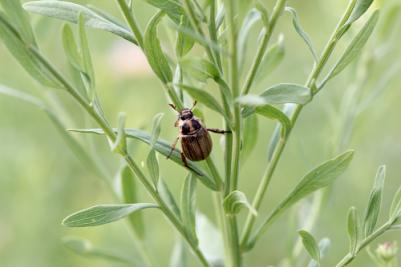 In one of the fields sporadic entities of Entomoscelis orientalis
(Motschulsky, 1860) were founds. Few were Chlorophanus sibiricus
(Gyllenhal 1834) and Lixus iridis (Olivier, 1807) (Curculionidae), Epilachna
vigintioctomaculata (Motschulsky, 1857), and Lygus rugulipennis
(Poppius, 1911) and Eurydema gebleri (Kolenati, 1856) (Hemiptera). Of
the above mentioned species Epilachna vigintioctomaculata deserves
special attention. A serious outbreak of this pest invasion was recorded in the
spring of 2011 in the Amur region. In spring 2012 in connection with the large
number of the hatched overwinter beetles, an unfavorable forecast about further
increases in pest invasions to the fields was made (www.rosselhoscenter.ru). However, due to the adverse weather conditions, they did not happen.
Single local outbreaks were observed only in private households, where
fields were located close to the
forest. This is due to the fact that imago prefer to spend the winter under the
plant litter on edges of the woods, from where it expands to agrocoenosis in
spring. Along with Mylabris, which are also capable of giving widespread pest
outbreaks, Epilachna vigintioctomaculata is the most harmful to potato
crops in the Amur region.
In one of the fields sporadic entities of Entomoscelis orientalis
(Motschulsky, 1860) were founds. Few were Chlorophanus sibiricus
(Gyllenhal 1834) and Lixus iridis (Olivier, 1807) (Curculionidae), Epilachna
vigintioctomaculata (Motschulsky, 1857), and Lygus rugulipennis
(Poppius, 1911) and Eurydema gebleri (Kolenati, 1856) (Hemiptera). Of
the above mentioned species Epilachna vigintioctomaculata deserves
special attention. A serious outbreak of this pest invasion was recorded in the
spring of 2011 in the Amur region. In spring 2012 in connection with the large
number of the hatched overwinter beetles, an unfavorable forecast about further
increases in pest invasions to the fields was made (www.rosselhoscenter.ru). However, due to the adverse weather conditions, they did not happen.
Single local outbreaks were observed only in private households, where
fields were located close to the
forest. This is due to the fact that imago prefer to spend the winter under the
plant litter on edges of the woods, from where it expands to agrocoenosis in
spring. Along with Mylabris, which are also capable of giving widespread pest
outbreaks, Epilachna vigintioctomaculata is the most harmful to potato
crops in the Amur region.
Potentially
dangerous, but not yet the cause of mass outbreaks are Monolepta
quadriguttata and Exomala pallidipennis (fig. 2).
 The complicated character of coevolution of insects and plants is
indicated by the fact that certain groups of insects can grow only on certain
plants. There is currently little data that would make it possible to trace the
historical links between groups of insects and their fodder plants. From the
point of view of insects-plant system, the changes in weed species composition
results in significant changes in the species composition of insects. If quite
typical pests were detected in the fields of cultivated crops, others were
attracted by the species of weed plants. In such cases, the cultivated plants
act as a secondary resource associated with a lack of major fodder species for
pests. Zero tillage can reduce the effects of the pests population control,
exercised by natural mechanisms.
The complicated character of coevolution of insects and plants is
indicated by the fact that certain groups of insects can grow only on certain
plants. There is currently little data that would make it possible to trace the
historical links between groups of insects and their fodder plants. From the
point of view of insects-plant system, the changes in weed species composition
results in significant changes in the species composition of insects. If quite
typical pests were detected in the fields of cultivated crops, others were
attracted by the species of weed plants. In such cases, the cultivated plants
act as a secondary resource associated with a lack of major fodder species for
pests. Zero tillage can reduce the effects of the pests population control,
exercised by natural mechanisms.
Index of sources:
1. N.I. Vavilov selected works. In 2
volumes. V. 1. L.: Nauka, 1967. -425 p. (in Russian).
2. Ŝegorec O.V. Amur Potatoes.
Bilogizing Technology of Cultivation. – Blagoveschensk: LL Publishing company
«Rio», 2007. – 400p. (in Russian).
3. Ulyanova T. Weed Flora in Russia
and other CIS Countries. – Spb.: WRI, 1998. – 233 p. (in Russian).
4. Mosejko A.G. Updating of
Agricultural Value of Leaf Beetles’ Species (Coleoptera, Chrysomelidae),
Damaging Soy in the Far East // Plant Protection. -2010. - № 1. P. 42-47. (in
Russian).
5 Costin V. D., Krylov A.V., Ivliev
L.A. Milfoil Chrysomela – potential pest of potato in Kamchatka//Report of the Far East division of the Siberian Branch
of the Academy of Sciences of the USSR. 1963., ISS. 17.P. 97-99. (in Russian).