Petryshyn
T. R.
National
Technical University of Ukraine “Kyiv Polytechnic Institute”
Face Detection and Recognition
Face detection is essential front end
for a face recognition system. Face detection locates and segments face regions
from cluttered images, either obtained from video or still image. It has
numerous applications in areas like surveillance and security control systems,
content based image retrieval, video conferencing and intelligent human
computer interfaces. Most of the current face recognition systems presume that
faces are readily available for processing. However, we do not typically get
images with just faces. We need a system that will segment faces in cluttered
images [2]. With a portable system, we can sometimes ask the user to pose for
the face identification task. In addition to creating a more coorperative
target, we can interact with the system in order to improve and monitor its
detection. With a portable system, detection seems easier. The task of face
detection is seemingly trivial for the human brain, yet it still remains a
challenging and difficult problem to enable a computer /mobile phone/PDA to do
face detection. This is because the human face changes with respect to internal
factors like facial expression, beard, mustache glasses etc and it is also
affected by external factors like scale, lightning conditions, and contrast
between face, background and orientation of face.
Face detection remains an open problem.
Many researchers have proposed different methods addressing the problem of face
detection. In a recent survey face detection technique is classified in to
feature based and image based. The feature based techniques use edge
information, skin color, motion and symmetry measures, feature analysis,
snakes, deformable templates and point distribution. The problem of face
detection in still images is more challenging and difficult when compared to
the problem of face detection in video since emotion information can lead to
probable regions where face could be located.
Problem
definition:
We are given an input scene and a suspect database, the goal is to find
a set of possible candidates. We are
subject to the constraint that we are able to match the faces from the scene in
an interactive time and that our algorithm is able to run on the given embedded
hardware.
Approach:
The basic algorithm starts with a
pre-processing step, consisting of digitization and segmentation. The next step
is called face segmentation. We define the face segmentation problem as: given a
scene that may contain one or more faces, create sub-images that crop out
individual faces. There are several algorithms available in the literature that
can solve this problem. Face segmentation makes use of facial features in order
to identify the face. Some algorithms for tracking face contours are known to
be effective. Tuning them to our embedded system will be a challenge. After
face segmentation, the device enters into the face identification mode, as shown in Figure 2.1.
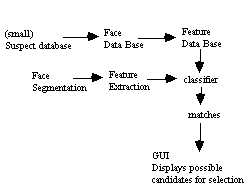
Figure 2.1 - Face Identification System
Human skin is relatively easy to detect
in controlled environments, but detection in uncontrolled settings is still an
open problem . Many approaches to face detection are only applicable to static
images assumed to contain a single face in a particular part of the image.
Additional assumptions are placed on pose, lighting, and facial expression.
When confronted with a scene containing an unknown number of faces, at unknown
locations, they are prone to high false detection rates and computational
inefficiency. Real-world images have many sources of corruption (noise,
background activity, and lighting variation) where objects of interest, such as
people, may only appear at low resolution. The problem of reliably and
efficiently detecting human faces is attracting considerable interest.
Motivation:
Face detection plays an important role
in today’s world. They have many real world applications like human/computer
interface, surveillance, authentication and video indexing. However research in
this field is still young. Face recognition depends heavily on the particular
choice of features used by the classifier One usually starts with a given set
of features and then attempts to derive an optimal subset (under some criteria)
of features leading to high classification performance with the expectation
that similar performance can also be displayed on future trials using novel
(unseen) test data
Interactive Face Recognition is divided
in to several phases; it includes
·
Creating drivers
for the handheld device that link with the application with the captured image.
·
A face detection
program is run inside the handheld device which detects the face from the image
·
The obtained face
is transmitted through wireless network
·
The server
performs the face recognition and is transmitted back
Each work is assigned three weeks of
time.
The Interactive Face Recognition can
benefit the areas of: Law Enforcement, Airport Security, Access Control,
Driver's Licenses & Passports, Homeland Defense, Customs & Immigration
and Scene Analysis. The following paragraphs detail each of these topics, in
turn.
Law
Enforcement: Today's law
enforcement agencies are looking for innovative technologies to help them stay
one step ahead of the world's ever-advancing terrorists.
Airport Security: The Interactive Face
Recognition device can enhance security efforts already underway at most
airports and other major transportation hubs (seaports, train stations, etc.).
Access
Control: The Interactive Face Recognition
device can enhance security efforts considerably. Biometric identification
ensures that a person is who they claim to be, eliminating any worry of someone
using illicitly obtained keys or access cards.
Driver's
Licenses & Passports: The
Interactive Face Recognition device can leverage the existing identification
infrastructure. This includes, using existing photo databases and the existing
enrollment technology (e.g. cameras and capture stations); and integrate with
terrorist watch lists, including regional, national, and international
"most-wanted" databases.
Homeland
Defense: The Interactive Face Recognition
device can help in the war on terrorism, enhancing security efforts. This
includes scanning passengers at ports of entry; integrating with CCTV cameras
for "out-of-the-ordinary" surveillance of buildings and facilities;
and more.
Customs
& Immigration: New
laws require advanced submission of manifests from planes and ships arriving
from abroad; this should enable the system to assist in identification of
individuals who should, and should not be there.
The Interactive Face Recognition device
is a test bed for embedded face recognition research. As such, it contributes
toward building a general infrastructure for research into embedded vision,
further benefiting society.
Literature
Cited:
[1]
Turk and Pentland, Face Reconstruction
and Recognition Using Eigen Face
Method.[2] K.Sandeep and A.N.Rajagopalan, Human Face Recognition in cluttered color
Images using skin color and edge information