matematik
The sums solved by means of the equations for school children of 5-9
classes
Ryspaeva Manar Kazhibaevna
Director of High
School No 18 sity of Kokshetau. Kazakhstan
The sums solved by means of the equations, we can divide into 5 types:
I. Sums on comparison of values;
II. Sums on calculation of speed on the earth and in air;
III. Sums on calculation of speed in water;
IV. Sums for group work;
V. Sums on finding of two and three-digit numbers;
Comparing each of these sums, showing ways of their decision, we will show their registration.
I. To the sums that are solved by the comparison of values we can carry sums in which 2-3 digit are compared between themselves or their division and finding their percent. Ways of the solution of sums consist of four parts: 1. Short writing. 2. Plan.
3. Equation. 4. Answer.
Before starting the solution of a sum it is necessary to write down a short statement of the sum “>” or “<” signs, then to choose the plan of the decision and a condition of drawing up of the equation.
Planning the solution of a sum we will designate the smallest unknown number - x. Then we will find other unknown numbers.
Then we work out the equation by means of known numbers and conditions of sums.
After finding x we answer a question of a statement of the sum and write down the answer.
It is necessary to check correctness of the answer.
Now we will show the decision of some sums for 7-9 classes according to the textbook "Algebra".
We will solve sums showing their registration in a writing-book.
№1. There is 40 000 tons of wheat in two barns. To one barn was delivered 4000 tons of wheat, from the second barn was taken away 8000 tons of wheat. Then in two barns there stayed an identical number of tons of wheat. How many tons of wheat was there earlier in each of these barns?
1) Short writing: 2)
Plan:
I+II+III=40000 tons (plan)
If there is tons of wheat in I – barn,
 I+4000 tons = II
– 8000 tons (40000 – x) is in II – barn.
I+4000 tons = II
– 8000 tons (40000 – x) is in II – barn.
(equation)
I
- ? tons, II - ? tons
3) Equation:
x+4000=(40000-x) – 8000
x+4000= 40000-x – 8000
2x = 28000
X = 14000 (I – barn)
40000 – 14000 = 26000 ( II – barn) Answer: 14000
tons, 26000 tons.
№2. Three tractor brigades repaired 104 tractors in a month. The first brigade 12 tractors less than the second brigade, and the third brigade repaired of tractors of two brigades. How many tractors did each brigade repair?
1) Short writing: 2)
Plan:
I+II+III=104 tr. (equation)
If I – brigade x tractors repaired, then
 I<II 12 tr.
II–(x+12) tractors repaired, and
I<II 12 tr.
II–(x+12) tractors repaired, and
III ~ (I+II) tr. III –
 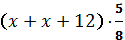 tractors repaired.
(plan)
I - ? tr., II - ? tr., III - ? tr.
(in I – brigade)
26 + 12 = 38 (in I – brigade)
104 – (26+38) = 40 (in III – brigade)
3) Equation:


Answer: 26 tr., 38 tr., 40 tr.
№ 3 During holidays a group of pupils weeded part of the plot sown with cucumbers in a day, during the second day of the left plot, 12 hectares of the plot wasn’t sown. How much hectares is the area in all?
1) Short writing: 2) Plan:
I - of all plot, If in total the plot is x hectares, then I – day
II - of the left plot was sown, hectares, and II - hectares are sown.
12 hectares wasn’t sown.
In total ? hectares.
3) Equation:
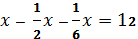
x = 36 (hectares are the area in all) Answer: 36 hectares
№ 4. Three groups of pupils gathered 65 books for their school library. The first group gathered 10 books less than the second group, and the third group gathered 30% of books gathered by two groups. How many books did every group gather?
1)
Short writing: 2)
Plan:
I + II + III = 65 books. (equation) If group I gathered x books, then group II gathered (x + 10) and group III gathered
I < II books (x + x + 10)×0,3 books.
III ~(I + II) - 30%
I -?, II - ?, III - ? books.
3) Equation: Answer: 20 books, 30 books, 15 books.
x+ (x + 10) + (2x + 10)×0,3 = 65
x+ x + 10 + 0,6x + 3 = 65
2,6x = 52
x = 20 (books of group I)
20 + 10 = 30 (books of group II)
65 – (20 + 30) = 15 (books of group III)
№ 5 1,2 of kvass was brought to the first kiosk that is less than was brought to the second kiosk. Every hour the first kiosk sold 90 l. of kvass, and the second kiosk sold 80 l. of kvass. In 2,5 hours the second kiosk had 65 l. of kvass that is less than in the first kiosk. How many litres of kvass were brought to each kiosk?
1) Short
writing: 2) Plan:
I > II 1,2 more. If x l. of kvass were brought to II kiosk, then 1,2x l.
In 1 hour I ~ 90 l. of kvass were brought to I kiosk.
II ~ 80 l. were sold. (plan) In 2,5 hours II kiosk 80×2,5 = 200 l. and I kiosk
After 2,5 hours: 90×2,5 = 225 l. of kvass was sold, then II kiosk –
II < I 65 l. was left. (equation) (x - 200) l., and I – (1,2x - 225) l. was left.
I - ? l., II - ? l.
3) Equation: Answer: 540 l, 450l.
(1,2x – 225) – (x - 200) = 65
1,2x – 225 – x + 200 = 65
0,2x = 90
x = 450 (l. in II kiosk)
450×1.2 = 540 (l. in I kiosk)
II. While short writing down of sums on calculation of speed it’s necessary to draw the road scheme and use known formulas from physics: S = v×t, v = S/t, t = S/v. And while showing ways of sum decision it is necessary to designate the unknown number x as there are a lot of letters in order not to mix what of them is unknown. Let’s take a few sums and show their registration.
№ 6 The distance between two cities is 284 km. The cargo train with speed of 48 km per hour started from the city A to the city C, after an hour a passenger train was coming in the opposite direction with speed of 70 km. per hour. In how many times the trains will meet?
Picture
 48km/h 70 km/h
А С
І ІІ
284km
1) Short writing: 2) Plan:
S1 + S2 = 284 km. (equation) t2 = x hours
 U1 = 48 km/h, t1 = (x+1) hours
U2 = 70 km/h.
(plan) S1 =
48(x=1)km.
t1 > t2 1 hour S2
= 70x km.
t2 = ? hours.
3) Equation: Answer: 2 hours later.
48(x+1) + 70x = 284
48x + 48 + 70x = 284
118x = 236
X = 2(t2)
№7 The first bus
with speed of 36 km per hour started from the city to the village, 40 min.
later the second bus with speed of 48 km per hour started from the very city to
the village and the buses came to the village simultaneously. How
many kilometers are there between the city and the village?
 Сity 48km/h 36 km/h Village
 I bus. II bus.
S
1) Short writing: 2) Plan:
 U1 = 36 km/h, if
t2 = x hours, then
U1 = 36 km/h, if
t2 = x hours, then
U2 = 48 km/h. (plan) t1 = (x + ) hours, and S1 = 36 (x +) km.,
t1 > t2 40 min. = hours S2 = 48x km.
S1 + S2 = S (equation)
S = ?
3)
Equation:
36 (x + ) = 48x
36x + 24 = 48x
12x = 24
x = 2 (h. – t2)
S = 48×2 = 96 (km) Answer: 96 km.