ABOUT THE MEANING OF THE
MUSEUM OF INSECTS IN MASTERING THE METHOD OF BIOLOGICAL PEST CONTROL
T.Marinenko,
T.Mamedova, K.Ramazanova
KGU named
after Baitursynov, Kostanay, Kazakhstan
marinenko1957@mail.ru, takamika@mail.ru, aru_1612@mail.ru
Entomological museum, our university is a scientific
center for the study entomofauna of Kostanai region and serves as base for
professionals, involved in entomology and plant protection. According to its
profile and tasks planned museum is completed, providing advice, support
contact with alumni working in the regional branches of the
RepublicanStateInstitutionsInstructionalCenter phytosanitary diagnostics and
forecasts.
The museum in addition to a huge number of insects
caught in Kostanai region, there are many entomophages species affiliation have
not yet been determined. Activities entomophages saves and maintains a balance
in nature. At the first stage of work with them, identified 82 species,
composed exposition collection, it included representatives of 11 groups, 36
families , 68 genera. In preparing the exhibition, we relied on the material
collected by us in guided hikes (1997-2009).
Owning material collected for a long time from different parts of
Kostanai region , comparing their phenological observations and summarizing the
literature data on the biology collected entomophages we can decide on the
types that can be used against those or other pests. In the study of values entomophages important to know their life and seasonal
cycles, as well as the degree of conjugation with the owners of their
development, taking into account the features of host plants and the prevailing
environmental conditions. This allows you to more accurately determine the
periods of highest abundance and activity entomophages and establish their
ability to suppress the pest in the field of its propagation.
Since biological methods rely primarily on the use of
entomophages need to establish their species composition determines the value
for biological and integrated methods of plant protection.
Among the variety of pests of our museum visitors see
useful entomophages that heals without pesticides planting grain, vegetable,
fruit and other crops. It is known, for example, that to control the colorado
potato beetle enough 3-4 Carabus
canellatus Ill for 1m2, to prevent the mass reproduction of the
second generation beetle.
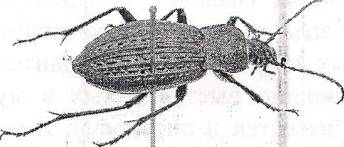
Carabus canellatus
Among entomophages meets small (9-11 mm ) of the original species are voracious predators
such as Rhaphidia ophiopsis L.
representatives of a very ancient group of insects. They hunted at various slow
insects – fly, caterpillar e.t.c.
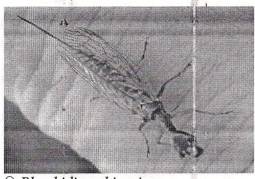
Rhaphidia
ophiopsis
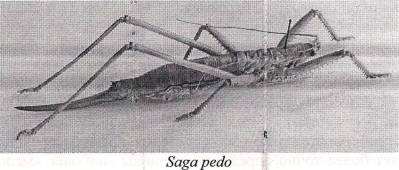
There are an amazing collection of the museum is a
rare flightless predatory grasshopper body length is 53-75 mm, it is called
steppe Saga pedo Pall. With
ovipositor Saga pedo at different depths in the ground lays stood open 7
infertile eggs that develop only females . Hunts as a predator, eats not only
the small grasshoppers, but also large grasshoppers, crickets, beetles,
bugs. Saga pedo a typical representative of the steppe fauna of Northern
Kazakhstan. Decreasing form, it becomes
very rare as a result of agricultural land use and in the Red Book of
Kazakhstan.
In Kostanai region during development of virgin lands
many steppe species of insects have reduced their numbers, as opposed to pests,
whose number has increased due to the contrary mono cropping largest squares.
For a long time the attention of specialists focused on the fighting against
pests rather than on the protection of
useful and rare species. For example, fauna lacewing (Neuroptera) is poorly understood. We often met at the raspberries
and currants common lacewing Chrysopa
carnea Step., Body length of 12-13 mm, 26-28 mm wingspan. Its larvae are
fast runners, grab aphids and suck , leaving only the skins of which make a
cocoon before pupation. Chrysopa carnea
proved effective against different types of aphids, developed methods of mass
rearing using as food grain moth larvae.
It
is very timely to create in our human resources specialists regional
entomologists. Their task is the definition of material for economically
important (for each of the natural zones) insect pests and their entomophagous.
In this connection, acquire value display in the museum collections of insects
Kostanai region, the species composition of which is known and defined. In
collaboration with the Agricultural Research Institute Kostanai for agronomists
and other specialists Entomological museum themed lectures , tours, workshops to
help students to have a wonderful opportunity to get nova new information and
expand vision.
The essence of biological control is the use of
natural enemies of insect pests. There are not insect species that do not have
their own predators and parasites. Some insects are affected by several
parasites, but not all of them can be used for biological defense.
Need to protect and promote the involvement of
entomophages them on crops. One of the techniques is attracting entomophages
planting nectar plants (both power supplies), such as umbrella, which feed on
the flowers of flies and parasitic Hymenoptera tahin in the adult phase.
Biological control of insect pests is the most
advanced in the direction of entomology, the chemicals with which fight against
pests, poison the soil, plants, penetrate with agricultural products in the
human body, silently causing damage to health. Therefore, this method is
gaining importance and distribution. The modern approach to the management of
the pest population is inherently ecological. It uses a variety of existing
methods of struggle so that for each case could use some system tools and
techniques that complement each other. This is numerically integrated
management for population of pests.
REFERENCES
1. N.Nikita,
A.Sviridov Insects Red Book of the USSR - Moscow: Pedagogy, 1987. – 176p.
2. T.Marinenko,
Natural enemies of pests berries Northern Kazakhstan / / VestnikKazNU series
biological. 2004 - № 2 (23). - P. 133-137.
3. Handbook of Plant
Protection / Ed. A.Sagitova, Ismuhambetova Railway - Almaty: Nauka, 2004. –
320p.