Е.В.Васильчук
к.э.н.,
старший преподаватель
Костанайский
государственный университет им. А. Байтурсынова
Business development models of the internal revenue system control
Organization's
system of internal control is a tax management process complex object. In turn,
the management solution of complex object is performed in two stages, where the
original analysis conducted control object, which is: in the evaluation of the- resulting indicators of trouble spots in the
formation of an object model definition of management- criteria that achieve a certain
goal. In the future, provided construction management system that provides the
implementation of optimal control found. [1]. A
concept model of the organization of the internal tax control. This concept defines the basic approaches to the
creation of the internal tax control of the economic entity as a single
business entity. The concept is focused primarily on the achievement of the
main control objectives, namely the pre-emption of illegal and wasteful in terms
of the interests of the enterprise business operations at the initial stage of
a management decision. Only if there is assurance that the goals and
objectives of the economic entity achieved efficiently and economically, on the
results of the planning and organization of the internal tax control can be
indicative of a well-functioning system of internal tax A key component of the
concept is a model of the organization of the
internal tax control. The establishment of the system of internal fiscal control
should be limited to certain means of implementing interrelated stages, which
are components of the model. The concept model of the organization's system of
internal control is designed to tax purposes create a unified approach to- the system of internal tax control in enterprises; improve the efficiency of the- internal tax control in general;
reducing the number of- violations of tax laws by taxpayers;
creation and development of a- model of the internal tax control.
The main phase of a conceptual model was the selection of variables and
parameters of the object in the process of which were specified performance
criteria system.
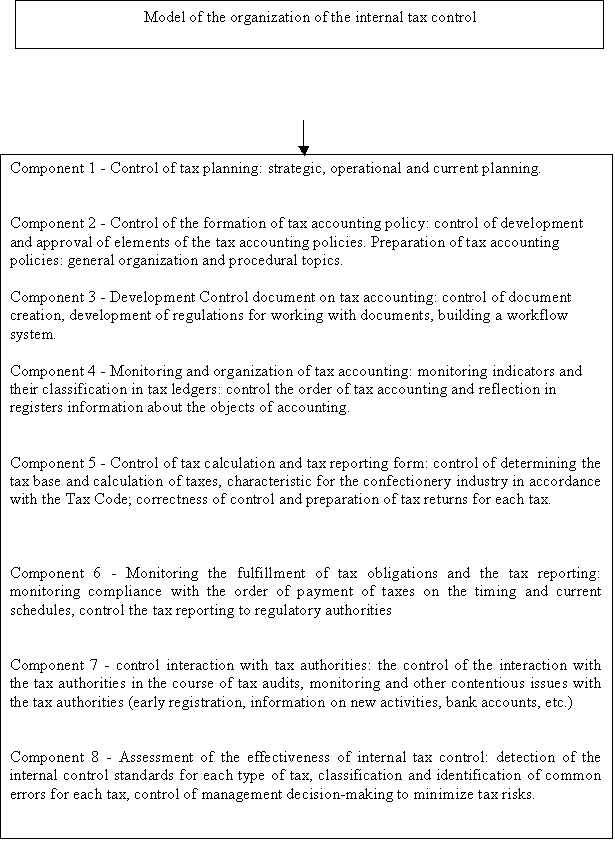









Figure 1 - Model organization
of the internal tax control
Model of organization tax control system consists of eight major components (Figure 1)
Component 1 . Tax Planning
Component 2 . Formation of accounting policy for taxation purposes
Component 3 . Workflow system on tax accounting
Component 4 . Organization of tax accounting
Component 5 . Control tax calculation and tax reporting form
Component 6 . Control of tax reporting to the tax authorities
Component 7 . Control of fulfillment of tax obligations Enterprise
Component 8. Performance Evaluation of the internal tax control
Of
all the possible parameters of the object to select the most significant (in
this case, under the essential parameters are those factors that most strongly
affect the achievement of management objectives). [3] In determining the value
of the efficiency criterion used, taking into account the characteristics of
the object and the consumption of resources allocated for its operation for
some time. A preliminary analysis of
requirements for the model were determined by methods that describe the actual
processes and methods of checking the correct operational model [4]. Study
properties of the model determines an estimate
of the accuracy of the description of real phenomena and versatility of the
model.
However, taking into account that this model can be used
as medium enterprises , and large businesses and its components can be
transformed according to the needs and forms of organization of the company. [5
] .
Information and
communication infrastructure is the provision of an internal tax control in
terms of interaction with other departments or external actors in the company
to obtain the necessary data. Logistics allows tax control system in the
company with the necessary material and technical resources ( equipment ,
office equipment, technology and facilities). Organizational support in
addition to highlighting features in the enterprise entities engaged in an
internal tax control (departments ) , also helps to establish the status and
delineate the area of activity of subjects of internal tax control . Talking
about the organizational structure , attention is drawn to the fact that in
recent years some companies use so- called "simple organizational
structure ." This is a temporary structure , consisting of a team of skilled
employees of the enterprise , created in most cases for the implementation of a
complex project on time with a given level of quality, so , for example, to
check the status of payments to the budget for a particular tax (VAT) ,
corporate income tax (CIT ) , etc. currently, the internal tax control most
widely in large holding companies with independent , sometimes geographically
remote subdivisions . Financial security to determine volumes and financing
activities of the internal tax control . Accounting and analytical support
seems to be one of the key , as is the basis for control measures. From the
above tasks of internal tax control is seen that most of them aimed
specifically at addressing issues related to the calculation and payment of
taxes and fees. In turn, namely accounting and analytical support to obtain
information about the assets and liabilities taken into account is the basis
for calculating taxes and duties of the tax liabilities. Legislative (legal )
framework and methodological support is a system of laws and regulations ,
standards, checklist procedures, internal guidance documents on the basis of
which the internal tax control . Formation of on-farm control - a key component
of business strategy for any company. By means of internal control is ensured
safety of the property , identification and mobilization of existing reserves
in the sphere of production and finance , creating conditions for improving the
management of the company. [ 6 ]
In turn, the internal tax control is an integral component
of the system of economic control over the enterprise . By means of tax control
company can define and regulate financial flows. In addition, the smooth
functioning of the internal tax control directly affect the results of the
state tax control . Before proceeding to the requirements of the organization
's system of internal control in the enterprise tax , I would like to stay at
such a key moment as defining the scope of the internal tax control
Traditionally, managers of many companies interested in establishing or
strengthening tax services tax control units , and in some cases the formation
of individual departments . Certainly, the creation of separate structural
subdivisions of internal tax control requires additional resources ( financial,
labor , time , etc.). Therefore, in order to determine the scale of the system
of internal control and its tax structure management of any enterprise must
select defining criterion . In this case, such a criterion is proposed to take
the tax burden placed upon the company . Thus, some experts used the scale that
determines the need for fiscal measures , in particular planning at a certain
level of tax burden . It seems appropriate to consider the scale specified in
terms of assessing the scale functioning of the internal tax control . The
proposed scale is analyzed dependence of tax control measures on the level of
tax burden on the company , the higher the level of the tax burden , the
greater the need for the enterprise in the activities of the internal tax controlThe
tax burden in this case is calculated as the ratio of taxes paid to the volume
of products (works , services). [ 8 ]
So by means of the proposed scale
enterprise performs a test of the existing mechanism of tax control and tax
burden , subsequently , on the basis of the results, carried out the
construction of the internal tax control . Well-organized system of internal
tax control not only helps in making management decisions , but stimulates a
conscientious attitude to the execution of their duties taxpayers to pay taxes
and fees. In order to create a well-functioning system of internal tax control
any manager enterprise must determine the requirements for the organization of
the internal tax control . Requirements for the organization of the internal
tax control vary depending on the particular company or group of companies .
However, there are strategic issues that must be addressed regardless of the
type and size of the company , in general, we are talking about the following
key issues :
- definition of goals and objectives of the tax system of internal control;
- establishing the
status of the department (division ) of the internal tax control in the
corporate structure : mechanisms and its interaction with other units of the
company ;
- development of the organizational structure of the internal tax control
- establishing
responsibility centers and responsibility of individual performers internal tax
control ; - determine the
order of interaction between structural units of the company within the issues
solved by the internal tax control ;
- development of procedures and rules of the department of internal tax
control , internal documents regulating the work of tax control and its
relationships with other departments of the enterprise;
- criteria for
evaluating the effectiveness of the department of internal tax control .
The main tasks of an internal tax
control in the first place , you must include the unification of methods and
approaches to the calculation of tax as the whole company and its various parts
( or different group companies ) . Solving the specified task , the company can
automatically eliminate possible distortions and errors arising from the use of
different methods of calculating taxes at the same time in all divisions ( group
companies ) . The purpose of the tax control is to optimize the current
payments to the budget and reducing the tax burden , and tax risks in the
enterprise. It is required to determine the risk level acceptable tax planning
schemes , and the willingness of companies to change business structure for tax
optimization. Status of the internal tax control - is, first and foremost , its
position in the organizational and management structure of the company . The
most commonly used two types of management structures , as well as their
combination : linear, linear- functional and functional. [9 ]
References
1
Hudyakov AI Brodsky GM Tax theory: a
tutorial. - Almaty LLP "Publisher
NORMA-K", 2009. – 392
2 Bourtsev VV
State financial control: methodology and organization. - M.: IVC
"Marketing", 2010. - 327.
3 VV Pugachev Internal audit and control. Organization of internal
audit in the economic crisis. - M: Business and Services, 2010. - 224.
4 RV Makeev Statement of internal control system of inspections
reporting to business performance. - M.: Top, 2008. - 296.
5 Butovo TV Management Consulting. - M.: TENS
2011. - 495 p.
6 BN Sokolov,
Roukin V.V.Sistema internal control (organization, methodology, practice). -
Moscow: ZAO "Publisher" Economy ", 2007. - 442.