Economic
sciences / 7. Accounting and Auditing
Vashchuk Y.V, master's degree,
Karaganda Economic University of Kazpotrebsoyuz, 100009, Republic of
Kazakhstan, Karaganda, Akademicheskaya str. 9
Suggestion
for usage of analytical procedures in conditions of Kazakhstan audit
development
Conditions
for the development of Kazakhstan's audit and requirements of the global audit
determines the need for a critical review of currently used and new and
improved methods of audit. In this regard, this article substantiates the
necessity of an integrated approach in order to fully analyze and synthesize
the actual material, the auditor clarify the auditor's sequence of actions,,
identify the authenticity of information sources involved. Audit is seen as a
process, which is based on the definition of the type, location, the role of
auditing procedures and techniques and identification of their impact to the
the final results of the whole process. The correct choice and adequate
performance of the audit procedures that is what the achievement of the audit
objectives depends on A comprehensive study of the audit process requires
a combination of analysis and synthesis. The analysis assumes decomposition of
audit and each of its elements into their constituent parts and studying them
thoroughly. To understand the basics of the audit process it is necessary to
define stable relations between its elements and the causes of various
phenomena and merge them into a single entity, ie synthesize. In these
positions can be traced the reproduction of analytical procedures conceipt
involving the use of methods of analysis and synthesis, and based on the
existence of causal relationships between data. Thus, a comprehensive
examination of the audit process initially defines central position of
analytical procedures in auditing[1, p. 85].
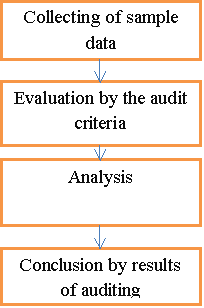
Figure
2 shows a diagram of the audit process, which combines elements interrelated to
achieve a common goal. Each element contains the analytical components
logically connected to each other. The basis of such a representation of the
audit process is made of auditing stages indicating the purpose of each phase
direction of work to achieve the goals and analytical procedures applied [2, p.
134].
 0
0
 00251659264
Figure
2 Scheme of the audit process
Within
each audit firm specific audit techniques, the applicable procedures and audit
methods, forms and procedures for registration of the working documentation are
expressed in the form of internal audit standards. In this regard, the
dissertation developed a draft of intrafirm standards "Analytical Procedures",
which has already been adopted for implementation in a number of audit firms.
The
distinctive features of the offered intrafirmaudit standard are:
-
Clarification of the analytical procedures definition;
-
Identification of the audit conditions, allowing to extend the usage of
analytical procedures;
-
Consider the potential use of analytical procedures at each stage of audit _,
using an integrated approach to the audit process, involving a permanent record
previously completed procedures and the results obtained;
-
Availability of specific recommendations for the use of analytical procedures
of audit stages taking into account the order of their fullfillment-definition
of purpose, form, fullfillment, analysis of results;
-
Availability of interrelations with other internal standards governing the work
of the audit organization, and marking of work documents needed to filled in .
During
the audit such indicator as audit risk is of great importance, the construction
of the entire audit process depends on. In this regard, it is suggested to
evaluate the total audit risk based on three components:
-
A preliminary audit risk;
-
Risk in potential risk areas;
-
The risk of customer acceptance
Preliminary
audit risk is determined on the pre-planning on the basis of information about
the client's business resulting from performing analytical procedures by
analyzing the presence of any fact of risky conditions of the organization
activity, which include, in particular, the dependence of the organization in
relation to other parties, the use of significant amounts of raised funding
sources, in terms of branch of activity, versatility of business, organization
structure. The prevalence of positive responses indicates a high risk of the
auditor [3, p. 112].
Risk
in potential risk areas is determined by using the balance sheet data. The
areas of potential risk are the balance sheet items, changes in the share of
which in the structure of balance currency in the reporting period amounted to
more than 10%, or the growth rate deviates from the growth rate of balance
currency by 1.5 timesas well as new balance sheet items. Areas of potential
risk of the auditor are determined by using the results analytical procedures
such as the calculation of the individual balance sheet items proportion in the
total result and figures comparison of audited financial statements with
similar data from previous periods with the indication of positions with the
largest deviations. The level of risk is initially determined separately in
terms of assets and liabilities of the balance sheet. The overall auditor risk
is estimated by the highest risk level of the two - the asset or liability.
Evaluation of the level total audit risk is carried out using a special table
which has systematized all possible combinations of three components. The
actual level of audit risk is in the row containing the specific values
of its elements.
Compliance
with the rules (standards) of audit is relatively easy verified through the
analytical procedure such as the analysis of audit documentation. Assessment of
sufficiency and appropriateness of audit evidence are based on the analysis of
fulfillment of all points of the plan and the audit program by using the
results the analytical review of the working documentation of the auditor. With
the purpose of quantitative expression here are the following scales of
scoring:
-1
Point - "yes" - the work in accordance with the standards and
procedures for the audit program are fully implemented, which is proved by the
presence of the duly prepared working documentation;
-0.5
Points – “not fully" - there are some indications of fulfillment the
necessary tasks according to standards or procedures of audit programs, but if
the documentation is badly prepared, there are no conclusions of the results of
work and procedures carried out;
-0
Points - "no" - there are no signs of compulsory work fulfillment
according to standard requirements or performing audit procedures of audit
programs.
When
considering such quality criteria as used audit procedures, we believe that it
is the widespread use of analytical procedures can significantly improve audit
quality at the same time reducing auditor time to hold it. This is manifested
in two ways. On one hand, when by the results of analytical procedures there
are no significant or unusual deviations, there is a reduction of labor costs
and the cost of audit. Otherwise (in case of deviations, requiring detailed
consideration) analytical procedures direct the auditor's attention to areas
that are potentially distorted, and thus contribute to the identification of a
large number of errors and inaccuracies. Moreover, by focusing audit work in
areas where the risks of undetected errors is higher we can reduce the time
spent on the checking of areas with low audit risk. Thus, examination of the
quality criterion seems expedient to be carried out on the basis of assessment
of the degree of using the analytical procedures in the audit. This is done by
calculation of the coefficient ratio of audit procedures (Kap):

where:
 - actual level of
analytical procedures usage in auditing;
- actual level of
analytical procedures usage in auditing;
 - the permissible level of using
the analytical procedures under predetermined conditions of the audit.
- the permissible level of using
the analytical procedures under predetermined conditions of the audit.
Calculation
of  represents the ratio of the
number actually completed analytical procedures (AP) to the total amount of the
audit procedures (PS). Analytical procedures applied in the audit is carried
out during the compliance of auditing standards and audit procedures in accordance
with the audit program. This means that in order to determine actually
completed analytical procedures and all audit procedures there's used the
estimation of the amount of audit procedures performed according to programs of
audit and compliance of auditing standards based on the analytical review of
documentation[4, p. 315].
represents the ratio of the
number actually completed analytical procedures (AP) to the total amount of the
audit procedures (PS). Analytical procedures applied in the audit is carried
out during the compliance of auditing standards and audit procedures in accordance
with the audit program. This means that in order to determine actually
completed analytical procedures and all audit procedures there's used the
estimation of the amount of audit procedures performed according to programs of
audit and compliance of auditing standards based on the analytical review of
documentation[4, p. 315].
Lack
of the proper methodological developments affects the level of of using the
analytical procedures and thus leads to a decrease quality indicators of audit
that, in particular, has been illustrated in this dissertation research.
Introduction of the proposed project of intrafirm standard will allow a wider
use of analytical procedures, which in its turn will facilitate the
implementation of the of audit a qualitatively new level, providing adequate
expression of professional opinion on the authenticity of financial statements.
Application
of simple quantitative procedures is also effective during audit. Research of
the most important spheres (in which there are sharp deviations of the actual
indicators from planned) can reveal certificates of potential mistakes (on the
contrary, their absence can say that mistakes are improbable). Analytical
procedures of this type widely practice, for example, at audit of the state
enterprises. Thus it is necessary to consider two moments: it is how possible
to trust forecasts of the audited person (for this purpose the auditor talks
about procedures of drawing up forecasts to the personnel of the client) and
what probability of that the current financial information was changed by the
personnel of the audited person according to expected calculations (for data of
this probability to a minimum the auditor estimates risk of control and holds
detailed testing of actual data).
When
comparing indicators of the accounting period with indicators of previous
periods acute fluctuations shall draw attention of the auditor as they can be
connected with change of economic conditions or with errors of the financial
reporting.
Also
comparison of the actual financial performance with the forecast indicators
determined by the auditor when the auditor builds expected balance for
comparison it with the actual is applied; the essence of this procedure
consists that the auditor compares an account balance to other remaining
balance or the profit and loss account or builds the assumptions on the basis
of the developed tendencies.
When
comparing indicators of the checked economic actor with the industry average
data considerable deviations shall be studied by the auditor, however it is
necessary to consider distinctions in accounting policy of the entities,
economic conditions and possible specificity of products issued by the separate
entities; it is in certain cases reasonable to make comparison with entity
analog indicators. [5, p. 46].
After
selection and check of elements, but before creation of a final conclusion by
results of selective research the auditor shall study each revealed deviation
(mistake). Thus it is necessary to find out:
- than this deviation is caused: defects in
an internal control system, the wrong understanding the personnel of
regulations, carelessness, intentional misstatement;
- whether this deviation is accidental or
systematic, i.e. to inherent all documents, transactions (for example, as a
result of the wrong understanding the accountant of requirements of the
legislation);
-
this violation will affect other objects of accounting and financial
results as a whole [6, p. 189].
Application
of analytical procedures is based on an assumption of that interrelations
between data exist and continue to exist so far as there are no proofs
opposite.
Degree in which the auditor can rely on
results of analytical procedures, depends on an assessment the auditor of risk
of that the analytical procedures based on forecast data, can specify lack of a
mistake whereas actually checked size is significantly distorted.
Degree
of trust of the auditor to results of analytical procedures depends from:
-
materialities of considered articles (for example if account balances of
manufacturing inventories are essential, the auditor shouldn't rely only on
analytical procedures in case of a formulation of the conclusions; at the same
time he can rely only on analytical procedures for individual clauses of the
income and expenses if they are insignificant separately);
-
other audit procedures directed on achievement of the same purposes (for
example, other audit procedures which are carried out in case of check of
prospects of settlement of receivables, such as check of the subsequent cash
receipts, can confirm the conclusions drawn as a result of application of
analytical procedures to ranging of debtors on payment due dates);
-
accuracy with which expected results of analytical procedures (for example can
be assumed, the auditor when comparing profitability of a current period with
previous usually expects bigger compliance, than when comparing a share in cost
value of separate expense types, such, as costs for scientific researches or
promotional costs);
- estimates of an inherent risk and risk of
means of internal control (for example if internal control behind procedure of
handling of sales orders is insufficient and, therefore, the risk of means of
internal control is high, detailed tests of separate transactions and balance
on accounts, instead of analytical procedures will be more reliable when
forming conclusions of the auditor on receivables).
The
auditor should estimate and check reliability of existing means of internal
control (in case of their availability) behind preparation of information used
in case of analytical procedures.
If
such control facilities can be considered efficient, the auditor will have big
confidence of reliability of information and, therefore, in results of
analytical procedures.
Means
of internal control behind non-financial information can be checked together
with the means of internal control connected with conducting financial
accounting. For example, control facilities behind handling of accounts for
shipped products can provide at the same time and control facilities behind
reflection of a shipment process of its separate units or batches. In such
circumstances the auditor can check control facilities behind registration of
shipment of products at the same time with check of control facilities behind
handling of accounts.
Having
carried out the analysis of the found deviations, the auditor makes recommendations
about internal control system enhancement at the entity, to accounting.
Besides, the decision on increase in the amount of selection, carrying out
additional research [1, p. 225].
Results
of studying of each found deviation find reflection in working documentation of
the auditor.
References:
1.
Sheremet A.D., V.P. Suyts Audit: Tutorial. - 5th ed., Rev. and add. - Moscow:
Infra-M, 2009. - 448.
2.
Yudina G.A. Audit: Teaching Materials. Krasnoyarsk, 2005. - p.74.
3.
Alibekov S.I. Use of analytical procedures in audit activities, audit
statements: N 3, 2004. - p.5
4.
Arabyan K.K. Organization and conducting of the audit verification: Textbook.
Allowance. - M: Unity-Dana, 2009. - p.447
5.
Bulyga R.P. Audit: textbook for bachelors. - M: Unity-Dana, 2009-p. 431
6
. Burykin, A.I. analytical procedures in audit, auditor sheets: N 10, 2003. –
p. 6.