TRAFFIC
SIGN RECOGNITION
Магистрант Баширов
А.М.
Международный университет информационных технологий, Алматы, Казахстан
e-mail:aidos.bashirov@gmail.com
This article describes mobile application for traffic sign recognition.
The purpose of the project is to add essential features that can increase
safety for drivers, passengers and other members of the public. Therefore it
would be beneficial to finish and keep improving the project in future. So this
project could be considered as a pioneer in the traffic sign detection field.
While designing and implementing this application, the developer has gained a
valuable experience and knowledge in image analysis and image processing. The
project has covered many different fields like Android application development,
Hough transform implementation, different types of edge detection, pattern
recognition and of course testing of the application.
Urbanization,
growth of cities and their population bring serious changes into our lives.
That includes increasing numbers of cars on the road and traffic complexity.
Since the very early stages of car and traffic development the very first
concern of the designers and engineers was safety on the road. Most commonly it
depends on the drivers and pedestrians directly. Attentiveness or
inattentiveness of the traffic participants is one of the reasons why accidents
can happen.
TSR can be considered
part of the bigger problem of autonomous vehicles[3]. An autonomous vehicle
system relies on vision-based recognition of surrounding area in order to make
driving decisions. This vision-based recognition system functions as the
feedback provider for control of steering wheel, accelerator, brake, ..., and
needs to:
•
Recognize road and lane to allow control system follow the
course of own vehicle.
•
Detect obstacles on the road till control system avoid
•
them.
•
Detect the passing vehicles (e.g. by side or back cameras) to
notify the control system about probable hazards.
•
Detect and interpret the traffic signs to provide feedback for
safe driving.
Traffic signs provide important information
for drivers about road condition and hazards. Their discriminating shape and
colors make them easily recognizable by humans[2]. Same factors can help
development of a vision-based TSR system. Beside the application of TSR in
autonomous vehicles, it can also serve as an assistant driver (e.g. when
combined with speedometer output) to notify the driver about approaching a
traffic sign (e.g. even before driver sees it) or his risky behavior
(like driving above the speed limit).
Safe driving was one of the three
identified main work areas and meant to employ autonomous vehicle control for
safer driving with less mental load on the driver.
My
proposed method is composed of tree main stages:
1. detection, which is
performed using a novel application of maximally stable extremal regions
2. recognition, which is
performed with LBP features
mobility, which is performed using mobile
phone
Fast-paced developments in the car industry
require car makers to introduce newer, better, faster and cheaper features for
their products. Among those features and functionalities highest priority is
deservedly given to safety of the car including both passive and active safety
options. Most of the time, safety of a driver and his passengers directly
depends on information the driver gets about the traffic[4]. One of the
essential roles of traffic management is given to traffic lights that allow us
to stay in control of whatever happens on the road. To make drivers more
careful of the traffic lights it would be good to signal if there is a traffic
light ahead. Since, existing parking sensors are not able to sense signs and
traffic lights, and GPS navigation does not provide information about traffic
lights on the road, these features cannot be used for traffic light detection.
Video
monitoring however might provide enough information to processing to see if
there are traffic lights ahead. Even though there is no such system or device
available on the market currently, some of the auto giants have already looked
into this idea. For example, Opel has been playing with recognition of traffic
signs on the road and planning to install it on the Opel Insignia in the
future, which is on serial production. Mercedes is also working on such system
but did not release details of their achievements yet.
TODAY
TRAFFIC SITUATION
In
Kazakhstan today, nobody can doubt the fact that video surveillance systems
have brought about a positive change in the general security situation.
International experience, and unfortunately also experience in Kazakhstan,
testifies to the fact that without properly designed systems and professionally
trained personnel, it is impossible to ensure law and order, which lies at the
heart of all urban security.
The development of Kazakhstan's municipal video surveillance systems is mainly in this area, as well as monitoring of road users – obtaining footage of traffic violations is also improving the situation in this area, helping to protect society from corruption and favouritism. On the whole, Kazakhstan's municipal video surveillance systems are developed within the country's 'Safe City' programme and have their own characteristics. In order to understand them better, their development path needs to be traced right back to the very beginning, and all their influencing factors need to be assessed.
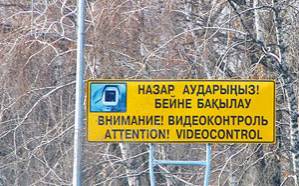
Figure 1 - video surveillance systems
By
2011-2012, spending on video surveillance in Kazakhstan's regional centres had
increased tenfold from 2008. A new OCC and 600 cameras were provided in Atyrau
and the number of surveillance cameras on the streets of Pavlodar, Atkau and
Semipalatinsk increased. Even in relatively small Kostanay (300,000
inhabitants) over $600,000 was spent, with dozens of video cameras connected to
an OCC and Department of Internal Affairs centres as part of the 'Safe Streets'
programme.
There
were several reasons for this unexpected growth, among them issues of
increasing vehicle numbers and attempts to change the situation on the roads,
as well as a general desire to enhance the level of road safety. But the most
important factor of all was a new one – the threat of terrorism. In 2011 there
were several high-profile successful and failed acts of terrorism, and global
experience shows that without modern video surveillance, countering this threat
is not possible.
We
can agree that is difficult to picture what happened in Kazakhstan in 2011
taking place in Europe – a radical Islamist stole a car, drove to a gun shop in
order to rob it, killed two police officers in the subsequent chase, and then
went on to the Office of National Security. Having arrived, he opened fire on
the building with a grenade launcher and only after this blew himself up (and
not just himself)[1]. Clearly, if the police had been able to see this situation
evolving, they would have been able to quickly find a way of stopping or
liquidating the terrorist. However, at the intersection of Taraz, in South
Kazakhstan, they could not see him, and he met no organised resistance. For
this reason, it is most likely that the reality and high probability of a new
terrorism threat led to cameras being quickly installed on streets and in
schools, hospitals, playschools and other public buildings.
Projects
were financed from city budgets, although there were attempts to do things a
different way – in Petropavlovsk in 2009, "taking into account the local
budget deficit", the Department of Internal Affairs asked the authorities
of the North Kazakhstan Region and the city of Petropavlovsk to "assist in
the acquisition of external surveillance cameras and the connection of them to
OCCs for newly constructed buildings, large markets, supermarkets, and other
facilities at the expense of construction companies and owners of these
facilities." Needless to say, after the first terrorist attacks in the
south, the government money was quickly found.
The
main conclusion is the existence of structure of municipal video surveillance
systems. Its function in Kazakhstan has expanded to include not just
accompaniment of official figures and recording of traffic violations, but also
monitoring in schools, hospitals, and public places.
At the same time, urban video surveillance
systems in other agencies – the fire and health services, the Ministry of
Emergency Situations, etc – has not developed. There have also been no attempts
to integrate situation rooms, which would ensure the effective use of security
cameras in a range of crisis situations.
This is name of my android application which I gave. It runs on android with 2.2 version and upper. Uses openCV library. For classsifieing uses LBP feature extraction. It was develeppen on eclipse juno 4.2 IDE.
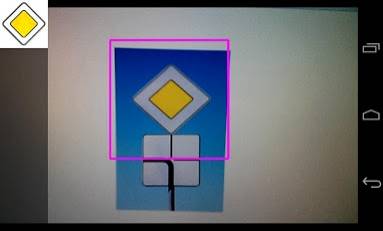
Figure 2 – Lead my way screenshot

Figure 3 – QR code to application in play
market
References
1.Eichner, M.; Breckon,
T. (2008). "Integrated speed limit detection and recognition from
real-time video". IEEE International Intelligent Vehicles Symposium:
626–631.
2.Assistenzsysteme von Opel - Das magische
Auge". Retrieved 17 December 2010.
3."Phaeton debuts
with new design and new technologies". Retrieved 22 April 2010.
4."Road Sign Information".
Retrieved 19 February 2013.
5."BMW 1 Series 3-door: Traffic Sign Recognition:" Retrieved 4 October 2012.