Methodology of electric power quality support in
distributive electric networks
Fedotov
Evgeny Alexandrovich
Kazan
State Power Engineering University
Russian
Federation
1
INTRODUCTION
The adaptation of Power systems to the market relations, the growth of
energy use by non-industrial consumers and also the mass deployment of the
digital control systems caused the increased demands to the reliability and
quality of the power supply in the distributive networks. Its whole length in
Russian Federation exceeds the 70% of the total lenght of all transmission
lines that shows the quantitave structure of the non-industrial consumers coverage.
The regional distributive networks of 6-10 kV fundamentally differ from
the urban networks in their significant extension and in their great number of dispersion loads. For the number of feeders
are typically the several tens of connections where the total lines length achieve 20-30 km. A
significant feature of fuel transfer
stations is their usage for connections of consumers located in rough country.
In the power supply systems of this regions can be used mid-range
transmission lines with the 40-50 km length because of the high voltage
networks absence, that makes practically
impossible to transfer the energy in compliance with required quality values.
The experience of oilfield transmission lines operation shows [1] that the
main problems of power supply interruption are the short circuits on overhead
transmission lines; voltage drop on overhead transmission lines of 6-10 kV that
feed the industrial consumers (their length can exceed 10 km where the load is over
than several megawatt that is caused by voltage loss of 15% and more), as
result the end consumers have the
voltage on the lower level what complicates the starting and self-starting of electric
motors.
In the electrical networks of 10 kV voltage the loads don’t have active
character.
In fulfilment of standard requirements for reactive power compensation
the load angle tangent on the buses of 0,4 kV should not exceed 0,35 and on the
buses of 6-10 kV should not exceed 0,4
(the contribution of the transform inductance is considered). Thus, in reactive
power compensation it’s necessary not to ignore the reactive component of the
load and particularly in the absence of
compensation devices.
2 Methodology
Let us view the transmission line, fig.1, where is installed booster transformer
with transformer coefficient k. Let us present the parameteres of the
transmission line after booster transformer to the main substation center. If
the booster transformer is not installed it is possible to take k=1, than 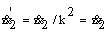 . This impedance represents the load impedance.
Than
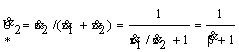 . (1)
. (1)
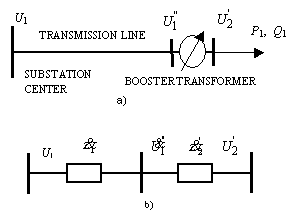

Fig.1. The principal circuit
(a) and its equivalent circuit (b)
Using the formula (1) for the transmission line impedance exclusion from
the subsequent equations. By the installing of the booster transformer we have
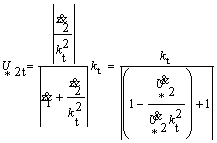 , (2)
, (2)
where  is the targeted transformer coefficient.
The formula (2) connects load
voltage before the booster transformer  installing with the transformer
coefficient of the transformer booster at the planned level of the targeted voltage
installing with the transformer
coefficient of the transformer booster at the planned level of the targeted voltage  .
.
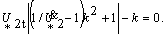
As far as in the formula (2) are included the complex quantities, and only
the modulus of desired voltage  is given, we come to the following equation with regard to transformer coefficient
 (3)
(3)
Evidently, it is necessary to clarify the influence of the voltage phase
 on the transformer coefficient value
for the next calculations.
on the transformer coefficient value
for the next calculations.
Let us assume that
 ,
,
where δ – angle between
the voltage vectors in the main substation center and on the load.
Further we evaluate the possible range of angle δ changes depending on the load parameters and on the
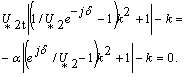
transmission line, but let us to continue the derivations. The expression (3)
gains the following form
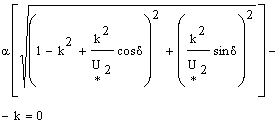
After transformations we’ve got the following equation
 .
.
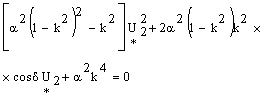
We come to the following formula that connects the transformer ratio of
the booster transformer k and the load voltage before booster transformer  installation:
 .
.
Solving the obtained equation relative to the voltage we find
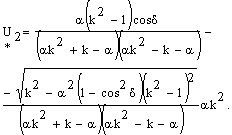 (4)
(4)
3 RESULTS
In the figure 2 are listed the sets of characteristics built after the
expression (4) where for the construction convenience the X-axis and Y-line are
exchanged: the variable is the voltage .
.
The angle δ is limited by value
of cosδ=0,90. It matches the load up to 4 МW where the length of transmission line is 30 km what can’t be achieved
for the transmission lines 10 kV.
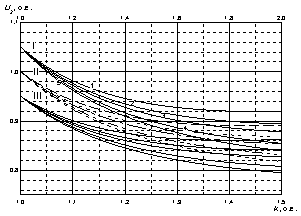
Fig 2. The required
transformer coefficient of booster transformer for the providing of desired voltage
level on the load with regard to the fase change between the voltages
I, II, III – characteristic
sets corresponding to targeted voltage level values: I – α=1,05; II – α=1,00; III – α=0,95;
for the each set the sequence
of the curve is the same and complies with the different values of angle δ :
1 – cosδ=0,90; 2 –
cosδ=0,93; 3 – cosδ=0,95; 3 – cosδ=0,98; 5 – cosδ=1,00.
From the obtained results the influence of the voltage fase change
should be taken into account because otherwise the understated values of transformer
coefficient come out.
So for the set I fig. 2 we take that
 (curve 3). May the original voltage was 0,94 о.е. As it’s seen on
graphs the required transformer coefficient is k=1,17. At the same time
if the influence of the voltage fase
change would be neglected and to mean that
(curve 3). May the original voltage was 0,94 о.е. As it’s seen on
graphs the required transformer coefficient is k=1,17. At the same time
if the influence of the voltage fase
change would be neglected and to mean that  , we find k=1,13.
The obtainded difference in booster transformer values is essential.
The maximum increase of booster transformer voltage installed in three
phases is 15% [2].
The obtained results show that for the achievement of required voltage level is necessary to
install two booster transformer sets in two phases.
4 CONCLUSION
1. The installing of the booster transformer on the transmission lines
in regional distributive networks helps to provide the standard values of the
electric power for the consumers without transmission lines reconstruction.
2. It is necessary to choose the transformer coefficient of booster transformer
taking into account the parameters change of the transmission line head part
and the phase change of the voltage on the ends of transmission line.
3. The inventive method for definition of targeted transforer
coefficient of booster transformer allows to exclude from the calculations the
transmission line inductance and use as key parameter the voltage load that exist before installing
of booster transformer.
References
[1] Baranovsky I.D., Khuchev J.V., Аbеuоv R.B. About problems
of alternative control devices efficiency in electric power supply / Russian conference «Electric Power: produce,
distributive and use». Tomsk, 2008.
- PP. 47-49.
[2] Perinsky Т.V., Rodionov О.S. Automatic voltage control operating experience of station
in distributive electric networks 6 – 10 кV. – Electro, vol. 3,
2009. – PP. 34-35.
Eugeny
Fedotov received engineering degree in electrical
engineering at the Kazan State Technical University in 2000 and PhD degree in technical
since at the Kazan State Power Engineering University in 2003. Currently he is
a Dozent of Electric Power Plants Department
of Faculty of Electrical Power Engineering and Electronics of Kazan State Power
Engineering University. He teaching interests include power plants, electric
part of power plants, electromagnetic transients in power systems. His research
interests include provision of quality of the electric power in the regional distribution
networks; ensuring the reliability of electric power systems; work
sustainability in regional distribution networks; research electromagnetic
transition processes in synchronous machine; simulation synchronous machine
with thyristor excitation system in Power System.