Ph.D., docent Sabirova L.B., undergraduate Jandarbekov N.T.
Kazakh National Technical
University after K.I.Satpaev
Kazakhstan, Almaty city
METHOD SELECTION OF
EFFECTIVE DEMULSIFIERS
Now, one of the effective
technology is the demulsifiers application at oil slime salvaging. In this
case, the main problem is a selection of effective demulsifiers not only for
individual waste pit, but also for each specific coating in the waste pit, as
the physicochemical properties of oil slime vary in barn depth. Because of the
multi-component and high stability of the barn emulsion, many selection methods
of effective demulsifiers do not give the expectative effect.
Presence of a maximum in the
frequency dependence of tgδ for the
samples under investigation gives an opportunity to try to apply the HF
dielcometric selection method of effective chemical reagents for controlling
the ARPD to the selection of effective demulsifiers [1, 2]. HF dielcometric
selection method of effective chemical reagents for controlling the ARPD established in work of Sayakhova F.L.
and developed by his disciples, is based on a comparison of the dielectric
characteristics of oils and inhibitors of the ARPD. For this purpose it is
investigated the frequency dependence of dielectric loss tangent of an angle
for oils and chemical reagents and determined the frequency corresponding to
the maximum values of the dielectric loss
tangent of an angle. If the frequencies values corresponding to the maximum
values of dielectric loss tangent of an
angle for oil and inhibitor are the same, the supramolecular levels energy
balance of these systems is approximately the same and, therefore, the
inhibitor is effective for this oil.
Since the foundation of
inhibiting tube oil-water emulsion constitutes the asphalt resinous substances,
the mechanism of demulsifiers action is similar to the action of ARPD
inhibitors. Perhaps frequencies coincidence corresponding to the maximum values
of dielectric loss tangent of an angle for emulsion and demulsifier may be a condition
of demulsifier effectiveness.
To test the hypothesis there
have been investigated the frequency dependence of tgδ for the series of demulsifiers.
By comparison with the test reports of the dielectric properties of the oil
slime samples under investigation was drawn a map of an effective
demulsificators for these samples (Table 1).
Table 1
|
Demulsifiers |
Reapon-CI
(Corrosion Ingibitor) |
Aquanox |
Hercules 1017 |
Daufax DF |
|
|
Sample № |
Water content, % |
||||
|
5 |
3 |
OE |
FOE |
FOE |
OE |
|
6 |
18 |
OE |
OE |
E |
FOE |
Note: E – an effective demulsifier, ME – an
ineffective
demulsifier, NE – an inefficient demulsifier.
We also study the dynamics
of oil slime destruction when exposed these demulsifiers. Defined parameter -
amount of detached water, on which were calculated the value of the residual
concentration of water in the oil.
In Figure 1, as an example,
the results of experimental studies of the sample №6 destruction are shown.
The diagram s show that if
the resonant frequency for demulsifier is close in meaning to the
resonant frequency of slime, the destruction is more intense. However, the
diagram s also shows that 40-50% of the water whereas does not exfoliate. This
can be explained by the fact that as water delamination, the frequency
corresponding to the maximum dielectric loss tangent of an angle for this oil
slime is slipped to higher frequencies area and the demulsifier ceases
to be effective, or ceases to act. Therefore, at this stage it is necessary to
re-select effective demulsifier taking into account the amount
of water in slime.
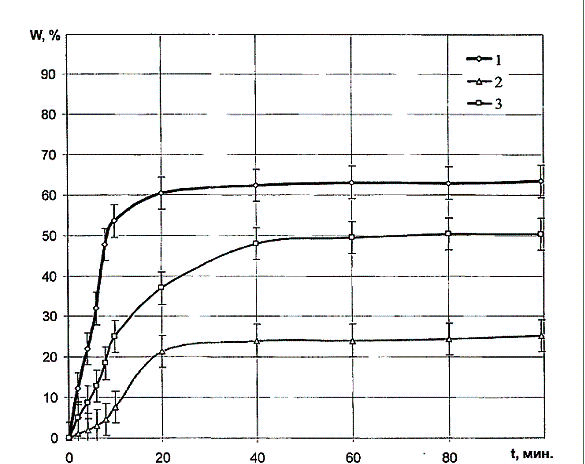
Figure 1. Dynamic of the
sample №6 destruction (fm = 75 MHz) under the influence of
demulsificators: 1 - Hercules 1017 (fm = 81 MHz); of 2 - Akvanoks (fm
= 132 MHz); 3 - Daufaks DF (fm
= 107 MHz).
Efficiency decrease is
controlled by the resonant frequency of oil slime fme during its
destruction. After the release of the resonant frequency of emulsion from the
width region of the resonant curve of the demulsifier for this slime it should
be selected the demulsifier with
other dielectric properties. The control of demulsifiers effectiveness is performed
in the following sequence:
1. The frequency
dependencies of tgδ for the samples of
concrete barn oil slime with different water concentrations are removed and the
resonant frequencies for each sample fm are determined by the
diagram s.
2. The dependence diagram
of the resonant frequency from the water concentration in the oil slime fm
(K) (Figure 2) is plotted.
3. From the diagram fm (K)
is determined fm3 by water concentration in the oil slime. If fme>
f2D, then for this part of the slime it is selected another demulsifiers.
In Figure
2, as an example, the curves of the frequency dependences corresponding to the
maximum dielectric loss tangent of an angle from the dispersed phase
concentration for the samples № 2 and №6 are shown.
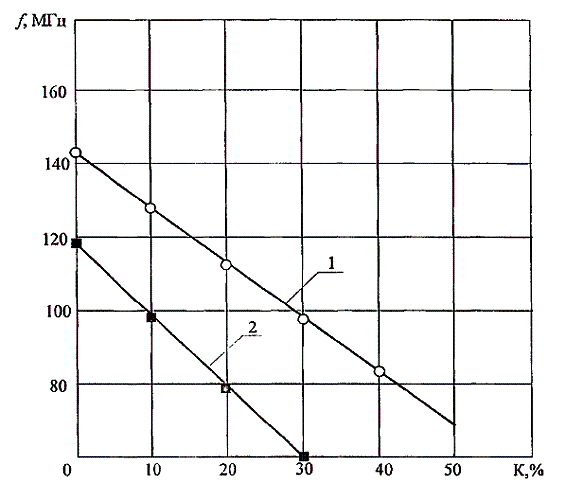
Figure
2 - The frequency dependence corresponding to the maximum dielectric loss
tangent of an angle from the dispersed phase concentration for the samples № 2
and №6.
In
order to establish the conditions of optimal process achievement were carried
out the series of laboratory experiments [4], including the studies of heat and
chemical treatment without and with the impact of SHF (super-high frequency)
electromagnetic field with separation in a centrifugal field of decanter.
Following
experiments were performed:
•
studies of heat treatment with the addition of chemical reagents with the
following separation in a centrifugal field of decanter;
• studies of heat treatment with the addition of chemical reagents with
the impact of SHF electromagnetic field with the separation in a centrifugal
field of decanter.
The
list of references:
1.
Sayakhov F.L., Zinnatullin R.R., Sufyanov R.R. and others. High-frequency
dielectric spectrometry for the selection and performance evaluation of
inhibitors application of the ARPD in the production fields of
"Archangelskgeoldobycha" // Petroleum Engineering, 2002. №2. - P.27
-31.
2.
The selection method of potentially effective reagents for the prevention and
removal resin paraffin deposits. Sayakhov F.L., Zinnatullin R.R., Sufyanov R.R.
and others. // Patent for an invention RU №2186202S17E21V 37/ 06. – Published
in B.I. 2002 №21.
3.
Chistyakov S.I, Sayakhov F.L. and others. Experimental studies of the
productive formation dielectric properties in variables in super-high frequency
electromagnetic fields // Geology and Exploration, 1971. №12.-P. 153-156.
4. Chistyakov S.I., Sayakhov F.L., Bondarenko P.M. Dielectric properties
studies of water-oil emulsion at super-high frequencies channel. // Proceedings
of All-Russian Research Institute of Horticultural Crops Selection of oil;
transport and storage of oil and oil products. -Ufa, 1972. - Release 9. - P.34
"> -352