T.Ye. Lobova, Cand.
Biol. Sci. A.V. Kelina, Cand. Biol. Sci. N.A. Slepchenko
The State Research Institution All–Russian
Scientific and Research Institute of Floriculture and Subtropical Crops of the Russian Academy of Agricultural
Sciences, c. Sochi, Russia
From
the experience of growing Veronica
umbrosa and Petrorhagia saxifrage
Abstract. The paper presents data on the study of Veronica umbrosa and
Petrorhagia saxifraga little-known in the culture of ornamental species,
their biological characteristics in culture conditions, duration of
phenological phases, coefficient of vegetative propagation, substrate
composition and cultivation conditions on the degree of insolation. It was
found that due to their ecological plasticity, biological properties and
ornamental qualities, Veronica umbrosa
and Petrorhagia saxifraga can
replenish the range of ground cover perennials used in landscaping.
Key words: ornamental herbaceous plants, Veronica
umbrosa, Petrorhagia saxifraga, reproduction, segments, cuttings, substrate.
Such methods of landscape design as rock gardens,
small areas using unconventional plants (vegetables, herbs and spicy crops) and
perennial herbaceous plants of the natural flora are being increasingly used in
modern urban landscaping. Besides having an aesthetic function these areas are
also a subject to certain environmental education, as they introduce people
with various plant communities. Newly created objects of urban landscaping are
often located in areas with unfavorable conditions for the growth, such as
former construction sites where the content of construction waste is quite high
in the soil, or sunny slopes with rocky and sandy soils, or shaded areas with
low insolation. In such places, the ordinary landscape lawn, flower landscaping,
and natural ground covers usually have a poor quality, so there can be used
unpretentious, quite ornamental and fast-growing ground covers from native
flora, corresponding to the optimum environmental protection. Using various
herbaceous ground covers as well as woody creeping forms and vines in small
groups can diversify landscape compositions, make people closer to nature, and
promote various styles, including such field as Nature garden.
All-Russian Scientific and Research Institute of
Floriculture and Subtropical Crops carry out an extensive work to attract
ornamental plant species of natural flora and develop the methods for their
reproduction. The studies have been conducted since 1996. Over the years, more
than 600 ornamental herbaceous plants have been studied in the region; over 100
promising crops and more than 20 ground covers have been recorded [5]. Among
the studied species of natural flora we can choose plants for cultivation in
different environmental conditions in relation to the following factors: light,
humidity, soil.
The practice of raising ornamental species of natural
flora in landscaping is not new, for native species are better adapted to the
conditions of the region, their use is safer and more economical. The data
given in the literature inform on the use of certain species that are in the
collection of the Institute, and many regions of Russia [2,3,4,8,10], among
them there are such species as: Ajuga
reptans, Geranium sanguineum, Lysimachia nummularia, Sedum acre, Vinca minor and V. pubescens, Veronica armena, Phlox
subulata, Arctanthemum arcticum. These species have performed well in
Russian humid subtropics (Sochi area), yet they are used in landscaping not
very actively.
Methods.
The objects of these studies are ornamental species Veronica umbrosa and
Petrorhagia saxifraga which are little known in the culture, preferring
sunny and shaded habitats.
The objectives of the research were to study the
biological characteristics of the given species under culture conditions, as
well as to establish duration of phenological phases, and coefficient of
vegetative propagation. Accounting and monitoring were being carried out for 3
years or more, according to conventional techniques [2,9].
At the same time in order to obtain more planting materials
we carried out research on the vegetative propagation of the species. We also
studied and determined the composition of the substrate and cultivation
conditions by insolation degree; optimal size of segments - parts of the plant
and cuttings. So the segment of Veronica
umbrosa is about 3-5 shoots, 8-10 cm long, with an extensive root system;
the size of a green stalk – is up to 10 cm, with 3-4 internodes. The segment of
Petrorhagia saxifraga – is about 1-3
shoots, 10-12 cm long, with an extensive root system, up to 10 cm; the size of
green cuttings is 10-12 cm with 10-15 internodes. The experiment on the
selection of optimal composition of the substrate was laid in two ways: light
sandy and medium loamy soils.
The results of research.
Veronica umbrosa has been in the Institute’s collected species of natural flora since
1996, when it was involved in the collection from Sochi forests, in 2003 it was
imported from Gagra city (Republic of Abkhazia) the second time.
Veronica umbrosa Bieb. belongs to Scrophulariaceae family.
It is indemic, Crimean-Caucasian species. Natural habitat is: Crimea, the Lower
Don, Caucasus, Western and Eastern Transcaucasia in the lower and middle forest
belt [6], in light pine and oak forests, forest edges and naked slopes. According
to the descriptions, it prefers shaded habitats. But according to our
observations, Veronica umbrosa is
cultivated well in areas with high insolation.
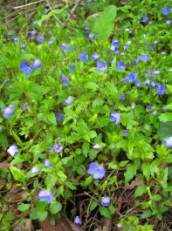
Veronica umbrosa – is a perennial herb. The root system is fibrous. The leaves are
medium-sized, 1-2 cm long, shallowly serrate or entire. The flowers are in
loose, long inflorescences. The clusters are axillary, striped, flowered, but
the flowering on cluster is stretched. The flowers are relatively large, with a
diameter of 6-15 mm [7].
Under Sochi conditions, it is a winter-green plant
which starts to grow actively in late January - early February. The beginning
of flowering occurs in February - March, and finishing - in April - May.
Plant height depends on the growth conditions, thus in
the shade these plants have smaller dimensions (diameter is 20 ± 5 cm) while in the open ground the curtain grew up to
50 cm.
Veronica umbrosa according to our observations, covering the territory with a solid dark
blue carpet, looks very impressive during the flowering period. The curtains
remain highly ornamental and up to 60 days or more at the expense of many
stems. Due to early flowering its inflorescences are used by local people to
cut flowers into small bouquets for sale that retain their ornamental effect
for 6-8 days.
It is well propagated by seeds. In our collection
self-seeding was recorded almost every year. Vegetative reproduction has a high
ratio from propagation by bush and softwood cuttings. According to our
observations, potential productivity of a two-year old mother plant is 215 pcs.
from softwood cuttings, and by dividing the bush - 35-50 pcs. (from a plant).
|
|
|
|
Pict. 1. Veronica umbrosa Bieb. |
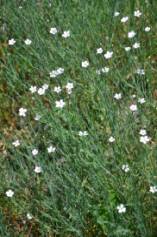
Pict. 2. Petrorhagia saxifraga (L.) Link. |
Petrorhagia
saxifrage (L.) Link. = [Tunica
saxifraga (L.) Scop.] (Caryophyllaceae).
Natural areas are the Mediterranean, Asia Minor, Caucasus. In our region, it is
found in the south of Tuapse, in the lower mountain zone, on coastal sand,
river gravel and rocky places and dry slopes. This is a perennial plant with
linear-spinelike rosette leaves. Flower stalks are numerous, 10-30 cm tall. The
flowers are small pale pink or white. The plant is well branched, vegetative
propagation coefficient is quite high. It is ornamental in sunny spots with
dry, calcareous soils [6].
According to our observations, Petrorhagia saxifraga tolerates lime-containing construction waste in soil, which is often found in new facilities
after the completed construction. It is almost not damaged by naked slugs.
Under Sochi conditions it is a winter green plant that
starts to grow actively in late February - early March. Beginning of flowering
occurs in May, ending in August and September.
The plants can be grown in both open and shadow areas.
However, in open areas clumps grow more intensively.
In our observations, it was noted that the three-year
old mother plant forms 25 rooted developed daughters in sandy soils. There is
also a high percentage of self-seeding. The cultivation requires a well-drained
soil and open sunny places.
Within the propagation by segments, we observed
standard sizes of planting material after 35-40 days in two options of
substrate (in the autumn the number of stems was 2-3 pcs. and the number of
regrowth shoots was 2-3 pcs. in the spring) [11]; the same sizes were achieved
by cuttings in 50-60 days.
We also took into account the growth of plants in the
two options of substrate and lighting conditions. The best results were
obtained during growing in light sandy soil without shelter (Table).
Table
The
growth of Veronica umbrosa and Petrorhagia saxifraga during the growing
season, depending on cultivation conditions
|
№ in order |
Option |
Size at the beginning of the growing season |
Size at the end of the growing season |
||
|
height, cm |
diameter, cm |
height, cm |
diameter, cm |
||
|
Veronica umbrosa |
|||||
|
1.1 |
light
sandy soil under cover |
9.62 |
13.50 |
4.80 |
27.4 |
|
1.2 |
light
sandy soil without cover |
8.50 |
16.75 |
9.20 |
35.20 |
|
1.3 |
medium
loam soil under cover |
11.87 |
22.12 |
10.37 |
80.00 |
|
1.4 |
medium
loam soil without cover |
13.87 |
18.25 |
14.50 |
39.25 |
|
Petrorhagia saxifraga |
|||||
|
2.1 |
light
sandy soil under cover |
20.00 |
13.12 |
21.87 |
18.50 |
|
2.2 |
light
sandy soil without cover |
17.00 |
12.50 |
19.50 |
31.00 |
|
2.3 |
medium
loam soil under cover |
11.75 |
7.50 |
9.00 |
25.71 |
|
2.4 |
medium
loam soil without cover |
13.62 |
10.12 |
10.28 |
28.57 |
Due to their ecological flexibility, biological
properties and ornamental qualities, Veronica
umbrosa and Petrorhagia saxifraga
can replenish the assortment of ground cover perennials used in landscaping of
the region. The results of studies on the reproduction of the species lead to
the conclusion that in order to obtain a large number of planting material
quickly it is necessary to use the method of propagation by cuttings, but
coverage of the area will be slower for 10-20 days, while if you want quick
growth and coverage, it is necessary to apply segments.
References
2. Beideman I.N. Method for studying the
phenology of plants and plant communities / I.N. Beideman - M .:
"Science". - 1974. - 155.
3. Burlutskaya L.V. Arctanthemum arcticum (L.) Tzvel. in the Botanical Garden of SFU
and its reproduction / L.V. Burlutskaya // Coll. prs. "Subtropical and
ornamental plants." - Sochi: The State Research Institution All–Russian
Scientific and Research Institute of Floriculture and Subtropical Crops of the
Russian Academy of Agricultural Sciences, 2011. - Vol. 45. - P. 32-38.
4. Burlutskaya L.V. Studying groundcovers
in the Botanical Garden of Rostov University / L.V. Burlutskaya, S.G. Petrova
// Bull. Nik. Bot. Garden. - Yalta, 2001. - Vol. 83. - P. 13-15.
5. Evsyukova T.V. Perspective species of
the natural flora of the north-western Transcaucasia for cultivation in the
region. / T.V. Evsyukova, N.A. Slepchenko // Proceedings of the International
Conference "Problems of flora and vegetation of the Caucasus." –
Sukhum: Institute of Botany of Abkhazia Science Academy. - 2011. - P. 193-198.
6. Kolakovskiy A.A. Flora of Abkhazia /
A.A. Kolakovskiy - Tbilisi: "Metsniereba." 1980 Vol. 3 - P. 288 and
vol. 1 - P. 168-169
7. Kreicha I. Rock garden in your garden /
I. Kreicha, A. Yakabova - Bratislava: "Nature." - 1989. - 311 p.
8. Kudryavtseva O.V. Flora of Ryazan region
as a source of ornamental plant introductions / O.V. Kudryavtseva, T.A. Palkina
// Belgorod State University. Series: Natural sciences. - 2011. - № 3 (98). - Vol. 14/1. -
P. 284-288.
9. Methods of phenological observations in
the Botanical Gardens of the USSR // Bull. Ch. Bot. Garden. - M .:
"Science", 1979. - Vol. 113. - P. 3-8.
10. Mironova L.N. Assortment of ornamental
herbaceous perennials for landscaping of flower beds in the cities of
Bashkortostan / L.N. Mironov, A.A. Reut, G.V. Shipaeva, A.F. Shaybakov //
Bulletin of Orenburg State University. - 2009. - № 6. - P. 237-340.