Аспирант Божко Н.В.
Харьковский национальный
экономический университет имени Семёна Кузнеца
Potential
and problems of today’s Ukrainian
agricultural
sector
Agriculture is a
vital development tool. Three out of every four poor people in developing
countries live in rural areas, and most of them depend directly or indirectly
on agriculture for their livelihoods. In most of developing countries,
agriculture is a strong option for spurring growth, overcoming poverty, and
enhancing food security. [1]
Industrial base
of the Soviet Union agriculture is a large part of Ukraine's economy. In 2008
the sector accounted for 8.29% of the country's GDP and by 2012 has grown to
10.43% of the GDP. Agriculture accounted for $13.98 billion value added to the
economy of Ukraine in 2012. Ukraine is the world's largest producer of
sunflower oil [, a major global producer of grain and sugar, and future global
player on meat and dairy markets. It is also one of the largest producers of
nuts. Ukraine also produces more natural honey than any other European country
and is one of the world's largest honey producers. Gross annual production of
honey in Ukraine is over 70 thousand tons, which allows the country to occupy
the first place in Europe and third in the world and is one of the world's
largest honey producers, an estimated 0.93% of its population is involved in
honey production. Because Ukraine possesses 30% of the world's richest black
soil, its agricultural industry has a huge potential. However, farmland remains
the only major asset in Ukraine that is not privatized. The agricultural
industry in Ukraine is already highly profitable but according to analysts its
outputs could still rise up. Ukraine is the world's 6th largest, 5th if not
including the EU as a separate state, producer of corn in the world and the 3rd
largest corn exporter in the world. [3]
In 2014 Ukraine
total grain crop was estimated to be record 64 million tons. However, in 2014
several regions have declared (themselves) independence (and are no longer
under control of Ukrainian central authorities) resulting in the War in Donbass
and the Crimea Crisis, hence the actual available crop yield was closer to 60.5
million tons. By October Ukrainian grain exports had reached 11 million metric
tons. Because of the decline of the metallurgy industry, Ukraine's top export
in prior years, as a result of the War in Donbass agricultural products
accounted for the nation's largest exported set of goods.
In 2014,
agriculture was the main exporter of the country (if you include corn
production, production of vegetable oil and food products. So, in 2014, steel
production was exported $ 12.9 billion, while total exports of agricultural
products and food industry totaled $ 13.6 billion. [4]

Fig. 1. Top 10 export
products of Ukraine in 2014 (billions of US dollars)
Although metal
sales are the highest export item, the leading export industry for the first
time became the AIC (if you put the data of crop, food and oil industry). [4]
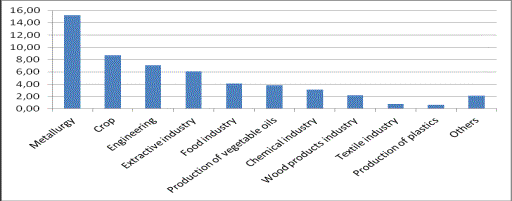
Fig. 2. Top 10 export
sectors of Ukraine in 2014 (billions of US dollars)
By signing the
agreement on association and free trade zone with the European Union, Ukraine
has committed itself to go to the European technical regulations, primarily in
agriculture. At the same time Ukraine has opened its internal food market for
goods from the EU. In the context of growing global competition in agriculture
to the forefront the issue of support to agricultural producers and the state
regulation of agro-industrial complex in the country.
To date, the
European Union has a common agricultural policy, which is based on a system of
agricultural subsidies and agricultural programs. To implement these programs
the EU spends annually about 40% of the budget. Uniform policies in agriculture
include both direct payments in the form of subsidies for the fields and land
that can be cultivated by a price support mechanism, including guarantees of
minimum prices, import tariffs and quotas on certain goods from outside the
European Union.
A special policy
in the EU is carried out in the field of technical modernization of
agriculture, modernization and renewal of fixed assets. The calculation here is
aimed at reducing manufacturing costs, including reduction in manual labor, and
therefore the high level of mechanization and automation of manufacturing
processes, whereby class competitive products produced.
Agriculture of
Ukraine to be competitive requires government support. The experience of
developed countries shows that the prosperity of agriculture is one of the
priority directions of development of the country. This issue after Ukraine's
accession to the WTO and the free trade zone with the EU became particularly
relevant, since in an increasingly global competition in agriculture Ukrainian
farmers are the most unprotected and vulnerable to all countries of the world.
References:
1. World Bank (2007). Agriculture for Development, p. 365. Washington DC: International Bank for
Reconstruction and Development.
2. capreform.eu
3. indexmundi.com