Экономические науки/6. Маркетинг и
менеджмент
Islamgaliyev
Ayan
Almaty Management University, Kazakhstan
Compensation Policy And Total Rewards As A Tool Of Human
Resource Management
An organization’s success lies in a motivated
workforce as highly motivated employees strive to produce at the highest
possible level and exert greater effort than employees who are not motivated.
Daft and Marcic (2007) also believe that employee motivation, organizational
performance, and profits are interconnected and cannot be separated [1]. The
most talented and innovative employees are not solely motivated by financial
rewards such as money, but seek satisfaction from their work.
According to Shields (2007), reward management is not
solely concerned with financial rewards. It is also concerned with non-
financial rewards such as recognition, communication, work environment, training
and career development. The financial rewards range from base pay, pay for
performance, pay for skills and competencies, and indirect financial rewards
such as benefits. Individuals are motivated by different factors, but employers
usually use money as a strategy for retaining employees [2, p.30].
Archer (2009) notes that the transition from personnel
management to human resources management has increased awareness of the
importance of human resources in the success of the organization. Archer (2009)
maintains that employees are equally critical to the overall business success
as are technology and other physical resources. The skills, knowledge,
attributes, and brainpower that employees possess make the organization have a
sustained competitive advantage over other organizations [3].
Employers face challenges of choosing rewards that
respond to individual needs and improving the profits and financials of the
organization. Tschohi (2009) states that globally, the economy is in a dismal
state and companies are downsizing and freezing salaries in order to survive.
Tschohi (2009) further suggests alternative remuneration strategies, which are
less costly such as employee recognition, better career programs, improved
organizational communication, and job enrichment programs [4].
Armstrong and Murlis (2004) believe
that organizations should implement remuneration systems that encompass both
financial and non-financial aspects as this would ensure the satisfaction of
different employees’ needs, thus, increasing levels of employee commitment and
performance. Non-financial remuneration systems include factors such as
recognition, promotion, increased responsibilities, and personal growth [5,
p.23]. These endeavors are aimed at motivating employees through satisfaction
of their esteemed needs and accomplishing organizational goals as the success
of the organization is linked to human capital.
Organizational success is measured by
the steady increase of shareholders wealth, profits, sales, return on
investment, and increased market share. Up to seventy-five percent of market
value is embedded in intangible assets, most notably ‘human capital’ or
employees. Imperfect knowledge of the value of these individuals and
unsatisfactory methods of remuneration allows talent to ebb away (Baron, 2003)
[7]. Pienaar (2007) postulates that the
link between people and profits is well established. Organizations that treat
employees like people have higher rates of productivity and lower rates of
turnover. He further maintains that high employee turnover is costly.
Organizations will have to replace the people who have been lost, together with
loss of knowledge, experience and customer relationships [7, p.21].
Shareholders desire increased growth
in their investment each year and to continually produce higher returns,
necessitating to having a motivated workforce who will perform at higher
levels. To do this on a continuous basis requires reward and remuneration
systems that are most applicable in the motivation and retention of employees
[7, p.22].
Swanepoel, Erasmus, Van Wyk and Schenk (2003) discuss
various internal and external forces that influence the compensation design
such as economy, union, and government [8, p.494].
Among all
kinds of budgets in an organization, remuneration cost remains a part of great
importance. With the speedy update of the modern world, however, the
traditional remuneration management has been facing great challenges both in
public and private sectors under the current economic and business circumstance,
and then come a lot of problems which can affect the performance of an
organization and even cause existential threats. Survey has demonstrated that
the cash reward which was paid most attention to is not as important as in the
past. Based on a 2002 survey of 1,500 employees (of all ages) conducted by
Nelson Motivation, Inc., San Diego, California, the ranks of employee
motivators in descending order are as follows: a learning activity, flexible
working hours, verbal praise, increased authority, autonomy, time with their
manager, time off from work, public praise, choice of assignment and written
praise . What is noteworthy is that the cash reward ranks 15th in importance
(Reynolds, 2005) [9, p.20]. In recent years, some other reward-related glossaries
also spring up as the progress of new-fashioned market economics, for example,
salary management, salary administration, payment (or pay) management,
compensation management, reward management etc.
Modern Rewards Management appears and develops in the
context of managing transformation; it not simply acknowledges and redounds
upon what the members have contributed to the organization, in fact, it’s a
specific action scheme of company strategic objective and values outlook
conversion. To some extent, Modern Rewards Management breaks through the
categories of “Money” and substance, which indicates that indirect income and
some no-monetary compensation have been playing parts of increasing importance
in Reward Structure Design. Generally, Modern Rewards Management is carried out
through Total Reward Management which matches with the work ethic and pursuit
of the present employees, and it is an important reflection of emphasizing the
relationship between enjoyment of reward elements and engagement.
However, the development and implementation of a TR
system cannot happen overnight; what is required is a long-term commitment to a
holistic approach to managing and engaging the workforce (Kao and Kantor, 2004;
Buchenroth, 2006) [10]. Furthermore, TR is not a panacea, since like other
reward systems, it may also fail to motivate employees as a result of a lack of
strategic consideration in its management (Crowe, 2002) [7, p.52]. In addition,
there is no one-size-fits-all model in this respect, and each organization
needs a tailor-made system to address its particular needs, with effective
implementation being the key to its success (Thompson, 2002) [8, p.11].
Moreover, some employers still do not agree on whether a TR approach has been
appropriate for their organizations since they consider it to be too broad,
which in itself causes confusion. The question of intrinsic rewards also
presents a challenge to these employers, since the evidence is that their
employees care in the main, about extrinsic rewards (Giancola, 2008).
The notion of TR clearly then, does not fit easily in
all organizations and with all types of employee, and bearing this in mind, the
question presents itself as to how readily it will transfer to the developing
country context, since the concept originated in the West where different
imperatives prevail in the work environment.
A large number of scientific studies
has pointed out that employees, referred to as the ‘Human Capital’ of a
company, play a fundamental role in the survival and success of an organization
by providing a competitive advantage (Hatch and Dyer, 2004). The Human Capital
reflects the overall knowledge, experience and competencies the staff of an
organization possesses. These assets are intangible and firm-specific, which
makes them not easily imitable by concurrent companies and therefore a source
for potential long-term competitive advantages (Afiouni, 2007). The Resource-Based View (RBV), an
influential movement within strategic management, seeks to explain the origin
of this sustainable competitive advantage. The theory proposes that a firm
should obtain resources that are ‘Valuable’, ‘Rare’, ‘Inimitable’ and
‘Non-substitutable’. Possessing these so called VRIN-characteristics gives
companies the ability to generate a competitive advantage and consequently
reach a higher performance level (Barney and Clark, 2007) [6, p.377].
Since people are a company’s most
vital asset, a top three priority on the HR agenda remains attracting,
motivating and retaining talent (Caye et al., 2007) . In the upcoming decades,
this HR-activity will become of even greater importance due to the worldwide
demographic shift, encompassing the massive ageing and retirement of the
working population. This mass-retirement of the so called baby boomers will lead to
great loss of knowledge, expertise and talent (DeLong, 2004), eventually
resulting in a (second) global war for
talent between organizations (Gardner, 2002). An extensive
survey, conducted by ManpowerGroup (2011) on nearly 40,000 employers across 39
countries, found that 34% of the employers experiences difficulties filling
positions due to a lack of available talent.
Apart from this talent war, the huge costs
arising from employee turnover makes the attraction and retention of core
employees a critical challenge for companies. ‘Turnover’ refers to “the actual movement of organizational
members across the boundary of an organization” (Hemdi and Nasurdin, 2005).
Despite its importance, the full costs associated with turnover are widely
unknown and often underrated due to the hidden costs of productivity loss,
customer dissatisfaction, low staff morale, etc. (Blum and Tremarco, 2008) [4,
p. 45].
An essential tool for organizations
to motivate and retain their workforce and to attract new employees is, next to
providing a favorable work-life balance, constructing a good and equitable
compensation system. Like Shields (2007) stated: “Compensation is the most critical issue when it comes to attracting and
keeping talent.” [2, p. 172]
Employee compensation plays a key role because it is
at the heart of the employment relationship, being of critical importance to
both employees and employers. From the organization's perspective, perhaps no
other set of decisions are as visible or as consequential for the success or
failure of an organization. From a cost perspective alone, effective management
of employee compensation is critical, given that it often represents the single
largest cost incurred by an organization, typically accounting for 10- 50% of
total operating costs, and as much as 90% of such costs in some labor-intensive
(e.g., service) organizations.
Of course, cost is only one part of the picture. It is
also necessary to evaluate the employee contributions the organization receives
in exchange. Thus, a second reason for studying compensation from the
organization's perspective is to assess its impact on a wide range of employee
attitudes and behaviors, and ultimately, the effectiveness of the organization
and its units. Compensation may directly influence key outcomes like job
satisfaction, attraction, retention, performance, flexibility, cooperation,
skill acquisition and so forth.
To the individual employee, compensation decisions
also have important consequences. Salaries and wages represent the main sources
of income for most people, and may also be taken as key indicators of a
person's social standing or success in life. Benefits, such as health care and
pensions, are also important determinants of well being and financial security
among employees and their dependents. Not surprisingly then, employees have
sought to influence such decisions in a variety of ways, including through
unions, supporting government regulation of compensation decisions, and through
the courts. Therefore, it is important to understand how individuals are
affected by (and react to) different compensation decisions.
"Compensation" in dictionaries treated as
reimbursement and reward. The Kazakhstan economic literature and in practice
most often used first meaning of the word - reimbursement. In foreign sources
compensation include all payments made by the employer to
employee, regardless of their forms: monetary, material, in the form of
services or benefits.
For
a proper understanding and use of the category of "compensation", it
is necessary to understand the correlation between the concept of
"compensation", "reward" and "wages", which are
closely related, but not the same.
In English, compensation means something that
counterbalances, offsets, or makes up for something else. However, if we look
at the origin of the word in different languages, we get a sense of the
richness of the meaning, which combines entitlement, return, and reward.
In China, the traditional characters for the word
“compensation” are based on the symbols for logs and water; compensation
provides necessities in life. In the recent past, the state owned all
enterprises and compensation was treated as an entitlement. In today’s China,
compensation takes on a more subtle meaning. A new word, dai yu, is used. It
refers to haw you are being treated – your wages, benefits, training
opportunities, and so on. When people talk about compensation, they ask each
other about the dai yu in their companies. Rather than assuming that everyone
is entitled to the same treatment, the meaning of compensation now includes
abrader sense of returns as well as entitlement.
“Compensation” in Japanese is kyuyo, which is made up
of two separate characters (kyu and yo), both meaning “giving something”. Kyu
is an honorific used to indicate that the person doing the giving is someone of
high rank, such as a feudal lord, an emperor, or a similar leader.
Traditionally, compensation is thought of as something given by one’s superior.
Today, business consultants in Japan try to substitute the word hou-syu, which
means “reward” and has no associations with notions of superiors. The many
allowances that are part of Japanese compensation systems translate as teate,
which means “taking care of something.” Teate is regarded as compensation that
takes care of employees’ financial needs. This concept is consistent with the
family, housing, and commuting allowances that are still used in many Japanese
companies.
Compensation
in the treatment of American and European scientists in labor economics and
motivation - is only part of the general system of remuneration received by the
employee from the employer.
The
term "compensation" in the treatment of not only
"reimbursement", but also "reward" is increasingly being
used in Kazakhstan companies. On the one hand, this is due to the study of
foreign experience in the field of compensation management. On the other hand,
the modern system of labor stimulation characterized by a variety of rewards,
among them, along with compensation, which is included in wages and other
payments that aren’t included are used. These social benefits, expenses of the
organization on the development of human capital, funded from the profits of
the organization, as well as compensation due to employment, the list of which
may be much wider than the statutory limits.
In practice, in many Kazakhstan organizations
compensation that is not included in the wage, form the concept of "social
package". But not all payments are included in the “social package” have a
social character, if strictly come from the word "social". So, at the
moment, some Kazakhstan companies in order to designate the totality of payments
in a different form using a broader concept, borrowed from American and
European practice management, namely "compensation package."
Compensation
package of each company is formed on the basis of financial capacity, degree of
understanding of leadership and its role in the owner motivation of labor
activity staff. These contrasting ideas about
compensation-multiple meanings (returns, rewards, entitlement) - add richness
to the topic. But they can also cause confusion unless everyone is talking
about the same thing. So let’s define what means “compensation.”
Most authors divide total compensation into two large
groups: the first group includes cash compensation, which is related to the
nature of the work performed and to employee functions, the second group
includes benefits.
According to Milkovich and Newman (2013), compensation
refers to all forms of financial returns and tangible services and benefits
employees receive as part of an employment relationship. Our focus is the total
cash compensation system in organization shown in figure 1.
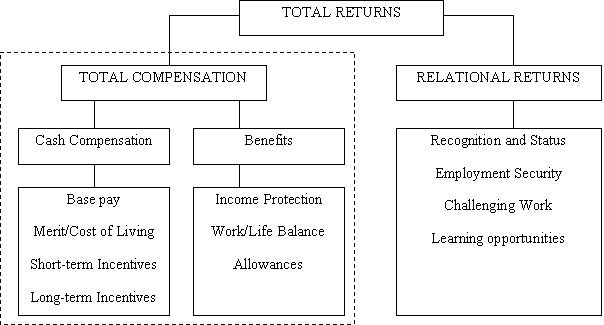
Figure 1 - Total Returns for Work
Source: Reprinted from Compensation 11th edition
(p.13), by G.Milkovich, J.Newman, B.Gerhart,
2013, McGraw-Hill International Edition. Copyright 2013 by The McGraw-Hill
Companies, Inc.
Figure
1 shows the variety of return people receive from work. They are categorized as
total compensation and relational returns. The relational returns (learning
opportunities, status, challenging work, and so on) are psychological. Total
compensation returns are more transactional. They include pay received directly
as cash (e.g., base, merit, incentives, cost-of-living adjustments) and
indirectly as benefits (e.g., pensions, medical insurance, programs to help
balance work and life demands) . Each
of these elements has cash value to the employee and organization. So pay comes
in different forms, and programs to pay people can be designed in a wide variety
of ways.
The functions and purposes
of each elements of Total Returns Model suggested by Milkovich and Newman
(2013) shown in table 1. So as given above in the table 1 compensation elements
play the main three functions: to attract, to retain and to motivate employees.
Functions
of compensation system. The first function is attraction, implemented in
attracting for the organization of staff and development of functional,
occupational structure of human resources of an organization able to
effectively carry out activities in accordance with organization's charter .
Table 1 - Total
Compensation Framework
|
Element |
Functionality |
Purpose |
|
Base Salary |
Reflects the value of
the role, skills, competencies and subsequent performance of the incumbent |
Attraction,
Retention: (for higher payers) Rewarding consistent
achievement of job and personal
objectives that are linked to business plan |
|
Short Term Incentive |
Reflects the
achievement and exceeding of business
plan |
Attraction
and Motivation |
|
Long Term Incentive |
Rewards long-term
achievement of strategic development plans |
Attraction,
Retention and Motivation: Rewarding achievement
on a three or more year business cycle basis |
|
Retirement Plan,
Benefits and Perquisites |
Creates financial
security Defends against
competition |
Retention Rewarding
achievement of annual business plan and individual objectives |
|
Source: Reprinted from Total Compensation for
Successful Retention (p.8) by Hay
Group, 2012. |
||
The
second function is to formation
of motivation among employees of the organization, ensuring high labor activity
staff in achieving the goals and tasks of the business. This feature is
implemented through the creation and use of systems of remuneration and
compensation packages structures capable adequately compensate for the investments made in
the formation and development of human capital with regard to the efficiency of
its use.
The
third function is developing. Compensation package of organization should be
focused on the development of human capital. Modern information society and
technology, high competition between companies requires high demands on the
quality of the workforce and its constant development. With universal access to
sources of information, modern technology and money capital, the only long-term
competitive advantage can only be human capital. Therefore, part of
compensation packages should be directed to the development of human capital.
The
fourth function is social. In the structure of the compensation package should
be fees associated with protection, preservation, enhancement, treatment,
rehabilitation worker health, aid for worker or his family members, who are in
a difficult financial situation. These payments must provide the employee
maintaining his health in an efficient and competitive condition. Especially in
the framework of this feature, you must allocate compensation aimed at
financing of human life since the end of work. This group includes pension
benefits payments, financial assistance in kind and cash, gifts for holidays,
anniversaries, funding for treatment, prosthetics, rest in sanatoriums.
REFERENCES
1
Daft L.R., Marcic D. Management the
new work place. - New York: Thomson, South Western, 2007. – 531 p.
2
Shields J. Managing employee
performance and reward concepts, practices, strategies. - New York: Cambridge
University Press, 2007. – 276 p.
3
Archer D. Strategic partnership
through human capital. – 2009.
Available from: < www.capam.org/documents/strategicparternshipthroughhumancapital.pdf
>
4
Tschohi J. Is money a motivator? No!
– 2009. Available from: <
www.24-7pressrelease.com/press-release-rss/is-money-a-motivator-no-83144.php
>
5
Armstrong M., Murlis K. Reward
management: a handbook of remuneration strategy and practice. Third
Edition. - London: Kogan Page, 2004. –481 p.
6
Baron A. The key to organizational
success // Development and learning organizations. – 2003. - №25. – Pp. 7-9.
Available from: < www.emeraldinsight.com/10.1108/14777280310478245 >
7
Pienaar C. What makes an
organization sick? // People Dynamics. – 2007. - №25. – Pp. 21-22.
8
Swanepoel B., Erasmus B., Van Wyk
M., Schenk H. Human resources management: Theory and Practices. Third
edition. - Lansdowne: Juta, 2003. – 659 p.
9
Reynolds L. A. Communicating Total
Rewards to the Generations // Benefits
Quarterly. – 2005. - №2. – Pp.18-23.
10
Kantor R.,
Kao T. Total rewards: clarity from the confusion and chaos // WorldatWork Journal. – 2004. -
№ 13. – Pp. 7-15.