O.I.
Panasenko, T.O. Samura,
O.O. Filatov, V.P. Buryak,
S.M. Kulish. N.A. Postal, I.V. Melnik, O.A. Kremzer, T.V Panasenko
Zaporozhye State Medical University
SAMPLE COLLECTION, TRANSPORT, AND STORAGE
In analytical
toxicology no matter how complex the equipment and careful the analysis, the
results may be rendered worthless if sample collection, transport, and storage
have not been performed with the analysis in mind.it is important to be
familiar with the nature and stability of the analyses, the nature of the
sample matrix, and the circumstances under which the analysis is to be
performed. Proper documentation of the history of the sample origin made of
collection, transport, storage, and the like is essential.
The analytic
concentration in the specimen is generally assumed to be representative of the
concentration in the particular fluid or tissue sampled. Whole blood, plasma
the fluid obtained on centrifugation of anticoagulated whole blood , or serum the fluid remaining when blood has clotted
are widely used in clinical work. This is because not only is blood relatively
easy to collect, but also a quantitative analysis can often give useful
information as to the magnitude f exposure and hence the severity of poisoning.
Excretions (exhaled air, urine) or secretions (saliva bile) are often less
useful as regards interpretation of quantitative data, but can be very useful
in qualitative work;
Biological
samples may contain infective agents and must be handled with care, especially
if originating from drug abusers, and must always be treated as if they are
infective. The major common risks are associated with tuberculosis, hepatitis
B, and human immunodeficiency virus (HIV). Urine is least likely to be infective.
It is thought very likely that following solvent extraction or other robust
sample preparation procedures, infective agents will be inactivated, except for
variant Creutzfeldt-Jakob Disease (CJD), but in homogeneous assays, such as
immunoassays, samples may continue to be infectious after incubation, even
though diluted. Indeed, incubation may increase the titer of the infective
agent.
Table
1. Types of variables affecting clinical samples
|
Variable |
Exple(s) |
|
Physiological |
|
|
Age |
Markers of bone timber
such as collagen cross-linkages are increased increases in childhood |
|
Sex |
Sex hormones |
|
Body Weight |
Urinary creatinine
increases with muscle mass |
|
Recent food intake |
Plasma glucose,
triglycerides, and so on, after a normal meal |
|
Died |
Malnutrition or
fasting will reduce serum albumin, urea and phosphate |
|
Menstrual Cycle |
Plasma concentration
of luteinizing hormone (LH) |
|
Drugs |
Drug treatment may
alter concentrations of some plasma constituents even in apparently healthy
subjects. |
|
Sample Analyte variations |
|
|
Incorrect specimen |
Value differences
between plasma and serum, venous and arterial blood, random and 24 urine
samples |
|
Incorrect collection |
The absence of an
appropriate enzyme inhibitor may allow continued enzyme action such as
catabolism of glucose or neuropeptides |
|
Hemolysis |
Red cell lysis may
lead to changes in plasma constituents, particularly potassium, phosphate,
and same enzyme and may interfere with the analytical method |
|
Collection during an
infusion |
Collection near to an
infusion site will give misleading concentrations of the compound being
infused or dilate other blood constituents |
|
Drug treatment |
Drug or metabolites
may interfere in the assay |
Staff in regular
contact with potentially infectious materials must be properly trained in the
safe handling and disposal of biological samples. Such staff should be
vaccinated against hepatitis B, polio, tuberculosis, and tetanus and possibly
other diseases in specific countries. Sample handling should be performed with
due attention to preventing droplets splashing into the eyes and minimizing
aerosol formation. Screw-capped sample tubes are preferable to use with push-in
stoppers as there is less risk of aerosol formation when opening the tube [6].
Clinical samples can be divided into
blood and related fluids, body fluids other than blood, excretory
fluids/residues, and other clinical specimens (Table 2). A range of additional
specimens may be collected for toxicological purposes. Special precautions will
be needed with unstable analytes. Most compounds measured in urine can be
considered stable for at least a few hours at room temperature as the urine may
already have been held at body temperature for some time before it was voided
[8].
Blood
("Whole blood") is the fluid that circulates through the arteries,
capillaries and veins. The adult human body contains some 5-6 litres of blood.
It is composed of plasma and blood cells. Normally venous blood is obtained. If
whole blood is to be analyzed, then sample should be collected into an
appropriate anticoagulant, mixed, and then frozen in order to lyse the cells
before the analysis.
Blood cells
include red cells and white cells, leukocytes. All may be harvested from
freshly collected blood with appropriate procedures Body fluids other than
blood.
Amniotic fluid is
the fluid that surrounds the foetus in the amniotic sac.
Breast milk is
the protein and fat-rich fluid produced by nursing mothers. The first
expression of breast milk is especially rich in protein.
Lymph is a
yellowish fluid derived from the lymph glands.
Peritoneal fluid
is the fluid that accumulates in the peritoneum. Tears are the clear watery
secretion of the tear ducts of the eye.
Even mild
haemolysis will invalidate a serum iron or potassium assays, for other analytes
concentrated in red cells such as chlortalidone. Leaving plasma or serum in
contact with red cells can cause changes due to enzymatic activity or
redistribution of an analyte between cells and plasma. In general, plasma or
serum should be separated from the blood cells as soon as possible, If
necessary, whole blood can be stored at- 20 C or below but freezing will lyse
most cell typer [7].
It is important
to use serum or the anticoagulant recommended for a particular measurement (
Table 3) and not to substitute an alternative without careful consideration.
Sodium citrate tulles contain 0,5 or 1 ml of the anticoagulant in aqueous
solution and so are unsuitable for quantitative work. Furthermore, dilution of
the sample may reduce the degree of plasma protein binding and consequently the
plasma: red cell distribution of the analyte. It should be ensured that lithium
heparin anticoagulant is not used if plasma lithium is to be measured. Heparin
too has been known to interfere in drug analysis.
Table
3. Anticoagulant for in vitro use
|
Anticoagulant |
Concentration (ml-1
blood) |
Comment |
|
Lithium heparin |
10-20 units |
General biochemistry |
|
Sodium heparin |
10-20 units |
General biochemistry |
|
Sodium fluoride which
either |
1-2 mg |
Glucose (inhibits
glycolysis) |
|
EDTA or oxalate |
6-10
mg |
General anticoagulant |
|
Sodium citrate |
3 mg |
Clotting studies not
recommended for other purpose as the aqueous solution dilutes the specimen |
|
EDTA |
2mg |
Hematology (stabilized
readily oxidized compounds) |
When whole blood is allowed to stand (15 min, room temperature ) in a
plain tube ( no anticoagulant) a clot forms that will retract sufficiently to
allow serum to be collected. For many analyses serum is preferred to plasma
because it produces less precipitation (of fibrin )on freezing and thawing.
The inter-relationship of centrifuge rotor diameter, speed of
centrifugation and relative centrifugal force (g-force) is set out in Box 1 .
Swing-out rotors are preferred for separating liquid phases.
On centrifugation of anticoagulated whole blood (2000g, 10 min, 2-8 C if
necessary), it will separate into three layers: the bottom layers ( normally
45% or there a bouth by volume) consists of red cells; a thin intermediate
layer of white cells and platelets called the "buffy coat " is the
next layer ; and the upper, aqueous, straw-coloured layer is the plasma (about
50% v(v). Provided the analyte is stable, anticoagulated whole blood can be
kept at room temperature or refrigerated (2-8C) for two days or so before harvesting
plasma [3].
More plasma than serum can be separated from whole blood. Some
commercial tulus contain agents such as plastic beads or a gel that sits at the
interface between the cell and the plasma to aid plasma collection. Gel
separators have caused problems with some drug analysis [1.5], although
reformulated gels have been claimed to have little effect on therapeutic drug
measurements [2]. However, this work has not been extended to other analytical
toxicology tests and tulus containing gel separators are therefore best
avoided.
Box
1. Calculating relative centrifugal force
1.
The relative centrifugal force (RCF, g) depends upon the speed of the
centrifuge in revolutions per minute (RPM) and the effective radius of
rotation, r.
2.
The radius of rotation varies along th length of the centrifuge tube.
3
.RCF may be quoted as maximus,minimum or average.
4.
Conversion tables and nomograms for each rotor are normally supplied by the
manufacturer the centrifuge.
5.
Modern centrifuges have the facility to set the RCF directly.
6.
The RCF-will be maximal at the bottom of the tube.
7.
RPM for a required RCF can be calculated from:
RPM
= 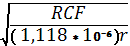 where r is in mm.
8.
RCF from RPM is given by: RCF = (1.118* )r (RPM)2?
To
collect erythrocytes, heparinized blood should be centrifuged (2000 g, 10 min),
the plasma , buffy coat and top 10% of erythrocytes (mainly reticulocytes)
removed, and the remaining erythrocytes) removed, and the remaining
erythrocytes carefully washed with isotonic, buffered saline to remove trapped
plasma. The cells may be used directly or frozen, either to cause haemolysis,
or for storage. Platelets are usually isolated by the slow centrifugation (
e.g. 300g 15 min )of anticoagulated whole blood to yield platelet-rich plasma,
which is centrifuge ( 2000 g, 10 min) to harvest the platelets. Other white
blood cells are most commonly obtained by centrifugation through media a
appropriate density (according to be manufacturer's instructions) or isolated
by solid-phase antibody techniques.
If
measurement of red cell: plasma distribution is to be performed, it is easier
to add the analyte to a portion of "blank" heparinized whole blood
and after allowing time for equilibration and controlling the pH of blood tends
to fall in vitro as oxygen is lost) to obtain plasma from one portion of the
blood and to freeze and thaw a second portion(to give haemolyzed whole blood)
and compare the results. Admittedly this gives the plasma : whole blood ratio,
but it is technically for simple than preparing washed erythrocytes. The
analyte erythrocyte concentration can be calculated if the haematocrit (the
proportion of erythrocytes in blood ) is known:
CE = 
Where, CE= erythrocyte
concentration Cb= whole blood concentration, Cp= plasma
concentration, and H=hematocrit[4].
Different urine
specimens, for example random, early morning end-of-shift, 24 hour, may be
collected in the course of metabolic or other studies, In metabolic studies, it
is important to note time the time of the beginning and the end of the collection
period so that the rate of urine production can be calculated. A random urine
sample is a midstream specimen-any preservative, such 2 mol L-1
hydrochloric acid is added after words. Fresh urine is yellow/yellow-green in
colour, but on storage in acidic solutions the colour changes to yellow/brown
and even to dark brown due to oxidation of urobilinogen to urobilin. Crystals,
party cularly of uric acid and calcium oxalate may form causing turbidity.
When random,
early morning , or end-of-shift specimens are collected, it is common practice
to relate certain analytical results to a "fixed" urinary constituent
such as creatinine, which is considered to be excreted at a relatively constant
rate in normal subjects . However, as creatinine is derived from creatinine,
there are situations, such as muscle wasting or in bodybuilders dosing with
creatine, when this is not stricly true.
The
concentrations of many drugs and metabolities, and of some endogenous
constituents, will remain the same in acidified urine for over a week at room
temperature, and for up to a month at 2-8 C. Unacidified urine undergoes
microbiological attack and many changes accur, including the complete lass of
amino aids. For long-term storage acidified urine can be frozen (-20 ºC)
but it may be necessary to centrifuge the sample to remove any precipitate
formed during storage prior to any analysis.
Stomach contents
is specimen encompasses vomit , gastric aspirate and gastric lavage fluid as
well as the contents of the stomach at postmortem. The nature of this sample
can be very variable and additional procedures such as homogenization followed
by filtration and/or centrifugation may be required to produce a liquid
amenable to analysis.
The analysis of
faeces is rarely performed in clinical chemistry, but sometimes drug and
possibly metabolite analysis may be required in pharmacokinetic and metabolism
studies. Analyses may also be requested if for example, the guestion of drug
leakage from ingested packets of drug antemortem is raised. Unire plasma,
unire, and other fluid samples, faeces are not homogenous, and thus it is often
necessary to analyze the whole sample or homogenize the whole sample and prove.
That the fraction taken for analysis is representative of the whole. It may
take more than a day before an orally administered drug or a drug metabolite
appears in faeces.
Histology
specimens are usually collected into a preservative such as formalin (aqueous
formaldehyde solution). such pretreatmeent must be borne if mind if
toxicological analyses are requested sub-seqnently. Samples of tissue obtained
postmortem are normally kept at 4 ºC prior to analysis.
S
U M M A R Y
Variations in
bioanalytical measurement may be subject-dependent and reflect normal
physiological changes, whilst others may reflect sample collection and handling
procedures. Postmortem specimens are a special problem because , generally,
information on the analyte concentration in blood at the time of death is
required. Postmortem blood concentrations may not accurately reflect perimortem
blood concentrations for several reasons. Haemolysis is common, for example,
whilst haemostasis may lead to changes in the cellular composition of the
"blood" being sampled. There is also the possibility of contamination
during collection , for example , with stomach contents, and of leakage of
intracellular potassium into plasma, which begins soon after death, is such an
example.
1. Berk S.I., Litwin A.M., Du Y., Cruikshank G, Gourevitch M.N., Arensten
I.M.. False reduction in serum methadone concentrations by BD Vacutainer serum
separator tules (SST TM) Clin. Chem., 2006.-val 52.-pp 1972-1974
2. Bush V., Blennerhasset I, wells A, Dasgupto A. stability of therapeutic
drugs in serum collected in vacutainer separator tulus containing a new gel
(SST II), The Drug Monit., 2001.-val.23.-pp259-262
3. F Clarke's Analysis of Drugs and
Poisons. fourth Edition/Editied by Anthony C Moffat, M. David Osselton, Brian
widdop.-London: The pharmaceutical Press, 2011.-2609 p.
4. Fundamentals of analytical toxicology/ Edited by R.I. Flanagan.-New
York: Yohn Wiley and sons 2007.-532 p.
5. Karppi I., Akerma K.K., Parviainen M. Suitability of collection tubes with
separator gels fr collecting and storing blood samples for collecting and
storing blood samples for therapeutic drug monitoring (TOM.) Clin. chem. Lab.
Med., 2000.-val.28-p.p.313-320
6. Lam C.W., Yames Y.T. Mecluskey R., Hunter R.L. Pulmonary toxicity of single
wall carbon nanotubes in mice 7 and 90 days after intratracheal instillation.
Tox. Sci., 200-val.77-pp126-134
7. Sporkert F., Brunel C., Angsburger M.P. Fatal talperisone poisoning:
Autopsy and toxicology findings in three suicide casus.-2012-val. 215.-pp.101-104.
8. Warheit D.B., Laurence B.R. Reed K.L., Roach D.H., Reynolds G.a.m, Welb
T.R. Comparative pulmatary toxicity assessment of single wall carbon nanotules
in rats.