Педагогические
науки/5.Современные методы преподавания
Maksut A.E., Gaurieva G.M.
L.N.Gumilyov Eurasian National University, Kazakhstan
COMMUNICATIVE AND SITUATIONAL
FOREIGN LANGUAGE TEACHING OF SCHOOL STUDENTS
Nowadays internationalization
of all domains of social life leads to the fact that a foreign language is
considered to be a real necessity in practical and intellectual actions of the person.
For this reason, teaching of school students a foreign language is the social
order of society. As a result, development of an efficient model in organization
of teaching process at school is the need we are faced with.
Special attention
paid to acquisition of foreign languages has caused changes in nature of
foreign language teaching. There was a transition from the previous orientation
to adoption of grammatical structures to communicative which is directed to
mastering skills of the live speech. Continuous practical use of language helps
pupils to overcome dislike of linguistic manipulations, does training attractive,
as it is coordinated with an ultimate goal and by that provides assimilation of
the speech as a means of communication [1].
The communicative
and situational teaching which is guided by the conceptual provisions of
communicative approach, stated in works of linguists of RK and CIS and foreign scientists
is represented to be one of the actual directions promoting improvement of foreign
language teaching at schools. Communicative and situational foreign language
teaching is aimed at the development of foreign-language communicative
competence and assumes the organization of educational process on the basis of
a situation as the main unit of teaching, imitating a real foreign-language
communication. Imitation of real communication is provided by communicative and
situational teaching, in which extralinguistic parameters of a situation and
the principles of communicative-orientated teaching are integrated, such as:
-
the situational feature of teaching,
consisting in selection of material and its activization by communicative
situations;
-
the authenticity of teaching, intending
the use of educational material borrowed from real life situations and creation
of conditions for educational communication which are brought most closer to
real;
-
the functionality in selection and
organization of educational material which is realized in its compliance with
the conditions of communicative situation, intensions of the speaker and
communicative functions of the language;
-
the activity nature of teaching
which is shown in the communicative and situational tasks directed to the
formation of foreign-language communicative competence of students [2].
Development of
communicative skills is impossible without awareness of language system (words,
the grammatical phenomena, phonetic material) and skills of operating these
means. Therefore it is accepted to include knowledge of language material and
skills of successful operating in the content of communicative and situational
foreign languages teaching.
Within communicative
and situational teaching there is an assimilation not of the language system,
but system of the language means necessary for students usage in a varying
sphere and situation of communication. Consequently, selection of language and
speech material is made on the basis of its use rate at the solution of
communicative tasks within situations of foreign-language communication.
Development of
effective algorithm / technique of communicative and situational foreign
language teaching demands use of the system approach representing a modern
method of scientific research for the solution of problems of theoretical and
practical character. Communicative and situational teaching as a methodical
system is defined by coherence and integrity of its components. In
definition of the notion "methodical system of foreign language
teaching" we will address its treatment by I.L. Bim, claiming that as
"the main components of methodical system it is possible to consider the
purposes of foreign language teaching, the contents of a subject, educational
process, methods and appliances of teaching" [3;17]. In the methodical
system of communicative and situational foreign language teaching of school students,
six main components are distinguished: content of foreign-language communicative
activity, student, teacher, means of the organization of communicative
activity, educational process, and management.
Thus, the foreign
language, and also process of its mastering at school represent the
interconnected and interdependent systems. Such approach gives the chance to
present development of communicative competence of school students as
complicated multicomponent system, and also to develop effective linguo-didactic
model of its realization. The models of foreign language teaching existing at
many schools not fully consider the changed needs for receiving qualitatively
new language teaching, and in this connection there is a need of modernization
of teaching system of school students and development of content of communicative
and situational teaching, within which the communicative situation is considered
as training unit, whereas mastering a complex of the most frequency and
significant situations for cross-cultural communication leads to development of
foreign-language communicative competence.
The complete
system of teaching English of school students at different levels of training
intends, on the one hand, autonomous character at each level, and, on the
other, the interrelation of all levels of training, where achievement of the
objectives of each level allows to use a foreign language in a varying form and
provides a possibility to continue training at the following level. Based on
various approaches to determination of formed level in foreign-language
communication skills, we distinguished, as did Markarjan K.V. [4], communicative
and satisfactory, communicative and sufficient and communicative and optimum
levels of formation of school students’ communicative competence. Within the
considered levels we have made selection of the communicative situations
necessary for mastering by school students, and have defined the communicative
skills and abilities formed at them.
Level of communicative and satisfactory foreign language skills assumes work on the situations aimed at the
development of linguistic, pragmatical and discursive components (within the
monological statement) of foreign-language communicative competence. At this
stage there is a mastering pronunciation standards of the object language,
grammatical and lexical skills. Thus, work at this level can be presented by
the following communicative exercises and tasks.
Situation 1.
Housing «Where do You live?»
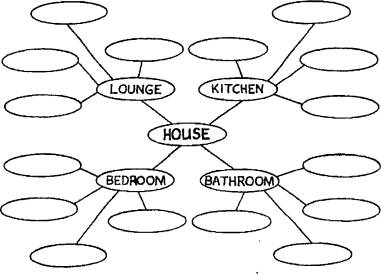
Activity 1. Make
a list of words related to the place where you live, use your list of words and
the words given in brackets (saucepans, shower, sofa, towels, alarm clock,
kettle, video, sheets, sink, washbasin, coffee table) and arrange them in
the spidergram below.
Activity 2. What
do you do in each room? What things are in these rooms? e.g.: This is a
living room. We watch TV in the living room. There is a TV set and a sofa in
the living room.
Activity 3.
Describe your perfect home.
The
communicative and sufficient level of proficiency in a foreign language assumes work on the situations
directed to achievement of formation pragmatical and discursive components (within
dialogical statements) of communicative competence of school students. At this
stage the following educational aims are pursued: development of abilities to
realize communicative intention by the choice of the speech actions
corresponding to the studied situation and logic of course of the speech act;
development of abilities to understand different types of communicative
statements, to build complete statements of various functional styles;
formation of abilities to structure oral and written texts. We will consider
achievement of objectives on the example of the communicative exercises and
tasks aimed at the development of speech and cogitative activity of students.
Situation 2. Bringing up children «Coping with adults».
Activity 1. Put the phrases in each sentence into the correct order and
discuss them in class.
1.
different
from/being a/teenagers/I think/when my/teenagers today/is very/parents were.
2.
ways
we/freedom today/In some/have more.
3.
other
ways/life is/ But in/and difficult/more complicated.
4.
a lot/I
feel/today put/on teenagers/of pressure/that parents.
5.
not/every
teenager/It is/the best/to be/possible for.
6.
feel
I/space/Sometimes I/some/just/need.
The
communicative and optimum level of foreign language skills assumes work on the situations directed to
formation of strategic and sociocultural components of communicative
competence. School students learn to overcome difficulties of communicative
character; to select and use the most effective strategy for the solution of
the set communicative tasks - rephrasing, description, argument. Knowledge
about cultural features of native speakers, their habits, customs, rules and
standards of behavior, social conventions, regional geographic features of the
studied linguoculture are also formed.
Situation 3. Health and Healthy lifestyle «Are you going
in for extreme sports?»
Activity 1. Read the following words and ideas about extreme sports.
Put them into two groups: for and against. Add some ideas of your
own.
risk,
adrenaline rush, danger is exciting, challenging your body, sense of
achievement, doing something different, accidents, fun, you need reliable
equipment
Activity 2. Discuss the pros and cons of extreme sports with your
partner. Respond to his counter-arguments.
Activity 3. Write an essay for or against the statement according to
the plan: «Extreme sports are becoming more and more popular with teenagers.
But they are very dangerous that's why should be banned»?
-
write the
title of the essay;
-
make a
general statement to introduce the topic;
-
write
about the advantages and disadvantages or the arguments for and against in
separate paragraphs;
-
use a new
paragraph to introduce each new topic;
-
support
your new ideas with arguments;
-use linking words and discourse markers - furthermore, in addition
to this, a further negative/positive aspect of this is, for one thing, for
example, for instance, such as, on the one hand, in contrast, however, in fact,
actually, on the other hand, as far as I’m concerned, in my view/opinion, to
sum up, to summarize, in conclusion;
-
summarise
your arguments at the end of the essay;
-
you
should include your own opinion;
Overall, in the conditions of social and economic and political changes
of modern society, the knowledge of foreign languages acts as the integral
attribute of successful self-realization of the personality, allows to join
actively in life of society of open type, to master achievements of world
science and culture. Communicative orientation of educational process is necessary
for the solution of the tasks set by society, whereas communicative and
situational foreign language teaching promotes more effective development of
communicative competence of school students.
List of
literature:
1. Gal'skova
N.D. Sovremennaja metodika obuchenija inostrannym jazykam Tekst.:
posobie dlja uchitelja
/ N. D. Gal'skova.
M.: ARKTI, 2000. - 165s.
2. Mil'rud,
R.P. Sovremennye konceptual'nye principy kommunikativnogo obuchenija
inostrannym jazykam [Tekst] / R.P. Mil'rud, I.R. Maksimova // Inostrannye
jazyki v shkole. - 2000. - № 4.
3. Bim, I.L.
Sistema obuchenija inostrannym jazykam v srednej shkole i uchebnik kak model'
ee realizacii [Tekst]: avtoref. dis. ... dokt. ped. nauk. / I. L. Bim. - M.,
1976.-17s.
4. Markarjan, K.V. Obuchenie inojazychnomu
pragmaticheskomu obshheniju studentov nejazykovogo VUZa [Tekst]: dis. ... kand.
ped. nauk. / K.V. Markarjan. - Pjatigorsk, 2006. - 183s.