УДК 582.998.1(574.23)
G. J. Sultangazina, Y. A.
Simanova
A.Baitursynov Kostanai State University,
Kostanay
TAXONOMIC ANALYSIS OF FAMILY ASTERACEAE
Dumort. OF THE FLORA OF NATURAL PARK
“BURABAY”
Abstract: This paper presents the results of
the research of the flora of State National Nature Park "Burabay".
The taxonomic analysis of the species of Asteraceae family is considered. Obtained materials are the results of field
studies (2010 - 2015), the literature data are taken into account.
Keywords: State National Nature Park,
Kokshetau Upland, flora, taxonomic analysis, family, species, genera.
Currently, the principles of the
unified state system of environmental monitoring are being laid in the study of
modern flora where an important place is given to tracking the status of
fitobioty. Biodiversity is not static and is constantly changing. It was formed
as a result of genetic changes and evolutionary processes. Currently,
biodiversity is in the decline due to habitat degradation, size reduction of
some populations and species extinction [1].
Floristic analysis makes it possible
to determine the characteristics of the gene pool of species, the prospects for
its use and the degree of importance of its preservation. The works of many
researchers are devoted to this issue. [2, 3]
However, this applies to the flora
generally. As for the major taxa in the rank of family types which normally
make up a small part of the flora, such investigations are rare in the
literature [4].
Identification of the species, the
generic composition and analysis of the flora of any territory can detect
individual floral features; provide material for the restoration of the history
of formation of flora and changing trends. This
is the basis of rational use of plant resources, and the organization of
protection of rare and endangered plant species.
Kokshetau Upland is the northern
part of Sary-Arka, low mountain massif in Kazakhstan up to 947 m in height (
Kokshe). The landscape is characterized by great diversity. Kokshetau Upland is
composed of ancient rocks of Archean and Proterozoic origin (gneiss, quartzite,
phyllites, schists). The eastern part is framed by volcanic-sedimentary of folded
Lower Paleozoic strata. The slopes are covered with pine forest. In the lows there are birch and aspen
small-leaved forests.
The climate is sharply continental,
insufficiently humidified. Average annual precipitation is 300-390 mm, in the
northern and western windward slopes up to 500 mm. Winter is cold, the average
January temperature is -18 ° C minimum -46 ° -48 ° C. Summer is moderately dry,
warm, the average July temperature is +19 +20 ° C, maximum up to + 42 ° C.
Soils are mountain-forest, mountain
chernozems. Common pine and pine-birch forests are common on the Kokshetau
Upland on cryptopodzolic and forest dark-colored soils, and there are also
aspen-birch forests on dark-colored soils and malt on denudation plains ,
interspersed with rich-forb-redfeather steppes on ordinary chernozems developed
on hill denudation and accumulative foothill plains and loops.
Major rivers flowing through the
Kokshetau Upland:The Imanbulak, the Arkanburluk, the Zhylandy the Zhabay ;
Lakes: Imantau, Zerendiskoye, Borovoye, Shchuchye . Rivers are generally dry
most of the year. Lakes often have salt and brackish water [5, 6 ].
Floristic studies were limited by
the territory of the State National Nature Park (SNNP) "Burabay". The
area of National Park is 129,935 hectares, which is about 1/5 of the area of
Kokshetau Upland. The work was based on the field research expeditions of
2010-2015. The studies were conducted by a routing method. The study covered
the territory of ten forestry of SNNP
"Burabay". As a result of extensive research herbarium material was
collected. Collection of herbarium specimens is kept at the Department of
Biology and Chemistry of A.Baitursynov Kostanay State University.
Flora of the State
"Burabay" National Park is rich and diverse. It comprises 691 kind of
higher vascular plants. One of the largest families of the flora of the region
within the first ten systematic spectrums is the family Asteraceae Dumort.,
species of which are important components of a variety of plant communities
[7].
The family Asteraceae is one of the
largest families of flora in the world. It comprises more than 1,500 genera and
over 20 000 species, widespread throughout the globe. In Kazakhstan, the family
is represented by 146 genera and 883 species. [8] In the "Flora of
Kazakhstan" on the territory of Kokshetau Upland 71 species are
represented [9].
Our targeted research revealed that
in the national park "Burabay" 86 species are found which belong to
36 genera, 16 subtribe, 7 tribes and three subfamilies.
Within the Nature Park
"Burabay" the most numerous in the number of genera is the tribe -
Cichorieae, having in its composition 9 genera (Table 1.).
Table 1 - Distribution of species Asteraceae Dumort family of the flora
of Nature Park "Burabay" according to taxonomic units
|
Подсемейство |
Триба |
Подтриба |
Род |
Число
видов |
|
1 |
2 |
3 |
4 |
5 |
|
I.Cichorioideae (Juss.) Kitam. |
1.Cichorieae Cass. |
1.Lactucinae Less. |
1.Crepis
L. |
3 |
|
2.Hieracium
Cass. |
2 |
|||
|
3.Lactuca L. |
3 |
|||
|
4.Pilosella
Hill. |
2 |
|||
|
5.Sonchus
L. |
1 |
|||
|
6.Taraxacum
Wigg. |
2 |
|||
|
2.Scorzoneraciae Dum. |
7.Scorzonera
L. |
7 |
||
|
8.Tragopogon
L. |
2 |
|||
|
3.Hypochaeridinae Less. |
9.Trommsdorffia
Bernh. |
1 |
||
|
II.Carduoideae Kitam. |
2.Cardueae Kitam. = Cynareae
Less. |
4.Carduinae Kitam. |
10.Carduus
L. |
1 |
|
11.Cirsium
Mill. |
5 |
|||
|
5.Centaureinae O. Hoffm. |
12. Centaurea L. |
1 |
||
|
13. Serratula L. |
4 |
|||
|
6.Cynarinae O. Hoffm. |
14.Arctium L. |
1 |
||
|
15.Jurinea Cass. |
1 |
|||
|
16.Saussurea D.C. |
2 |
|||
|
3.Echinopsideae
Cass. |
7.Echinopsidinae Cass. |
17.Echinops L. |
1 |
|
|
III.Asteroideae(Cass)Lindley. |
4. Astereae Cass. |
8.Asterinae Cass. |
18.Aster L. |
1 |
|
19.Erigeron L. |
2 |
|||
|
20.Galatella Cass. |
3 |
|||
|
21.Tripolium
Ledeb. |
1 |
|||
|
9.Filagineae Polj. |
22.Filago L. |
1 |
||
|
10.Solidaginae O. Hoffm. |
23.Solidago
L. |
1 |
||
|
5.Anthemidea Cass. |
11.Chrysanteminae O. Hoffm. |
24.Leucanthemum
Mill. |
1 |
|
|
25.Tanacetum
L. |
1 |
|||
|
1 |
2 |
3 |
4 |
5 |
|
|
|
|
|
|
|
|
|
|||
|
26.TripleurospermumSch. Bip. |
1 |
|||
|
12.Anthemidinae(Cass)O. Hoffm. |
27.Achillea L. |
4 |
||
|
28.Anthemis L. |
1 |
|||
|
13.Artemisinae Darijma |
29.Artemisia L. |
17 |
||
|
6.Senecioneae Cass. |
14.Senecioninae(Cass) R. Kam. |
30.Ligularia
Cass. |
1 |
|
|
31.Petasites
Mill. |
1 |
|||
|
32.Senecio
L. |
4 |
|||
|
33.Tephroseris
Rchb. |
2 |
|||
|
34.Tussilago
L. |
1 |
|||
|
7.Inuleae Cass. |
15.Gnaphalinae Reichenb. |
35.Antennaria Gaertn. |
1 |
|
|
16.Inulinae Cass. |
36.Inula
L. |
3 |
7 genera belong to the tribe
Cardueae and 6 genera belong to the tribes Astereaei Anthemidea. Tribe Cardueae
is quite large in the number of genera, it is 15, trailing only Anthemideai
Cichorieae, which include 23 and 25 genera relevantly. The smallest tribe in
the number of genera is - Echinopsideae, which includes only 1 genus. 4 genera belong to the tribe
Inuleaeotnositsya, and 9 genera belong to the tribes Astereaei Senecioneae per
tribe.
Generic spectrum of the family is
given in the diagram (Figure 1). From it can be seen that the largest genera of
the family are: Artemisia, constituting 19.77% (17 species); Scorzonera - 8,13%
(7 species), Cirsium- 5,81% (5 species). Genera Achillea, Centaurea, contain 4
types per genera and respectively make up to 4, 66% of all members of the
Asteraceae family, and Crepis, Galatella, Inula – up to 3.49% as per (3 types).
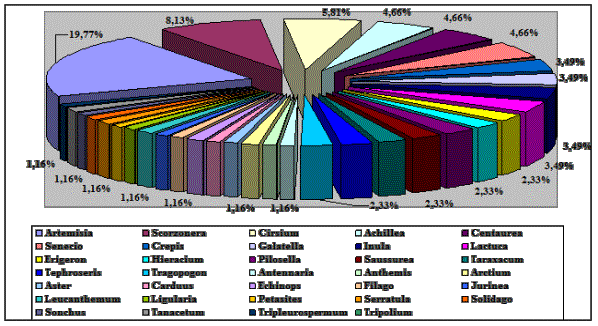
Figure 1 - Generic
spectrum of Asteraceae Dumort family of the flora of Nature Park "Burabay"
In general, the major genera of the
family Asteraceae are composed of 53 species, accounting for 62% of all types
of the family Asteraceae of the flora of the studied area. The remaining 33
species and 38% accounted for 1-2 species genera of the family Asteraceae.
Some mathematical indices to assess
the complexity of the taxonomic structure [10] or flora autonomy [11], as well
as analysis of the interaction of different typological characteristics of
flora [12] are not widely used or misused.
An important taxonomic flora
characteristic is the ratio of the number of genera and species. As pointed out
by A. Tolmachev [13], increased autochthonous development leads to a relative
enrichment of flora species, whereas allochthonous development leads to a relative
enrichment of genera. L.Malyshev [14,
15] proposed an empirical formula that allows
to calculate the expected number of species in flora according to the actual
number of genera. As model data he used the wealth of species and genera in
districts of flora of the former USSR and the truncated equation of the
parabola of the second degree:
S'= 314,1 + 0,0045383
* G2;
According to the relative magnitude
of discrepancy of the real number of species it can be expected to judge the
extent of identity or autonomy of flora (value A):
A = (S-S ') / S, where S - the
actual and S' - the estimated number of species in flora, G - the actual number
of genera.
In different works Malyshev called
the indicator "A" differently: the index of autonomy [10], the index
of autochthonous-allochthonous [14] or the originality index [16]. If the index
is negative - the development of the flora was dominated by allochthonous
trends, if positive - autochthonous.
Then, according to the above
formula, the index of the autonomy of the flora family of "Burabay"
Natural Park will be:
S'= 314,1 + 0,0045383 * 362, hence A
= - 2.7
A negative value of the autonomy
index indicates the predominance of allochthonous trends and the role of large
migration of species of the family Asteraceae of flora of Kokshetau Upland.
The complexity index of the
systematic structure [7] reflects the level of wealth (number of taxonomic
units of different ranks) and the degree of uniformity of taxa distribution of
lower rank among higher taxa rank. It is calculated as a function of
H-Shannon-Weaver [17]
H = - Σpi log 2(pi), where pi is the proportion of
the number of taxa of lower rank within each taxon of higher rank in relation
to the total number of taxa of lower rank in the flora [10].
Hence H = - Σ12,4 log2 (12,4) = - Σ12,4 * 1,88 = -
Σ23,31
H-function takes the maximum value under the full evenness of the
distribution, that is, if all the families have the same number of species.
Since this index depends on the number of higher rank taxonomic units, it is
not that its absolute value matters but its relation to the theoretical maximum
for a specific number of higher rank taxonomic units (genera). This ratio is
called N′ function (N′ = H / Hmax), an indicator of convergence of
the distribution of species to maximize uniformity, or the maximum systemic
complexity.
Then Hmax = - Σ36,5 log2 (36,5) = - Σ36,5 * 2,46 = -
Σ89,79, hence N′ = - Σ23,31 / - Σ89,79 = 0,3
The complicity index of the
systematic structure of Asteraceae family indicates the approximate distribution
of species in the family to the maximum evenness.
REFERENCES
1. Tishkov, A. A. Teorija i
praktika sohranenija bioraznoobrazija / A.A. Tishkov //Jekologicheskij vestnik
Rossii. – 2006. – №9.– S.7-12.
2. Malyshev L.I.
Floristicheskie spektry Sovetskogo Sojuza // Istorija flory i rastitel'nosti
Evrazii. – L., 1972. – S. 17–40.
3. Malyshev L.I.
Kolichestvennyj analiz flory: prostranstvennoe raznoobrazie, uroven' vidovogo
bogatstva i reprezentativnost' uchastkov obsledovanija // Bot. zhurn. – 1975. –
T. 60, № 11. – S. 1537–1550
4. Shmidt V.M. Statisticheskie
metody v sravnitel'noj floristike. – L.: Izd-vo Leningrad. un-ta, 1980. – 176
s.
5. Ivashhenko A.A. Zapovedniki i nacional'nye parki Kazahstana/ A.A.
Ivashhenko – Almaty: Almaty kіtap, 2006. – S. 272-273.
6. Akmolinskaja oblast'.
Jenciklopedija/ pod red. B.O. Zhakyp. – Almaty: Қazaқ
jenciklopedijasy, 2009. – S. 326-327.
7. Sultangazina G.Zh. i dr.
Flora nacional'nogo prirodnogo parka «Burabaj» // G.Zh.Sultangazina I.A.
Hrustaleva, A.N. Kuprijanov, S.M. Adekenov; – Novosibirsk: Izd-vo SO RAN, 2014.
– 242 s: il.
8. Bajtenov M.S. Flora Kazahstana v 2-h t.-Rodovoj kompleks flory. –
Almaty:Ғylym. T2. 2001.-280s.,im.66.
9. Flora Kazahstana.Alma-ata, 1956. T.1-9. 4248 s.
10. Shmidt V.M. Matematicheskie metody v botanike/ V.M. Shmidt. – L.:
Izd-vo Leningr. un-ta, 1984. – 288 s.
11. Malyshev L.I. Zavisimost'
floristicheskogo bogatstva ot vneshnih uslovij i istoricheskih faktorov/ L.I.
Malyshev // Botanicheskij zhurnal. – 1969. – T. 54. – №8. – S. 1137-1147.
12. Galanin A.V. Opyt
soprjazhennogo analiza tipologicheskih struktur konkretnyh flor/ A.V. Galanin//
Teoreticheskie i metodicheskie problemy sravnitel'noj floristiki. – L.: Nauka,
1987. – S. 167-189.
13. Tolmachev A.I. Vvedenie v
geografiju rastenij/ A.I. Tolmachev– L.: Izd-vo Leningr. un-ta, 1974. – 244s.
14. Malyshev L.I. Zavisimost'
floristicheskogo bogatstva ot vneshnih uslovij i istoricheskih faktorov / L.I.
Malyshev // Botanicheskij zhurnal. – 1969. – T. 54. – №8. – S. 1137-1147.
15. Malyshev L.I.
Kolichestvennaja harakteristika flory Putorana/L.I. Malyshev // Flora Putorana.
– Novosibirsk: Nauka, 1976. – S. 163-186.
16. Malyshev L.I. Ocenka
original'nosti flory po taksonomicheskoj strukture/L.I. Malyshev //
Botanicheskie issledovanija Sibiri i Kazahstana. – 2000. – № 6. – S. 3-10.
17. Shannon C.E.The mathematical theory of communication/ C.E.
Shannon, W. Weaver. – Urbana, 1949. – 117 p.