Shapovalov V. V.,
postgraduate student
Simon Kuznets Kharkiv National University of Economics
Analysis of the global labour market
After the period of rapid increase between 2007 and 2010, the
global youth unemployment rate settled at
13.0 per cent for the period from 2012
to 2014. At the same time, the
number of unemployed youth declined by 3.3 million from the crisis peak: 76.6 million youth were unemployed in
2009 compared to an estimated 73.3 million in 2014.
The youth share in total unemployment is also slowly decreasing.
As of 2014, 36.7 per cent of the global
unemployed were youth. Ten years previously, in 2004, the youth share in total unemployment was 41.5 per cent. While the
indicator marks an improvement
over time, it is still worthy of note that youth made up only one-sixth of the global population in 2014 and
are therefore strongly overrepresented among
the unemployed [1].
Despite some signs of “good news” presented above, the instability
of the situation continues and the global
youth unemployment rate today remains well above its precrisis rate of 11.7 per cent in 2007.
Overall, two in five – 42.6 per cent,
economically active youth are still either
unemployed or working yet living in poverty. In the face of such statistics, it is safe to report
it is still not easy to be
young in today’s labour market.
In the Asian regions and in the Middle East and North Africa,
youth unemployment rates worsened
between 2012 and 2014. For the developed economies, the youth unemployment rate improved over the same period, but
still in 2014, rates exceeded 20
per cent in two-thirds of the European countries and more than one in three unemployed youth had been
looking for work for longer than one year.
In Central and South-Eastern Europe, Latin America and the Caribbean and sub-Saharan Africa, youth unemployment rates have
demonstrated a declining trend in both the
medium and short-run periods. In all regions the stability of career prospects becomes
increasingly tentative, but the situation could appear more degenerative in the developed
countries where formal employment on a permanent contract was once the standard. In the developed economies, shares
of youth involuntarily working
part-time or engaged in temporary work have declined from the crisis peak, but within a longer term increasing
trend as more young people take up part-time or
temporary work in combination with education [4].
While
the outlook for youth entering the labour market now does look slightly more
positive than for those entering over the previous five years, we should not discount
the lingering harm accruing to the cohorts who experienced long-term unemployment
spells or were forced to take up less-than-ideal jobs during times of low labour
demand. In still too many countries, the youth population continue to suffer
the effects of the economic crisis and austerity
measures put in place as a reaction. In these countries,
finding work, let alone full-time work, as a youth with no work experience
continues to be a drawn-out uphill struggle.
Youth
in developing countries continue to be plagued by working poverty stemming
from the irregularity of work and lack of formal employment and social protection.
In 2014, more than one-third – 37.8 per cent, of
employed youth in the developing world were
living on less than US$2 per day. Working poverty, therefore, affects
as many as 169 million youth in the world. The number increases to 286 million if
the near poor are included (living below US$4 per day) [2].
In
most low-income countries, at least three in four young workers fall within the category
of irregular employment, engaged either in own-account work, contributing family
work, casual paid employment or temporary non-casual labour. Nine in ten young
workers remain in informal employment. This compares to an only slightly improved
share of two in three youth in the middle-income countries.
The
deficiencies in the quality of available employment in most developing countries
block the successful transition of young people but also serve as a severe impediment
to economic development. While development should bring gains in the shares
of youth in paid employment that is neither casual nor temporary in nature, the fact
that we are not there yet has consequences for measurements of youth
transitions.
Results
demonstrate that the transition paths of the most disadvantaged youth
are often the most direct; that is, they move directly from school – if they
even go to school – into the irregular and informal work
that they are likely to continue doing for a lifetime.
Even in developed economies, a short transition period to a first job should
not be overly praised if the job does not offer a good foundation for the
broader transition to a stable and satisfactory job in
adulthood.
The
global youth labour force and labour
force participation rate continues to decline as
enrolment in education increases. Between 1991 and 2014, the share
of active youth (either employed or unemployed) in the youth population declined
by 11.6 percentage points compared to a 1 percentage point
decline in the adult labour force participation rate [7].
The
global youth employment-to-population
ratio – the share of the working-age population
that is employed – declined by 2.7 percentage points
between
2007 and 2014. The declining trends in youth EPRs are
closely linked to increasing trends in educational enrolment.
After
a period of rapid increase between 2007 and 2010, the global youth unemployment rate settled at 13.0
per cent for the period 2012 to 2014 and is expected to increase only slightly to 13.1 per
cent in 2015. The rate has not yet recovered
its pre-crisis rate of 11.7 per cent in 2007.
The
number of unemployed youth has
declined from 76.6 million at the peak of the crisis in
2009 to an estimated 73.3 million in 2014.
Globally,
the ratio of youth to adult
unemployment rates has hardly changed
over
time and stood at 2.9 in 2014. The youth unemployment rate has been consistently
close to three times that of the adult unemployment rate since 1995 [7].
Strategies
to promote youth employment should articulate the mix and
interaction
of macroeconomic policies, labour and employment policies and other
interventions specifically targeting young people, particularly the most disadvantaged. Policies that offer fiscal incentives, support
the development of infrastructure and develop enabling
regulations for enterprises operating in sectors with high
employment
potential can help improve youth employment outcomes.
The
positive effect of public investment on youth employment can be maximized by
ensuring that young workers have the right skills and are supported in the job matching.
In this sense, linking investment in infrastructure with labour market policies
would boost both quantity and quality of jobs for youth.
Comprehensive
packages of active labour market policies that target
disadvantaged
youth can help in the school-to-work transition.
An
increase in public investment, social benefits and active labour market policies
has an impact on youth employment, particularly in terms of labour
market participation. Evidence shows that public spending on labour market
policies is associated with significantly higher youth employment-topopulation ratios
[8].
Specific
policies and targeted interventions to support the transition of young workers
to the formal economy yield better results if designed as part of macroeconomic
policies and include interventions to improve legal and
administrative
requirements for entrepreneurial activity, reforms to advance the quality
of youth employment through access to rights at work, better working conditions
and social protection.
Coordinated
responses and partnerships are required to scale up policies and strategies
that have had an impact on the quantity and quality of jobs for young people.
After
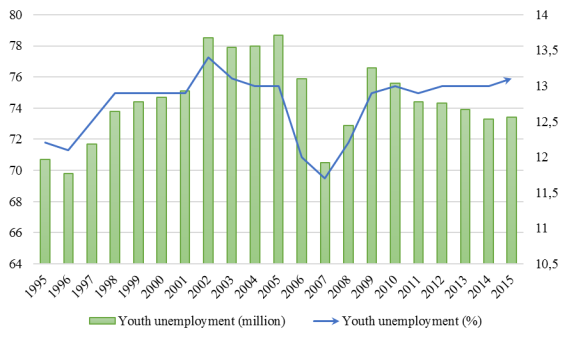
a period of rapid increase between 2007 and 2010, the global youth unemployment
rate settled at 13.0 per cent for the period 2012−14 and is expected to increase
only slightly to 13.1 per cent in 2015. While
this
rate is now on par with rates of the early 2000s, the number of unemployed
youth has shown a significant decline over the same
period: 78.7 million youth were unemployed in 2005, 76.6
million at the peak of the crisis in 2009 and then descending to
an estimated 73.4 million in 2015. That the youth unemployment rate has not decreased
with declining numbers of unemployed youth is a signal of the longer-term trends
in the declining youth labour force, the denominator of the rate. In the
ten-year span between 2005 and 2015, the youth labour
force declined by as much as 46 million while the number
of unemployed youth dropped by 5.3 million [6].
Figure
1 reflects well the cyclical nature of youth
unemployment and reminds us of the often repeated
tenet that youth are among the most severely impacted by
economic
crises; youth are the “first out” as economies contract and the “last in”
during periods of recovery. Evidence from previous
crises suggest that it takes an average of
four
to five years from the resumption of economic growth before overall employment returns
to its pre-crisis levels. Recovery of youth employment can take even longer.
In fact, at this point in time, nearly ten years after the onset of the global economic
crisis, the global youth unemployment rate remains well above the pre-crisis rate
of 11.7 per cent in 2007 [7].
Policies
that promote employment-centred and inclusive growth are vital if young people are to be given a fair chance at a
decent job. Youth labour market outcomes
are closely related to overall employment trends but are also more sensitive to the business cycle as demonstrated in earlier
chapters of this report. A boost in aggregate
demand is key to addressing the youth employment crisis as this will create more job opportunities for young people.
Keeping
youth employment strategies anchored to macroeconomic and sectoral policies
is therefore critical. Far too often, however, interventions that aim to
increase labour demand remain underutilized. It is quite
uncommon to find a comprehensive set of policy priorities,
targets and outcomes for youth employment, let alone with
sufficient
funds and resource allocations.
Macroeconomic
and growth policies can support youth employment if
investments
are sufficient and well placed. Job growth can be spurred by encouraging
economic diversification and structural
transformation. Rural
non-farm economic activities are currently the source of 40 to 70
per cent of rural households’ income in Africa, Asia and
Latin America. A recent analysis of the results of the SWTS concluded that
many countries – especially the low-income countries in sub-Saharan Africa – need to
move beyond low-productive agriculture and petty trades in rural areas [3].
In
these countries the promise of rural diversification and structural transformation
has not yet resulted in better jobs for significant shares of young people living
in rural areas.
Strategies
to promote agricultural diversification and expand the productive segments
of the industrial and services sector are required to harness gains from structural
changes and boost labour demand for youth in developing countries. There are
multiple and diverse pathways to structural transformation as highlighted [5].
Regardless
of the policy choice, the State must play an active role, be it
in building markets, nurturing enterprises, encouraging technological
upgrading, supporting learning processes and the
accumulation of capabilities, removing infrastructural
bottlenecks to growth, modernizing agriculture and providing access to finance. Positive
employment outcomes can be encouraged by reducing
macroeconomic volatility
by engaging in timely and targeted counter-cyclical policies. Through fiscal
and monetary policy, central banks and financial
authorities can encourage high levels of investment,
enhance financial inclusion and ensure access to credit, particularly by granting
credits to priority sectors with high potential to create quality employment [4].
The
impact of expansionary fiscal policy on employment
outcomes
has been the subject of research and analysis over the last decade, and, more particularly,
during the economic and financial crisis. In the realm of youth employment, a
argues that counter-cyclical fiscal policy can help
to curb youth unemployment. This instrument is more effective if preceded
by a relatively conservative fiscal policy in non-recessionary periods, by increasing
expenditure and reducing taxes during recessions and doing the opposite during
economic expansion.
References:
1. Behrendt, C. 2013. “Investing in people:
Extending social security through national Social
Protection
Floors”, in I. Islam and D. Kucera (eds): Beyond macroeconomic stability:
Structural transformation and inclusive development
(Geneva,
ILO/Basingstoke, Palgrave Macmillan).
2. Divald, S. 2015. Comparative analysis of policies for youth employment in Asia and the
Pacific (Geneva, ILO).
3. Elder, S. 2014. Labour market transitions of young women and men in Asia and the
Pacific, Work4Youth Publication
Series No. 19 (Geneva, ILO).
4. Islam, I.; Kucera, D. 2013. Beyond macroeconomic stability: Structural
transformation and
inclusive development (Geneva,
ILO/Basingstoke, Palgrave Macmillan).
5. Islam, R.; Islam, I. 2015. Employment and inclusive development (London,
Routledge Studies in Development Economics).
6. Lieuw-Kie-Song, M.; Puerto, S.; Tsukamoto, M.
(forthcoming). Improving labour market
outcomes of
youth: A review of evidence from public works programmes (Geneva, ILO).
7. Report: Global employment trends for youth 2015: scaling
up investments in decent jobs for youth / International
Labour Office. - Geneva: ILO, 2015
8. Scarpetta,
S.; Sonnet, A. 2012. “Challenges facing European labour markets: Is a skill
upgrade the appropriate
instrument?”, in Intereconomics, Vol. 47, No. 1.