MEL’NICK V.M.
National Technical
University of Ukraine “KPI”
THE GAS STREAM SOUND
SUPPRESSOR
The construction refers to Mechanical engineering,
namely, to sound suppressors, and can be used for noise declining of different
pipelines when throwing the discharge gas out into the atmosphere [1].
There is known the gas stream sound suppressor, that
includes a cylindrical body with a flushing hole, a diffuser in the form of
cone, a coverage with a conic ledge, and a washer, that is placed between body
and coverage, made of cellular material, and also mounting hardware [2].
The drawback of this suppressor consists in a
restricted capacity that chokes the scope of its use.
There
is also known the gas stream sound
suppressor, that includes a cylindrical post with a central gullet, cross-holes
and a cartridge of a glass shape, that is made of porous material and is
fastened to the body [3].
This suppressor is the most suitable, by its technical
essence and the attainable effect. It is also accepted as a proximal analog.
The drawback of the known suppressor consists in a low
efficiency of noise suppression, in consideration of lack of gas stream space
movement in the central gullet of the post.
Inherently of the useful model there is a task to
improve the suppressor, by including in its construction the complementary
element that secures space, instead of sliding in the proximal analog, gas
stream movement in the central gullet of the body, it leads to the accessory
stream sound energy dissipation, and to the sound protection efficiency growth.
The assigned task can be solved, by that fact that the
gas stream sound suppressor, that includes a cylindrical body with a central
gullet, cross-holes, and a cartridge, that is made of porous material, which is
fastened to the body. The novelty of the suppressor is that it is equipped with
a plate, allocated in the central aperture of body, the aperture is of screw form.
Mentioned features secure the space (screw) movement
of gas stream, instead of sliding (straightline) movement in the proximal
analog that calls its turbulization.
The gas
stream turbulization, as is known, increases the sound energy dissipation, this
fact accessory decreases its acoustic power, in the issue the suppression efficiency
grows [4].
The gas
stream suppressor is introduced on the fig. 1, the general form; on the fig.2
is the cross-section A-A on the fig.1.

Fig.1
The
suppressor includes the cylindrical body 1 with a central diameter “d”, the
bore 2 and the cartridge 3 of glass shape, that is made of porous material, for
example, polyethylene, or other well known material, and is fastened to the
body. The body 1 is executed in the shape of the disk 4 with the connecting
pipe 5 on the one end and the shank end 6 on the other end. The shank end 6 has
the cross-holes 7 for chopping the gas stream 8. The cartridge 6 is fastened to
the body 1, by the bolt 9 that is screwed with a washer 10 into the shank end.
The suppressor is equipped with the plate 11, which is allocated in the central
gullet 2 of the body 1. Such form of the plate 11, can be obtained when making,
by twisting of even metal plate with «δ» width (fig.1.19) around its longitudinal axis
“O-O” along the circular lines, until getting the surface with required “H”
step on the “L” length.
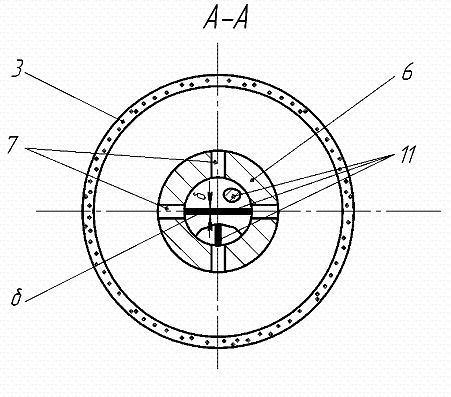
Fig.2
The
suppressor principle of operation is following.
When
getting the discharge gas into the channel 2, its stream 8 parts into two
flows. Each of them modulates, by the plate, in a screw form, getting, hereby,
besides basic sliding, the accessory rotary motion around the axis “O-O”.
Consequently, the flow turbolizes and, thus, loses some part of its sound
energy. Then the compressed gas penetrates the cartridge 3 pores, and exits
through the atmosphere by completely or considerably losing of its first sound
energy,
In the
issue of this, the gas stream movement in the flushing hole occurs, by an
accessory giving a rotary motion to it, notably, by generating multiple
acoustic rotary motions. This calls the accessory dissipation, and,
consequently, the gas sound energy, which penetrates the environment, reduces,
thus the sound suppression efficiency grows.
The
suppressor is made of a simple construction, and it does not demand
considerable costs on implementation.
References
1. Mel'nik, V.N.
Determining gyroscopic integrator errors due to diffraction of sound waves [Текст]/ V.N. Mel'nik, V.V. Karachun // Іnternational Applied
Mechanics. ISSN: 10637095. Volume: 40.
Issue: 3. Pages: 328-336. Year: 2004-03-01. EID: 2-s2.0-3042853113. Scopus ID:
3042853113. DOI: 10.1023/B:INAM.0000031917.13754.2a.
2.
Karachun, V.V. Elastic stress state of a floating-type suspension in the
acoustic field. Deviation of the spin axis [Текст]/ V.V. Karachun, V.N. Mel’nik // Strength of
Materials. ISSN:
00392316. Volume: 44. Issue: 6. Pages: 668-677. Year: 2012-11-01. EID:
2-s2.0-84961216138. Scopus ID: 84961216138. DOI: 10.1007/s11223-012-9421-2.
3.
Mel’nick, V. The
emergence of resonance within acoustic fields of the float gyroscope suspension
[Текст]/ V. Mel’nick, V. Karachun //
EasternEuropean Journal of Enterprise Technologies. ISSN: 17293774. Volume: 1.
Issue: 7. Pages: 39-44. Year: 2016-01-01. EID: 2-s2.0-84960858488. Scopus ID:
84960858488. DOI: 10.15587/1729-4061.2016.59892
4. Mel'nik, V.N. Influence
of acoustic radiation on the sensors of a gyrostabilized platform [Текст]/ V.N. Mel'nik, V.V. Karachun // International
Applied Mechanics. ISSN: 10637095. Volume: 40. Issue: 10. Pages: 1164-1170. Year:
2004-10-01. EID: 2-s2.0-14744289091. Scopus ID: 14744289091. DOI:
10.1007/s10778-004-0008-x