Undergraduate of the specialty
"Biology" – Nadyozhkina I.
Cand. Sc. of Biology – Sultangazina G.
Kostanay State University named
after A. Baitursynov
GEOGRAPHICAL
ANALYSIS OF STEPPE FLORA IN THE NATIONAL PARK "BURABAI"
The conservation of biodiversity is one of the global environmental
problems and it becomes more and more acute every year with the disappearance
of species.
Floristic studies were carried out in the territory of the State
National Natural Park (SNNP) "Burabai" located in Kokshetau
mountainous area covering the block of Paleozoic rocks of the same name in the
north-western part of the Central Kazakhstan Upland.
The boundary location of Kokchetau upland between forest-steppe and
steppe vegetation zones left an imprint on the character of its vegetation.
K.P. Gorshenin [1955] considered this territory as "false
forest-steppe" based on the fact that outlier-steppe landscapes are
widespread there.
On the modern vegetation map the area of Kokchetau upland is charted as
the forest-steppe of lowlands, the part of the steppe zone with the
predominance of northern zonal types of steppes in combination with birch,
asp-birch and pine forests [1].
The national park covers Bohr mountain-forest massif located in the
eastern part of Kokshetau Upland (north-western part of Kazakh Upland). Its
area is 129,935 hectares. The maximum height of the ridge Kokshetau is 947.6 m
above sea level. The ridge is made of deep-seated igneous rocks, mostly of
granite. There are also pegmatites, syenites, porphyrites. The once irruptive
from the depths of the earth molten magma transformed the composition of the
surface sediments. The following metamorphic rocks were formed: schists,
quartzites, cherts [2]. The park territory is hilly and lowland terrain, most
evident in the western part. The complexity of topography and geological
structure as well as other factors determine the extremely diverse and
contrastive soil cover [3]. In the area, adjacent to the granite Lowland, the
most common are black earth carbonate, normal, leached and solodized, dark
chestnut underdeveloped and incomplete developed cobble soils as well as
chestnut soils on dense crystalline rocks [4]. The climate of the study area
has a clear continental character. The annual amplitude of air temperature is
in average 80-90 °C. In July the
temperature rises to + 41 °C, in January in certain years it falls to - 51 °C.
The annual rainfall is 379 mm, its maximum is observed in elevated areas. Fast
drying out of soils in the spring and early summer occurs due to a low rainfall
and strong winds. The wind regime during the year is characterized by the
predominance of south-west winds (52%), the average annual wind speed is 3,25,3
m/s. The probability of adverse combinations of heat and moisture in the most
critical period for the development of plants (May –July), is in average about
50%. Late spring and early autumn frosts also adversely affect the growth and
development of plants.
The flora of the Natural Park "Burabai" has 691 species
(including 47 foreign) of higher vascular plants which belong to 101 families
and 344 genera, representing 49% of the total flora of the Central Kazakhstan
Upland and 12% of the flora of Kazakhstan [5].
Among the total number of identified vascular plants species the steppe
flora plants compose 124 species belonging to 75 genera, 24 families,
representing 18% of the total floristic diversity. The basis for the analysis
of steppe flora of the National Park "Burabai" was the list of
vascular plants. The main volume of factual material (more than 1,000 herbarium
specimens, about 50 geobotanical descriptions) was obtained during field work
in 2012-2014.
In the course of research, which aim was to identify the floristic
diversity of the steppe part of the Natural Park "Burabai", they
carried out a field study in 10 forest districts: Akylbayskoe, Borovskoe,
Katarkolskoe, Zolotoborskoe, Mirnoe, Barmashinskoe, Priozernoe, Bulandinskoe,
Temnoborskoe and Zhalairyskoe. In addition to field studies of collecting plants,
much work on viewing the literature was done ("Flora of Kazakhstan"
(1956-1966), Z.V. Karamysheva, E.I.
Rachkovskaya’s monograph (1973), Herbarium (the Herbarium of the Department of
Biology and Chemistry of Kostanay State University named after A. Baitursynov
and the Institute of Plant and Animal Ecology (Ekaterinburg).
An integral part of the flora analysis is the study of geographical laws
of its species distribution and based on the data the isolation of geographical
elements, i.e. the division of studied flora into groups of species with a
similar spread. All this allows us to generalize and systematize the existing
knowledge of the geographical distribution of plant species to reveal the
characteristic phytogeographic features of the formation of regional flora
(Portenier, 1993, 2000), as well as highlight some moments in its history [6,
7].
For phytogeographical analysis of meadow-steppe regional floras we used
the system of geographical elements developed by N.N. Portenier (1993, 2000)
and enriched by A.L. Ivanov (1998). The basis for pointing out of geographical
elements is the approach based on the conception of phytochorions
(Braun-Blauquet, 1919, 1923; Eug, 1931), on the principle of correspondence of
species distribution to A.Y. Takhtadzhyan (1978) pointing out of floral zoning
(Ivanov, 1998) [8, 9].
The Portenier-Ivanov system of geographical elements reveals
characteristic diagnostic features of fitohorion floras. During phytogeographic
analysis of steppe flora in studied region 12 geographical elements were found
(Table 1).
Table
1 – Geographical analysis of species composition of steppe flora in the SNNP
"Burabai"
|
Geographic
type |
Number of
species |
% of the
total number of species |
|
General Holarktic elements |
||
|
Palearctic |
25 |
20.2 |
|
Eurosibirian |
19 |
15.3 |
|
Holarctic |
4 |
3.2 |
|
Ancient Mediterranean elements |
||
|
Mediterranean |
14 |
11.3 |
|
Boreal elements |
||
|
Black
Sea Region-Kazakhstan |
29 |
23.4 |
|
Black
Sea Region-Kazakhstan-Mongolian |
12 |
9.8 |
|
Zavolzhsky-Kazakhstan-Mongolian |
7 |
5.6 |
|
Zavolzhsky-Kazakhstan |
5 |
4.0 |
|
Central
Kazakhstan-Mongolian |
5 |
4.0 |
|
Eastern
Kazakhstan |
2 |
1.6 |
|
Eastern-Kazakhstan-Mongolian |
1 |
0.8 |
|
Plurizonal elements |
||
|
Cosmopolitan |
1 |
0.8 |
|
Total |
124 |
100 |
1. Palearctic element. Ranges of species that make up this geoelement
comprise temperate and subtropical areas of Holarctic Kingdom within the Old
World without apparent beloning to one of subkingdoms. In the studied flora
there are 25 of these species (20.2%) (Fig. 1). This geoelement includes the
following steppe species: Phleum
phleoides (L.) H. Karst., Helictotrichon
pubescens (Huds.) Pilg., H. desertorum (Less.) Nevski., Festuca rupicola Heuff,
Elytrigia repens (L.) Nevski., Stipa pennata L., Artemisia pontica L., Achillea
setacea Waldst. & Kit., and others.
Figure 1 – aerographic species groups of steppe flora
in the SNNP "Burabai"
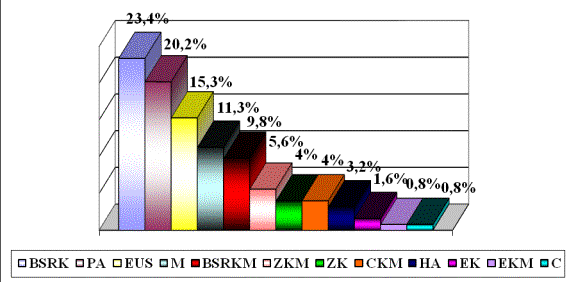
BSRK
– Black Sea Region-Kazakhstan, PA - Palearctic, EUS – Eurosibirian, HA –
Holarctic, M – Mediterranean, BSRKM – Black Sea Region- Kazakhstan-Mongolian,
ZKM – Zavolzhsky-Kazakhstan-Mongolian, ZK – Zavolzhsky-Kazakhstan, CKM –
Central Kazakhstan-Mongolian species, EK – Eastern Kazakhstan, EKM – Eastern
Kazakhstan-Mongolian, C – Cosmopolitan
2. Eurosiberian element. Includes widespread boreal species which are
absent in the New World. Their ranges cover the Eurasian part of the
Circumboreal Region (Takhtadzhyan, 1978). Here there are 19 species
(15.3%). This element includes the
following types: Pulsatilla patens
(L.) Mill., Adonis vernalis L., Ranunculus pedatus Waldst. &
Kit., R. polyrhizus Steph., Erysimum sisymbrioides C.A.Mey and
others.
3. Holarctic element. The species cover the territories of at least 3
Holarctic subkingdoms. A total number of such species in the National Park
"Burabay" is 4 (3.2%). Holarctics include the following steppe
species: Carex pediformis C.A.Mey., Artemisia frigida Willd., Koeleria cristata (L.) Pers., Potentilla nudicaulis Willd. ex Schltdl.
4. Mediterranean element. Includes species with ranges covering 2 or more
provinces of the Mediterranean region and making up its floral kernel. This
geoelement includes 14 species of steppe flora of the park (11.3%, respectively):
Elisanthe viscosa (L.)
Rupr., Gypsophila paniculata L., Alyssum tortuosum Waldst. &
Kit. ex Willd., Stipa capillata L, Poa stepposa (Kryl.) Roshev and others.
5. Black Sea Region-Kazakhstan element. This geoelement of the SNNP “Burabai” has 29
species (23.4%). These are the following: Ephedra distachya L., Adonis wolgensis Steven., Atraphaxis
frutescens (L.) K.Koch., Erysimum marschallianum Andrz and
others.
6. Black Sea Region-Kazakhstan-Mongolian element is represented by 12 species (9.8%) – Isatis costata C.A.Mey., Sisymbrium polymorphum (Murray), Caragana frutex (L.) K.Koch., Linum
pallescens Bunge., Salvia stepposa Des.-Shost., etc.
7. Zavolzhsky-Kazakhstan-Mongolian element is represented by 7 species, respectively 5.6%.
They are the following: Pulsatilla flavescens (Zucc.) Juz., Eremogone saxatilis (L.) Ikonn., Goniolimon speciosum (L.) Boiss., Alyssum lenense Adams., Clausia aprica (Stephan) Korn.-Trotzky.,
Hedysarum gmelinii Ledeb., Artemisia sericea Weber ex Stechm.
8. Zavolozhsky-Kazakhstan element includes 5 species (4%): Tulipa patens C.Agardh ex Schult.,
Astragalus vulpinus Willd., Eromogone
koriniana (Fisch.) ex Fenzl., Seseli
ledebourii G. Don., Scabiosa isetensis L.
9. Central Kazakhstan-Mongolian element includes the following 5 species (4%): Allium strictum Schrad., A. rubens Schrad. ex Willd., Artemisia commutata Besser., Thermopsis lanceolata R.Br., Chorispora sibirica (L.) DC.
10. Eastern-Kazakhstan element is represented by two species (1.6%): Thesium refractum C.A.Mey., Peucedanum morisonii Besser ex Spreng.
11. Eastern-Kazakhstan-Mongolian element includes one
representative (0.8%): Anthemis tinctoria
L.
12. Cosmopolitan element has a very wide distribution occurring in many
or certain areas of the globe. Real cosmopolitans inhabit all continents. This
element comprises only one species (0.8%) – Ceratocarpus
arenarius L.
The geographical analysis of steppe flora of the National Park
"Burabai" leads to the following conclusions. The flora of the SNNP
"Burabai" contains a significant proportion of species represented by
Boreal (49.2%), General Holarctic (38.7%) and Ancient Mediterranean (11.3%)
elements. Among the Boreal elements the largest by geographic species are Black
Sea Region-Kazakhstan (29 species or 23.4%), Eurosibirian (19 species or
15.3%), and among General Holarctic – Palearctic (25 species or 20.2%), Black
Sea Region-Kazakhstan-Mongolian (12 species or 9.8%). Ancient Mediterranean
element is represented by one type of geographical species – the Mediterranean,
to which 14 species of steppe plants belong. The proportion of Boreal
species distributed within Zavolzhsky-Kazakhstan-Mongolian (5.6%),
Zavolzhsky-Kazakhstan (4%), Central Kazakhstan-Mongolian (4%),
Eastern-Kazakhstan (1.6%) and Eastern-Kazakhstan-Mongolian subregions (0.8%),
as well as the areas of Holarctic subregion (3.2%) related to General Holarctic
region is small. Plurizonal element is represented by only one Cosmopolitan
species and composes only 0.8% of all steppe species of the park. Thus, in the
steppe flora of the SNNP "Burabai" dominate Black Sea
Region-Kazakhstan and Palearctic species with significant participation of
Eurosibirian, Mediterranean and Black Sea Region-Kazakhstan-Mongolian species.
REFERENCES:
1. Borisova,
I.V. Forest-steppes in northern Kazakhstan / I.V. Borisova, T.V. Isachenko,
E.I. Rachkovskaya. // Bot. journal. – 1957. – №5. – P. 677-690.
2. Ministry of
Industry and New Technologies of the RK [Electronic resource]/ the Committee of
Industry and Tourism – Mode of access: http: //www.kit.gov.kz
3. Gavrilov,
V.A. Brief description of the territory and forest-plant circumstances of the
region / V.A . Gavrilov // The main provisions of the organization and
development of the forestry in Kokchetau area. – Shchuchinsk. – 1988. – 26 p.
4.
Gorchakovskiy, P.L. Forest oasis of
Kazakh Upland / P.L. Gorchakovskiy. – M .: Nauka, 1987. – 158 p.
5.
Sultangazina, G.ZH. The Flora of the NationalNatural Park "Burabai"
/G.ZH. Sultangazina, I.A. Khrustalyova, A.N. Kupriyanov. – Novosibirsk:
Publishing House of SB RAS, 2015. – 117 p.
6. Portenier,
N.N. Methodological issues of pointing out of flora geographical elements /
N.N. Portenier // Bot. journal. – 2000. – №6 (85). – P. 76.
7. Portenier,
N.N. The system of flora geographical elements / N.N. Portenier // Bot.
journal. – 2000. – №9 (85). – S. 26-33.
8.
Takhtadzhyan, A.L. Floristic regions of the Earth / A.L. Takhtadzhyan. – M .:
Nauka, 1978. – 248 p
9.
Braun-Blanquet, J. Essal sur les notions “d’element” et de “territoire”
phytogeagraphiques/Braun-Blanquet J. //Archives des sciences physiques et
naturelles. – Geneve 1919. – Ser. 5, Vol. 1. – P. 497-512.