A. Bashuk
Assistant Professor
distribution of productive forces and production
technologies,
National University,
Kryvyi Righ
Diffusion
of innovations
Centro-peripheral
model based on the spatial transformation of the core of the world economy
through the generation, application and diffusion of innovations. According to
the teachings of J. Friedman, distribution innovations strictly hierarchical:
from high to low levels (cascade diffusion). The author identifies several
important factors that determine the stability of dominance over the periphery
of the nucleus. With one hand the constant innovation creates favorable
conditions for further development is within the kernel, providing maximum
access to information, creating a number of accompanying institutional
conditions. Thus, along with the effect of sinter effective psychological
effect which causes further modernization and qualitative transformation of the
economic system kernel. On the other hand, the kernel constantly mobilizes
various resources (mobile factors of production: labor, capital, natural
resources, etc.) from the peripheral areas and centers that reinforces and
perpetuates the differences between them, weakening the periphery [3].
The mechanism of
operation territorial systems "center - periphery" due constant
qualitative changes in the socio-economic relations within the nucleus, where
the extent of scientific and technological progress, new features, focusing
latest high-tech industries, new connections and respectively, is a constant
restructuring of the economy, which is accompanied by changes in the
qualification of labor and social composition of the population. [1] The
industries that do not meet the core status as a major generator of innovation,
gradually displaced to the periphery - first short-term (semi-), and then
distant. The above process is called "diffusion of old innovations",
plays an important role in the transmission of impulses from the periphery of
the growth causes economic development, while consolidating a clear
subordination technological braking. [4]
Exploring the
evolution of relations between center and periphery, J. Friedman (the national
level) identifies four stages of development (Fig. 1). Stage 1 category state
is a system of local cores, each of which has an impact. Intra polarization of
population and economy at this stage markedly stronger inter because the
dominance of the national core as the more developed regions is not expressed.
At stage 2 most favorable to the existing regional nuclear forms polarized
around a region, which is the core of the national territory, surrounded by a
wide periphery. In stage 3 in some peripheral areas as a result of the
hierarchical diffusion of innovation, the conditions for a more active growth
of regional nuclear polarization, New halos production, which leads to the
transformation of the spatial structure of mono-to polycentric. In stage 4 the
most dynamic element of culture that is mizhmetropolitenska peripherals (ie
poluperyferiya). As a result of the intensification of the use of space in the
external division of nuclei having enhanced agglomeration of high economic
aktyvnisyu. [1]
The above
chotyrystadiyna model focuses on the national scale. General laws polarization
territory marked J. Friedman, tracing and other taxonometric levels, including
the global.
Thus, at the global
level in Western Europe, the cradle of the Industrial Revolution may be
considered a typical example of one stage, the primary focus of
industrialization: it is in this part of the world emerged world system of
capitalism (world-system in Valerstanu). Long time European colonial powers
concentrated the bulk of the world's economic potential, implementing new
technologies that radically changed the nature of management and distribution
of productive forces.
From metropolitan
carried coordination and practically the whole process covering global space,
controlled by the main transport routes. In Europe, industrial development
occurred due to the emergence of new centers of agrarian regions and due to the
restructuring of old industrial regions. Thus, the development of industries
caused by the rapid rise of Europe - one of the centers of world civilization.
this process was accompanied by the transformation of Europe into economic and
political dominance of the world economy, which is characteristic of the stage
2 models J. Friedman. [2]
Later serious
competitors Western European pole (nucleus) of the world economy have created a
first U.S. (from the early nineteenth century.), And later Japan and Russia.
[44]
Monocentric world
system of capitalism has at the end of the last century transformed into
polycentric, and its new centers started vyperedzhuvaty in the world of Europe.
During the advanced industrial society (1870-1970) under the laws of 3 models
J. Friedman "center - periphery" appeared at the global level. [1]
Since the mid
1970s, developed countries have moved to a new stage of economic development,
which is associated with the beginning of the post-industrial era, the
so-called third industrial revolution (scientific and technological
revolution). Anticipating the role of tertiary sector (in most of the core of
the world economy, the sector concentrates nearly ¾ of all employees),
reducing the role of industry as a major industry to realize the achievements
of NTP. Characteristically, the bulk of the increase in employment in the
non-production sphere is directed not at those areas that are directly related
to development of advanced technologies in the industry (eg
telecommunications). Postindustrial period of development has caused not only a
qualitative transformation of the global kernels, but some of their expansion,
restructuring relationships within the entire world economy. Rapid growth of a
large group of medium developed countries and developing countries (in
Southeast Asia and Latin America) through the development of modern industries
(while maintaining their dependence on the leading centers) is a global form of
expression detected J. Friedman tendency to advancing development.
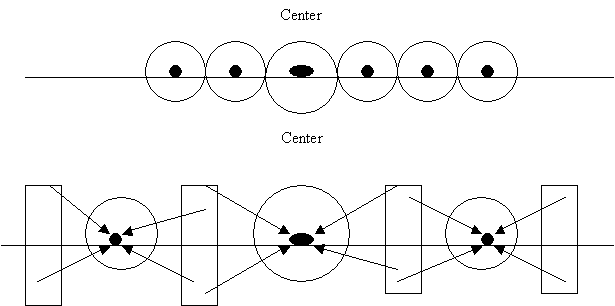



Rice. 1. Stages model J. Friedman
REFERENCES:
1. Грицай О. В., Иоффе Г. В., Трейвиш А. И. Центр и
периферия в региональном развитии – М.: Наука, 1991.
2. Cole J. P. Geography of World Affairs. London: Penguin
Books, 1963.
3. Friedmann J. Regional development policy. Boston :
Massachusetts Institute of Technology, 1966.
4. Schaetzl L. Wirtschaftsgeographic 1. Theoric.
Paderborn: Schoeningh, 1996.