Syzdykova
E.Zh. – candidate of economic sciences
Kassenova
D.I. - master of economic science
Koshmagambetova
K.D. - master student
Academician
Y.A.Buketov Karagandy State University
Financial prediction and
it’s methods
In modern conditions managing decisions should be made only after a careful
analysis of available information. For example, a bank or a board of directors
of a corporation should decide investing money into a project only after
careful calculations, coupled with forecasts of market conditions, determining
return on investment andappraising the possible risks. Otherwise, it may
surpass its competitors, who can better assess and predict the prospects for
development.
To solve problems associated with data analysis in the presence of random
effects, there is a powerful apparatus of Applied Statistics, part of which is
a statistical method of forecasting. These methods allow the identification of
patterns on the background of chance, to make informed predictions and assess
the likelihood of their implementation.
Forecast is a scientifically based description of the possible states of
the objects in the future, as well as alternative routes and timetables to
achieve this state. The process of developing forecasts is called prediction
(Greek Prognosis - foresight, prediction).
Forecasting must respond to:
• What is likely to expect in the future?
• How to change the conditions to achieve a specified, finite state
projection of an object?
Forecasts that respond to the questions of the first type, called the
search forecasts, the second type – regulatory forecasts. For example, the aim
is to provide each family with a separate apartment with an improved layout.
Normative forecasts show investment and the time within which this task would
be accomplished.
Depending on the prediction object there areseparate forecasts for the
scientific, technical, economic, social, political and military purposes, etc.
However, this classification is conditional, since mainlybetween these
forecaststhere are many forward and backward linkages. The need to determine
final practical prediction purposes involves determining the desired type of
prediction. Type of forecast is determined by two factors:
- Forecasting horizon and
-Hierarchical level of the indicator topredict.
By the time horizon forecasts are divided into short (1-2 cycles ahead of
time), medium (3-5 cycles) and long (more than 5 strokes ahead of time).
By the level of the indicator topredictthey are divided into macro-, meso-
and micropredictions. Everything related to the prediction of parameters
describing the activities of firms, companies and enterprises related to the
micro level. Meso (regional and sectoral levels) and macropredictionsare used
to describe the external environment.
Classification of economic forecasts is shown in Figure 1.
After studying Figure 1 we see that economic forecasts differ on the
following criteria: the magnitude of the object prediction of lead time, for
purposes of forecasting.
Construction of forecast and the related construction and experimental
check (verification) probabilistic-statistical model is usually based on the
simultaneous use of two types of information:
- A priori information about the nature and essence of the content of the
phenomenon represented, usually in the form of some theoretical laws,
restrictions, and hypothesis;
- Source of statistical data on the process and results of functioning of
the phenomenon or system.
It should be emphasized that in reality, a businessman, head of the company
may of coursesuccessfully run business and do not use methods of constructing
mathematical models of forecasting. However, in the competitionusing these
techniques provides a businessman and his business at times no less significant
competitive advantages than conquesting of a certain market share or getting
the best loan.
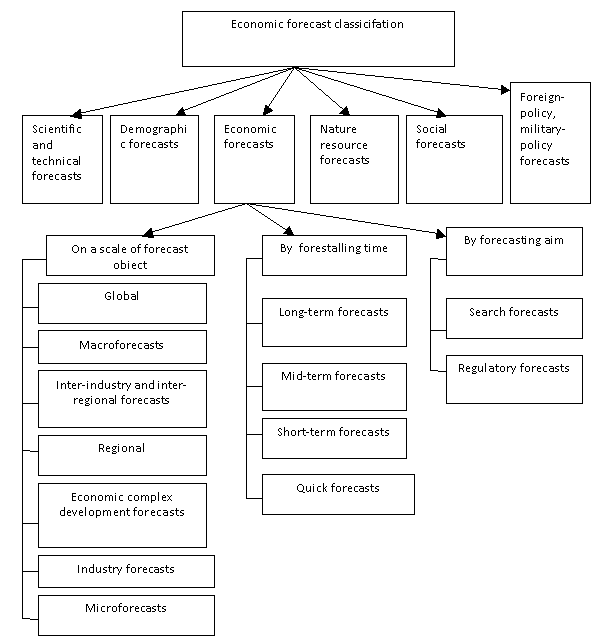
 Figure 1. Classification of economic
forecasts
Figure 1. Classification of economic
forecasts
Most practical interest of course representthe short-term and operational
forecasts. Mathematical methods and models used in problems of stochastic
analysis and forecasting in business can relate to the various branches of
mathematics: a regression analysis, time series analysis, formation and
evaluation of expert opinions, simulation, systems of simultaneous equations,
discriminant analysis, logit and probit models, the unit of logical decision
functions, the dispersion or covariance analysis, rank correlations and
contingency tables, etc. However, they are all united by the fact that
represent different approaches to solving the central problem of multivariate
statistics and econometrics - the statistical study of dependency problems,
which, again, is the basic problem of statistical analysis and forecasting in
business. The
scheme of choosing the forecasting mathematical tools is shown in Figure 2.
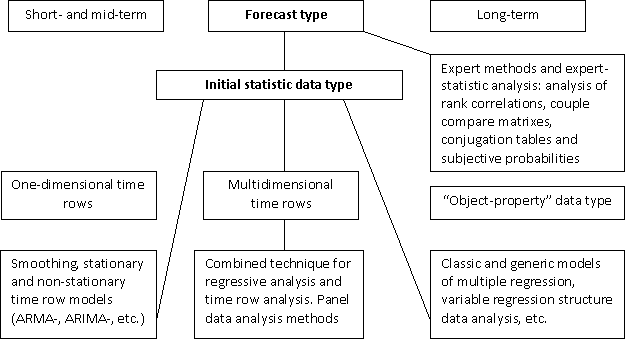
Figure 2. The
scheme of choosing the forecasting mathematical tools
Thus, the prediction is a multistage process involving goal setting,
information, processing, assessment and analysis, identification of prospects
and the probability of the forecast. At all stages of the forecasting a close
alignment with the objectives and tasksmust be ensured, i.e. with the strategy
of economic development, while in some cases on the basis of our stated goals
are projected path and its achievements, in other cases, the forecast is
carried out to determine the achievable, responsive to the needs of society
goals.
References:
1.
Aivazian S.A., Mkhitaryan V.S. Applied statistics and the foundation of econometrics.
- Moscow: UNITY, 2008.
2. Hanke
J. and Reitsch A. Business Forecasting. - N.Y.: Prentice-Hall, Englewood
Cliffs, 2005.