Sadanova
B.M., Oleinikova A.V., Miftahov R.R., Dakibaeva M.K.
Karaganda
State Technical University, Kazakhstan
Advantages
of object-oriented approach in construction of electronic learning resources models
Nowadays,
researching of the creation and development of electronic educational resources
has become very frequent. Internet resources play a role not only as means of
finding and obtaining a "useful information" but also as the tool for
the development of existing forms of education and creating new ones. In this regard, particular attention is paid
to the development of concepts and various forms of e-learning. E-learning
(e-learning) is based on the use of multimedia technologies and the Internet to
enhance learning process by facilitating access to resources and services, as
well as sharing and collaboration at the distance.
Educational
network systems must have a high level of interoperability (interoperable),
which is the possibility of interaction
with various other systems [1]. This requirement is very important when
creating distributed learning environments in the Intranet / Internet networks.
Most educational systems implement this requirement through the open access
interfaces to their services or by using a common format for data exchange, namely
XML and its associated object model representation of the documents DOM
(Document Object Model), carrying out, if necessary, XSL-transformations. This
approach allows us to solve the problem of syntactic interoperability.
Unfortunately, for interaction between different educational systems in the
Intranet / Internet networks in most cases providing only syntactic interoperability is not enough.
This is primarily due to the fact that the same information can be
syntactically represented in different ways,
and as a consequence there may be a natural barrier between the systems.
Thus,
the main obstacle in the process of creating web-based distance learning
courses is the lack of standardization of network training tools. To solve this
problem, it seems appropriate to use Semantic Web technology [2]. Concept of
the semantic web (Semantic Web) as a new format for the Web-content was
introduced by W3-chairman of the Consortium, Tim Berners-Lee (Tim Berners-Lee)
in 2001. Advantages of the new reporting format in the WWW is that it provides
the maximum degree of classification of any information, making the joint work
of people and cars more efficient. The main difference between Semantic Web
from the Web is that each page of a semantic network provides information in
two languages: an ordinary, human readable and shown in the browser, and the
special, the information which is hidden from human eyes, but can be understood
by intelligent software agents, robots . This special language describes the
material presented on the page with the tags and attributes that are
understandable to machines. Formal semantics of documents in this way can be
processed by computers, transferred between different agents, which might be
programs and people.
Today, the main volume of
structured data sources are the relational database, although it also may be
file systems, XML and databases,which extend the scope of its application, and
other types of information sources. Regardless of the method of storage, the
first issue of integrating heterogeneous data
which you will have to deal with
during the formation of a repository of information resources - is a variety of
models and data schemas, their low level of abstraction, a small level of the
adequacy of the semantic domain for high-quality solutions which need to work
with data corresponding to a significantly more semantically rich data model.
For example, a good solution may be to move to some object-oriented data model,
which is in many ways similar to semantic models, where the key unit is a
complex structured information object that supports a variety of attributes,
that is involved in various associations with other objects [3].
The transition from the
relational data model for object-oriented is a necessary step in building an
information storage. Object-oriented model allows you to:
• increase the level of
abstraction of the domain model;
• it is convenient to
highlight the canonical data schemes, representing the intersection of the
export schemas of data corresponding to the different subject areas, to build
unified object requests for access to distributed data and then aggregating the
results of queries in accordance with canonical schemes;
• in the case of RDFS and
OWL – you will have a uniform
representing format, which provides syntactic and semantic interoperability.
An example of a hierarchy
of objects can be a description of electronic educational resources stored on
the portal, digital library, etc. In order to allow automated processing, any
description shall have a uniform shape. Abstract class "document"
(general concept of an information resource) must match the abstract data
object that describes the data inherent in any document. Information objects
that describe the specific document types (text, test paper, abstract) must
obtain the general properties of the document, but also include properties that are unique to a particular
type of document.
Methods of working with
these information objects are electronic library services: a "smart"
search on storage libraries, generation of dynamic catalogs, profiling, etc.
Using the ontology is
advised to describe the structure of electronic educational resources. At the
formal level ontology is a system consisting of a set of concepts and a set of
assertions about these concepts, looking on which one can describe classes,
relations, functions and individuals. One of the most famous definitions of
ontology was given by Tom Gruber. It says: "Ontology is the exact
specification of a conceptualization" [4]. Conceptualization implies the
description of a domain that defines a set of objects that exist in the
described application domain, and the set of relations between these objects.
Ontology consists of a dictionary, that is, a list of logical constants and
predicate symbols to refer to a domain and set of logical statements
representing the constraints that exist in this subject area and narrowing
interpretation dictionary, ontology provides vocabulary for representing
knowledge and sharing knowledge on a certain topic as well as many links and
features available between entities designated by means of the dictionary.
It was decided to use the
ontology editor Protege in order to create and edit ontologies of electronic
educational resources. Protégé includes ontology editor which allows designing ontologies by turning
the hierarchical structure of abstract or concrete classes and slots. The
structure of the ontology is done similar to the hierarchical directory
structure. Formed on the basis of ontology, Protégé may generate
a form of learning for the introduction of instances of classes and subclasses.
In the developed ontology
subclasses and superclasses structure
is implemented in the description of
language C #, which can then be used as a basis for creating ontologies
in other programming languages. Figure 2 shows a possible division into different levels of
generalization.
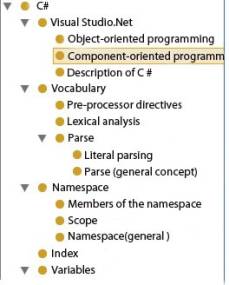
Fig 2. Different
levels of taxonomy C #
Content management system
(CMS), which creates a convenient WEB-interface to work with educational material
is used to build an interface between the machine and user . In order to
implement the inference machine was chosen
a set of libraries called
Jena.It is a clever means of
logical inference for context ontologies designed with user interfaces in the
areas of knowledge where logical
processing of large data sets is required.
Thus,
the representation of information, systematic and structured through the
ontologies can be used to form the structure of storage of teaching materials
as a resource for information and educational environment and the construction
of mathematical models and information of the course, as well as to facilitate
the retrieval of information resources in distance education learning. It
is intended to use modules of the
ontology to describe the subjects, establishing links between the basic
concepts of the subject area, and also to link each concept with information
assets that should be used for exploration of the topic. Further work is to
construct a model of informational and educational environment and development
of technology for users’ access by the corporate network and the university
through the Internet to the data.
References:
1. Scherbak
S.S.(2008). Formal models of representation of
knowledge for semantic web-services. Eastern-European Journal of Enterprise
Technologies,3(33), 68-71.
2. Berners-Lee
T., Hendler J., & Lassila O.(2001) The Semantic Web. Scientific
American, 284(5), 35-43.
3. Lapshin
V.A. (2010) Ontologies in computer systems.
Мoscow: Nauchnyi mir.
4.
Gruber T.R.(1991) The role of common ontology in achieving sharable, reusable
knowledge bases. In J. A. Allen, R.Fikes, & E. Sandewell (Ed.), Principles
of Knowledge Representation and Reasoning. Proceedings of the Second International
Conference (pp.601-602). Morgan Kaufmann.