Педагогические науки/5.Современные методы преподавания
Zhussupova R.F., Zhumataeva B.K.
Gumilyov Eurasian
National University, Astana, Kazakhstan
KEY REFLECTIVE PRACTICES IN THE EFL CLASSROOM
English as one of the means of
a dialogue and knowledge around the world takes a special place in the system
of modern education owing to the social, informative and developing functions.
Teaching a foreign language is
connected with the development both thinking and emotions and other spheres of
a person. Importance and necessity of including of personal motivational and
emotional spheres is underlined in the methodical literature in last years on
teaching foreign languages. Mastering the language in artificial conditions
without surroundings where it is spoken demands creation of the imagined
situations stimulating a real communication in the language.
Process of studying a foreign
language promotes the formation of creative independence as there is a possibility
of using creative tasks and exercises within the limits of the given subject
which demands independent work from student. They are taught to use a language
material for expression of their thoughts in a dialogical and monologue speech.
Foreign
language teaching and learning is one of the areas where learner feedback, peer
observation and reflective teaching are in use as key reflective practices in the EFL classroom.
Hence we suggest Reflective
practice as thinking about and learning from what happens
in classroom. Reflecting on what
teacher/learner does, why and how he/she does it, what the effects on learners
are, helps teacher to identify and take action on areas for improvement.
So
we propose for teachers to make up a booklet so that to plan, to conduct or sum
up every lesson and final achievements. It may be in a form of a key note and
teacher should keep in mind what went well in the classroom or didn’t go well
in a lesson. Think about the reasons
why something went well. Think about how
you can improve on the things which didn’t go well.
According
to British Council’s questions that help any teacher to develop professionally:
§
Did I achieve
my aims?
§
What did my
students learn?
§
Were the
materials helpful?
§
Did the
activities motivate the class?
§
Did my
students enjoy the lesson?
§
How do I know
my lesson was successful?
§
What did I
learn from my students?
§
What changes
will I make if I teach this lesson again?
Furthermore
perfecting the system of improvement qualifications and methodical work with
teachers in intercourse period, as its integral part, needs reorientation of
methodical services activities for providing professional growth connected with
competent teacher’s role of modern educational institution.
Secondly Learner feedback is a useful way of
understanding difficulties, preferences, what students find useful and what
they think could be done differently.
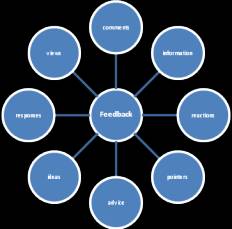
There are several important aspects to
consider when giving feedback:
• Both positive and negative feedback are
needed for the most effective learning. Negative feed-back is direct error
correction or drawing attention to error. Positive feedback can be affective,
can reward for correct or successful communication, or can provide the
opportunity for self-correction.
• Feedback can be oral, written, or
non-verbal; it can be given to individuals, groups, or the entire class.
• Feedback can be given immediately or
delayed, depending on which would be most effective for the task or situation?
• Feedback can be either formative or
summative. Formative feedback isn’t usually graded and is given at all stages
throughout the learning period. Summative feedback is given at the conclusion
of a unit, a project, or a period of learning. This can be a grade or a final
report on students’ work.
• It is important to understand the nature
of an error in order to determine whether and how to use corrective feedback.
For
teachers urgently gets feedback as from every stage of lesson as from the whole
learning process. Moreover she/he learns to evaluate his/her drawbacks and try
to avoid them in teaching later on.
And finally Peer
observation involves each other student’s observation. The aim of peer
observation is not to make judgments on groupmates learning, but to help and
support each others’ development. Through peer
observation students are able to see mistakes in their thinking and can correct
any problems in future assignments. Some students find it useful to
observe and be observed by a student who shares their interests and concerns.
The idea is to explore these areas together and provide encouragement and
support to each other in trying out ideas and new approaches. Some students
find it beneficial to be observed by a more experienced or advanced student who
will be able to give guidance and advice. By grading
papers, students are better able to understand the grading process and
recognize their own strengths and weakness while learning how to think while
completing assignments. Students also learn better strategies for taking tests.
By grading assignments, students may learn how to complete assignments more
accurately and how to improve their test results.http://en.wikipedia.org/wiki/Peer_assessment
- cite_note-9
To
illustrate the most productive and widely used technique of peer observation
learning we propose to use peer observation forms. So
learners have to write their essays to their classmates
as online as by post and after evaluate
each other. The equal form has both the learner whose essay is going to
be observed and the learner who is doing the observation. Evaluation list of
peer assessment may be follows according to highest criteria - exemplary (5) to lowest - weak (1):
|
Criteria: |
5 Exemplary |
4 strong |
3
satisfactory |
2
developing |
1 weak |
|
Ideas/
content |
Original treatment of ideas,
well-developed from start to finish, focused topic with relevant, strong
supporting detail. |
Clear, interesting ideas
enhanced by appropriate details. |
Evident main idea with some
supporting details. May have some irrelevant material, gaps in needed
information. |
Some attempt at support but
main topic may be too general or confused by irrelevant details |
Writing lacks a central
idea: development is minimal or non-existed, wanders. |
|
Organization |
Effectively organized in a
logical and interesting way. Has a creative and engaging introduction and
conclusion. |
Structure moves the reader
smoothly through the text .Well organized with an inviting introduction and a
satisfying closure. |
Organization is appropriate
but conventional. There is an obvious attempt at an introduction and
conclusion. |
An effort has been made to
organize the piece, but it may be list of events. The introduction and
conclusion are not well-developed. |
A lack of structure makes
this piece hard to follow. Lead and conclusion may be weak. |
|
Voice |
Passionate, compelling, full
of energy. Shows emotions and generates an emotional response from the
reader. |
Expressive, engaging,
sincere tone with good sense of audience. Writer behind the words comes
through occasionally. |
Pleasant but not distinctive
tone and personal. Voice is appropriate to audience and purpose. |
Voice may be mechanical,
artificial or inappropriate. Writer seems to lack a sense of audience. |
Writing tends to be flat or
stiff. Style does not suit audience or purpose. |
|
World
choice |
Carefully chosen words
convey strong. Fresh, vivid images consistently throughout the piece. |
Word choice is functional
and appropriate with some attempt at description. |
Words may be correct but
mundane; writing uses patterns of conversation rather than book language and
structure. |
Word choice is monotonous;
may be repetitions or immature. |
Limited vocabulary range. |
|
Sentence
fluency |
High degree of
craftsmanship; control of rhythm and flow. Variation in sentence length and
forms adds interest and rhythm. |
The piece has an easy flow
and rhythm with a good variety of sentence. |
The writing shows some
general sense of rhythm and flow, but many sentences follow a similar
structure. |
Many similar sentences with
little sense of rhythm. May have many short sentences. |
No real sentence sense-may
rambles or sounds choppy to read aloud. |
|
Conventions |
The writing contains few, if
any, errors in conventions. The writer shows control over a wide range of
conventions for this grade level. |
Generally, the writing is
free from errors, but there may be occasional errors in more complex words
and sentence constructions. |
Occasional errors are
noticeable but minor. The writer uses convention with enough skill to make
the paper easily readable. |
The writing suffers from
more frequent errors, in appropriate to the grade level, but a reader can
still follow it. |
Errors in conventions make
the writing difficult to follow .The writer seems to know some conventions,
but confuse many more. |
What’s more so that peer evaluation
works effectively the learning environment in the classroom must be supportive.
Students must feel comfortable and trust one another in order to provide honest
and constructive feedback. Teachers who use group work and peer assessment frequently
can help students develop trust by forming them into small groups early in the
semester and having them work in the same groups throughout the term. This
allows them to become more comfortable with each other and leads to better peer
feedback.
Thus the present research attempts to
find the essence of different types of key reflective practices in the EFL classroom as such as reflective practice, learner feedback and
peer observation. At
that point we make an attempt to review various sources on the topic but mostly
the attention is drawn to the significance of their usage and the purpose for
it.
Overall
we think that all the above reflective practices have strengths and limitations
and have an important function for both students and teachers. The most
significant fact is that choosing a combination of key reflective practices is the fairest and most logical
approach. In connection with it issues of
professional self-development become very actual.
References:
1.
Adrian Underhill. IATEFL Issues, June/July 1999, 149:17.
2.
Managing Change in English
Language Teaching. Lessons from Experience. Edited by Christopher Tribble.
British Council 2012. London. UK.
3.
Tessa Woodward. Ways of Working with Teachers. 2005. TWPublications.
4.
Leslie Opp-Beckman, Sarah
J.Klinghammer. Shaping the Way We Teach: English Successful Practices Around
the World. The University of Oregon, U.S. Department of State,
Bureau of Educational and Cultural Affairs, Office of English Language Programs
©2007.