BEST DECISION FOR PREVENTING COLLISIONS AT LOCAL LEVELS
Capt. Vadim Astrein,
Associated Professor, MSU Admiral F.F. Ushakov,
e-mail
astrein-vadim@rambler.ru
Abstract. This
article deals with the task of searching for the best control decisions for
preventing collisions at local elements level. Search based on optimization of
multilevel hierarchical systems by predicting the ships interactions in
accordance with COLREG-72.
Key words. Collision avoidance, hierarchical,
multilevel systems, coordinator, interaction, compatible technology.
The classic
approach to control preventing collision at sea is focused on the Collision
avoidance control system (CACS) without internal activity. Such a simplified
method identifying the best decision
for preventing collisions at sea is inadequate. The practical application of Collision avoidance process
(CAP) involves two types of
control actions:
– information (meta-control) control on the intellectual information
system;
– energy (power) control by using the main engine and propeller – rudder
complex group.
In the modern
shipping there is a urgent need for overall quality results for the carriage of
goods requiring optimization, i.e. the minimum of accidents at sea and maximum
yield of marine transport. These features make it possible to develop the HSPC
optimization approaches to the global and local tasks of CAP’s. However, the
idea of optimization requires a cautious attitude in the process of optimal
modeling the HSPC. Best does not mean safe. For this opinion, there are good
reasons. Take a look at some of them:
1) an optimal
solution is often volatile, i.e. minor changes in the State of the vessel or
the Environment could lead to significantly different choices of
action/alternatives/rules.
2) optimization
criteria and mathematical models of subsystems are always associated with the
overall goal as the result of action to avoid collision only indirectly, i.e.
more or less adequately but always close.
3) build the
optimal model of interaction of subsystems allows only local optimization for
subsystems with optimization criteria. If each subsystem of the HSPC will work
optimally it absolutely does not mean that optimally would work and the system
as a whole.
Therefore the
term "optimal decision" for preventing collisions is inadequate. “The
best decision” would be a solution that does not exceed a certain level of the
maximum allowable value of some evaluation function of the HSPC. In this case,
the use of the term: “the best decision to preventing collisions” will comply with
COLREG-72 and marine professional terminology.
If there is danger of a collision of two
vessels the "best decision" is achieved by coordinating effects on
the main engines and rudders of both
ships maneuvering in accordance with the rules of COLREG-72 to result in
passing at a safe distance. Thus the task is to find a parametric conversion
courses and speeds of both vessels 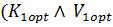 )
)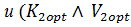 ) which is based on information received from key local elements
 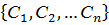 of every ship allows you to
obtain the global coordinating effects for collision avoidance. The validity of
action to prevent collision will be limited to the features of the ship itself,
technological limitations, prevailing circumstances and conditions.
of every ship allows you to
obtain the global coordinating effects for collision avoidance. The validity of
action to prevent collision will be limited to the features of the ship itself,
technological limitations, prevailing circumstances and conditions.
The general task can be formulated as follows: given a
fixed values and uncontrollable factors 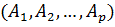 , stochastic uncontrollable factors
 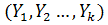 and fuzzy uncontrolled factors
 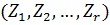 find the controlled factors
  belonging to the areas of their
valid values
belonging to the areas of their
valid values  which possibly could at maximum
criterion
which possibly could at maximum
criterion  in accordance with the COLREG’s
  Since the criterion
  is quantitative measure of the
achievement of the HSPC goal then mathematically it is expressed in the maximum
possible increase in the value criterion, i.e.
is quantitative measure of the
achievement of the HSPC goal then mathematically it is expressed in the maximum
possible increase in the value criterion, i.e.
|
|
(1) |


In fact the HSPC
is a complex of hierarchical, multilevel systems. Figure 1 shows the HSPC
coordinating with use of the principle of forecasting of interactions. The
Global parent control system shows as the Global coordinator  . Two vessels are controlled by the Local coordinators
  and the Subordinate local
systems by first ship (
and the Subordinate local
systems by first ship ( and by the second ship (
 .
.


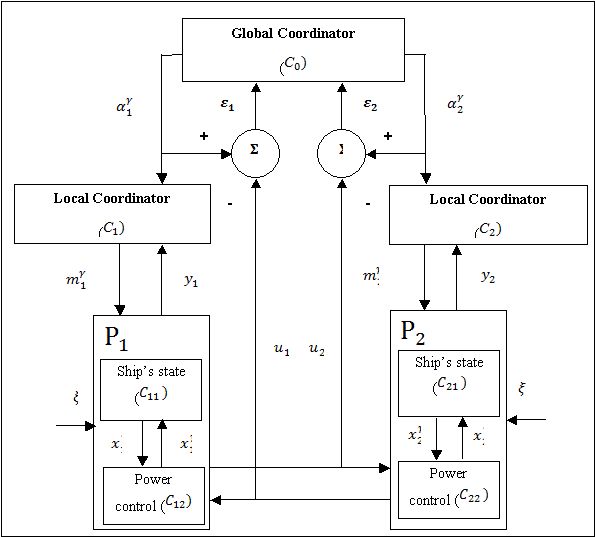

Figure 1 – Coordinating
with use of the principle of forecasting of interactions
In the
illustration there are the following types of signals. The first type
"command" signals are (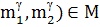 from the Local coordinators
  and Environment signal
 connected to CAP’s (
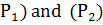 accordingly. There are decision signals from the Subordinate local systems
  ) and
) and  ) from
(
) from
( and (
and ( .
.
The role of ( is the ship control operators. The
signals are belonging from them have controlling effects (outputs), while
signals from the Coordinator
is the ship control operators. The
signals are belonging from them have controlling effects (outputs), while
signals from the Coordinator  to the Local Coordinators
 are called coordinating inputs
 . Generally the environment influences to the CAP’s and finally produces
a control signal (
. Generally the environment influences to the CAP’s and finally produces
a control signal ( .
.
Another kind of
vertical signals is a transfer of feedback information signals 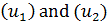 whose task is recognition error
(ε).
whose task is recognition error
(ε).
In order to find
the best decision can be used according to the paper [1] the "principle of
prediction of interactions”. Then the selected coordinating signal (γ) may be represented as:
|
|
(2) |

where:
 - predicted connecting signal;
 – the actual connecting signal appears when a control action is
  ;
;
 - decision by local elements (
 and (
and ( .
.
The best decision
is the task of choice 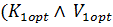 )
) ) in a feedback chain with
resolving of errors
) in a feedback chain with
resolving of errors  . The resulting value of errors
  based on certain predefined
parameters can be considered as transition from its original state
characterized by the set of input parameters to goal state which is effected by
transferring of certain information for inputs (
based on certain predefined
parameters can be considered as transition from its original state
characterized by the set of input parameters to goal state which is effected by
transferring of certain information for inputs ( and (
and ( .
.
When
searching for the best decision to preventing collisions based on the above
mentioned two types of solutions there are two interrelated tasks coordination:
global and local. Global task (meta control) is the task of making the best decision
for preventing collisions in accordance with COLREG’s rules of maneuvering and
the Local task (power control) would
be the best solution to combine technical, technological, etc. tasks performed
by the local elements of the vessels.
New coordinating
signal  can be obtained using a suitable
transformation of
can be obtained using a suitable
transformation of  to error (ε):
|
|
(3) |

The decision on the level of local tasks will be
coordinated on a global task any time whenever they coordinated on a global
task (task of preventing collisions). If the global and local tasks are
compatible the global goal is achieved when the Global coordinator  coordinates by the power controls of the Local coordinators
  in relation to the global best
decision task according to the formula (1) on the principles of coherence
subsystems [1].
in relation to the global best
decision task according to the formula (1) on the principles of coherence
subsystems [1].
Let
mark through the global task of best decision
which reflects the global goal of the HSPC and specified by pairs (
the global task of best decision
which reflects the global goal of the HSPC and specified by pairs ( . Where
  is the goal function as per
formula (4),
is the goal function as per
formula (4),  is the power control actions and
 is local function of quality:
|
where:
|
(4) (5) |






In equation (5)
shows the relationship between global and local tasks. In practice
implementation of the decision by the formula (5) local function of quality  plays a major role in CAP. Local
tasks have an important influence on the ship’s actions coherence and
feasibility of COLREG’s.
plays a major role in CAP. Local
tasks have an important influence on the ship’s actions coherence and
feasibility of COLREG’s.
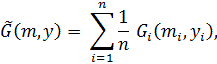
To assess the CAP
control you can enter the quality (G) function. The Global coordinator is to maximize
quality functions (G) with the
simultaneous variation of power control actions  CAP is a coordinated process if
global quality function (G)
coordinated with the local function
CAP is a coordinated process if
global quality function (G)
coordinated with the local function  by means of the best power
control actions (
by means of the best power
control actions ( (
( . Then for any global quality function (G) you can always find local functions
 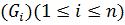 ,
, 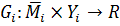 such that
  agreed with (G):
|
where:
|
(6) |


Let's look at a few examples. If you need extra
reverse from full ahead to full astern sometimes such order is dangerous for
the diesel engine and should be avoided. "Crash stop astern" could
result the engine room in a fire and “vessel not under command”. The inability
of the i - local element to define
completely implementing value is due to the construction of the main
engine and design of other local elements (start / reverse mechanism). Apriori
value
is due to the construction of the main
engine and design of other local elements (start / reverse mechanism). Apriori
value  и
и  for vessels with diesel engines
has shown that the best decision for preventing collisions on local-level
element (main engine) is the lack of reverse on established operating mode.
Based on this condition each coordinating signal γ,
γ
∈ Γ
determines the tasks to be solved at the level of local
elements (oil pressure, exhaust gas temperature, the temperature of the cooling
water, etc.). The local best decision (speed maneuver) with the diesel engine
is when an element
for vessels with diesel engines
has shown that the best decision for preventing collisions on local-level
element (main engine) is the lack of reverse on established operating mode.
Based on this condition each coordinating signal γ,
γ
∈ Γ
determines the tasks to be solved at the level of local
elements (oil pressure, exhaust gas temperature, the temperature of the cooling
water, etc.). The local best decision (speed maneuver) with the diesel engine
is when an element  of the main engine valid modes
  such that
|
where: |
(7) |
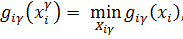


 element (the main engine) will
be called the γ-best local decision for the prevention of collisions. When for
collision avoidance the steering gear is used “any alteration of course to
avoid collision shall, if the circumstances of the case admit, be large” and “a
succession of small alterations of course should be avoided”. Hence the best
local task vessel’s steering gear control (course maneuver) is when an element
element (the main engine) will
be called the γ-best local decision for the prevention of collisions. When for
collision avoidance the steering gear is used “any alteration of course to
avoid collision shall, if the circumstances of the case admit, be large” and “a
succession of small alterations of course should be avoided”. Hence the best
local task vessel’s steering gear control (course maneuver) is when an element  of the valid rudder puts
  such that
|
where: |
(8) |



In the example the solution of the Global task  for collision avoidance are such
valid control actions
for collision avoidance are such
valid control actions  that
that
|
|
(9) |

where:
 - best of power action;
 - best power effect by the
engine and steering gear respectively;
- best power effect by the
engine and steering gear respectively;
 is the Cartesian product of CAP’s elements per vessel, i.e.
  - set of acceptable control actions by the main engine with given its
limitations,
- set of acceptable control actions by the main engine with given its
limitations,  - set of acceptable control actions by the steering gear bearing in mind
its limitations.
- set of acceptable control actions by the steering gear bearing in mind
its limitations.
In general the control permissibility of each
ship has a different nature and can be called by limitations of the ship itself
and the restrictions imposed by any special circumstances. The power control
actions  will be known as the best local
control actions, i.e. power control actions which relocate the ship to a safe
state in accordance with the Global goal function
will be known as the best local
control actions, i.e. power control actions which relocate the ship to a safe
state in accordance with the Global goal function  .
.
Comparing ( even in the above simplified
conditions, the coherence necessary between the elements at both global and
local-level coordination. The principle of prediction will execute only when
the best decision is achieved through local action if the predicted actions are
implemented in accordance with COLREG-72:
even in the above simplified
conditions, the coherence necessary between the elements at both global and
local-level coordination. The principle of prediction will execute only when
the best decision is achieved through local action if the predicted actions are
implemented in accordance with COLREG-72:
|
where: |
(10) |



The applicability
of the COLREG’s prediction principles are useless if the ships begin to violate
the COLREG-72. The principles of coordination deal with this problem by
introducing the force elements in the global and local levels of the HSPC. That
is a necessary and sufficient condition for coordination on the basis of the
cooperation principles between the ships without modifying the forecasting
purposes  .
.
Literature. 1
Mesarovic M. D. Mako, I. Tahakara “Theory of hierarchical, multilevel, systems”, Moscow, Mir, 1973.