Медицина/ 1. Акушерство и гинекология
Medieva S.K., Murzintseva T.V. (senior teachers), Esimhanova A. (student of group 2-001 PM), Otesh I.,
Shayahanova N. (students of group 2-043
GM)
Karaganda State Medical University
Cancer of the
uterus
Cancer is becoming an important public health problem in Asian countries
with aging of populations and changes in lifestyles associated with economic
development. Today cancer is the third leading cause of premature death in
Kazakhstan. Every year approximately thirty thousand Kazakhstani people are
diagnosed with cancer. This underlines the necessity on raising general
awareness of the scope of the cancer problem in Kazakhstan. This article concerns uterus cancer
in Karaganda region.
Cancer of the uterus (or
womb) is a common cancer that affects the female reproductive system. It is
also called uterine cancer and endometrial cancer.
It is the fourth most common cancer that affects women after breast cancer, skin cancer and cancer of the colon and rectum. Womb cancer is
more common in women who have been through the menopause, and most
cases are diagnosed in women aged from 20 up to 60.
Nearly of cancers of the uterus start in the endometrium and are called endometrial carcinomas. Cancers can also
start in the muscle layer or supporting connective tissue of the uterus. These
cancers belong to the group of cancers called carcenomas.
Based on clinical and diagnostic
evidence, endometrial cancer is staged as follows: stage I, cancer is confined
to the body of the uterus (corpus); stage II, cancer has reached the cervix but
not the lymph nodes or distant sites; stage III, cancer has spread outside the
uterus and possibly to nearby lymph nodes but remains in the pelvic area and
has not spread to distant sites; and stage IV, cancer has metastasized to the
lymphatic system and distant organs.
It is not clear exactly what causes womb cancer, but certain things can
increase the risk of developing the condition:
·
Conditions that increase the risk of
developing uterine cancer include those associated with increased estrogen
exposure, such as early menarche, late menopause, never having been pregnant, early pregnancy, large number of sexual
partners, venereal diseases, infertility, HPV, HIV. Additional
risk factors include age, family history of uterine cancer, history of breast or ovarian
cancer, diabetes, hypertension, and endometrial hyperplasia (an abnormal increase in the number of
cells lining the uterus).
·
Obesity and related
conditions. The body makes some of its estrogen in fatty tissue. That's why
obese women are more likely than thin women to have higher levels of estrogen
in their bodies. High levels of estrogen may be the reason that obese women
have a 9 times increased risk of developing uterine cancer.
·
Some precancerous
states appear to be the risk factors of uterus cancer: erosion, ulcer, hems of
a postnatal trauma, condylomas, polyps, and endometritis.
Uterine cancer symptoms can vary because there are several different types
of uterine cancer that can affect women, such as endometrial cancer and uterine
sarcomas. Endometrial cancer involves the part of the tissue that lines the
uterus, whereas sarcomas are tumors inside the muscle tissue and supporting
structures.
About 90% of patients diagnosed with endometrial cancer have abnormal
vaginal bleeding, such as a change in their periods or bleeding between periods
or after menopause. This symptom can also occur with some non-cancerous
conditions, but it is important to have a doctor look into any irregular
bleeding right away. Non-bloody vaginal discharge may also be a sign of
endometrial cancer. In about 10% of cases, the discharge associated with
endometrial cancer is not bloody.
Pain in the pelvis, feeling a mass (tumor), and losing weight without
trying can also be symptoms of endometrial cancer. These symptoms are more
common in later stages of the disease. Still, any delay in seeking medical help
may allow the disease to progress even further. This lowers the odds for
successful treatment.
A woman should see her doctor if she has any of the following symptoms:
·
unusual
vaginal bleeding or discharge
·
difficult or painful urination
·
pain in the
pelvic area
·
periods that
are heavy and prolonged
·
heavy
spotting that occurs between periods
·
more than
one period in a cycle month
·
vaginal
bleeding that occurs before and/or after sex
·
vaginal
bleeding in women who are post-menopausal
Incidence of uterus cancer in
Karaganda region
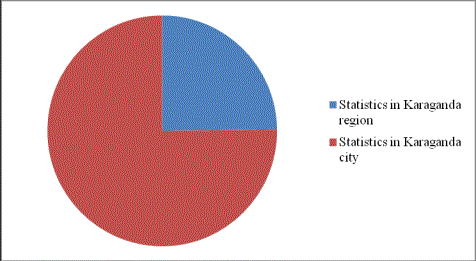
Uterus cancer incidence is related to age, although it does not follow
the same pattern of increasing incidence with age as is seen in most cancers.
Age-specific incidence rates rise sharply from around age 20-40, and
subsequently decline steadily. Reproductive and hormonal factors are thought to
be the main cause of uterine cancer.
Age-specific uterus cancer incidence among women 15-55
years of age in Kazakhstan
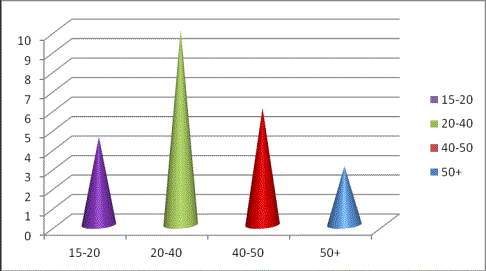
Statistics according to age
|
Patients’ age |
||||||||||||||
|
Tumor localization |
0-24 |
25-29 |
30-34 |
35-39 |
40-44 |
45-49 |
50-54 |
55-59 |
60-64 |
65-69 |
70-74 |
75-79 |
80-84 |
85+ |
|
Cervix uteri |
|
1 |
8 |
20 |
14 |
17 |
20 |
14 |
13 |
10 |
10 |
3 |
1 |
1 |
|
Uterine body |
|
2 |
|
7 |
5 |
9 |
12 |
21 |
40 |
18 |
20 |
15 |
4 |
1 |
All women are at risk for uterus cancer, but the risk
increases with age. In Karaganda region, about 100-150 new cases of womb
cancer are diagnosed each year. Uterus cancer is more common in women aged
20-40.
Cancer is largely a preventable illness. Two-thirds of cancer deaths can
be linked to tobacco and drug use, poor diet, obesity, early sexual relations,
abortions and lack of exercise. All of these factors can be modified.
Nevertheless, an awareness of the opportunity to prevent cancer through changes
in lifestyle is still under-appreciated.
Decreasing body weight and reducing exposure to estrogen may decrease
the risk of developing uterine cancer. High fruit and vegetable consumption has
been associated with a reduced risk for developing at least 10 different
cancers. Alcohol in combination with tobacco creates an even greater risk of
certain types of cancer. That is why healthy life style is so important for all
the women to decrease the risk of being ill.
Literature:
1. Cancer: prіncіples & practіce of oncology. - 6tһ ed. -
Pһіladelpһіa, Baltіmore, New York : Lіppіncott Wіllіams &
Wіlkіns. A Wolters Kluwer Company, 2001.
2. Jukic S et al. Pathology of the female reproductive system. Zagreb,
AGM; 1995.