Філологічні науки / Етно-, соціо- та психолінгвістика
К.ф.н. Гоца Н.М.
Тернопільський національний педагогічний
університет імені
Володимира Гнатюка
AFRICAN
AMERICAN LANGUAGE VS
AFRICAN
AMERICAN WOMEN’S LANGUAGE: THEORETICAL PREMISES
To
date, linguistic research has focused primarily on men (European and African
American) and European American women. Because of the dearth in research on the
language of African American women, this thesis focuses on African
American women’s language (AAWL) and traces in what way it differs from African
American Language (AAL) in general.
Very
often AAWL is by mistake identified with African American language (AAL) that
can also be called African American Vernacular Language (AAVL), African
American English (AAE), African American (Afro-American) Black English, Black
English Vernacular (BEV), Ebonics, and other. AAL is an object of discussion of many linguists. They debate
about its status in a language system. Some scientists name it as a language,
others – as a dialect. Great influence on AAL reception was made by scientific
literature that studies this branch of linguistics. With the help of these
works the attitude and politics concerning AAE changed. But the drawback of all
these scientific works is that they pay attention not to basic linguistic
phenomena of the Black language, but to the main aspects of linguistic ethnics.
In the frameworks of our investigation we consider AAL as a component of AAWL,
its constituent part and expressive means of its sociocultural aspect.
It
should be mentioned that AAWL can’t be investigated separately from AAL and
women’s language in general, as it undoubtedly combines linguistic features of
both these notions. But, we also admit that AAWL can be called a separate
linguistic phenomenon, as it represents African American feminism that in its
turn reflects combination of gender and sociocultural aspects of African
American women’s life. The other problem that makes this theme urgent is that
at present, AAWL is still largely misunderstood and mispresented not only in
Black male society, but also in White mainstream society.
So, the
aim of our study is to determine some peculiar characteristics of AAL and AAWL
and to show that AAWL can function as a separate linguistic notion.
We
should say that not so many scientists try to investigate thias urgent but
rather contradictory subject of AAWL. The most well-known are Denise Troutman [9],
Sonja L. Lanehart [7], Marcyliena Morgan [8].
Much more investigations are dedicated to social, historical, psychological, methodological
and less to linguistic peculiarities of AAE. To such researchers belongs J. A
Fishman [4], R. Burling [2], R. Fasold [3], J. Haskins [5], R. H.
Bentley [1], C. Kramasch [6], J. F. Trimmer
[9], and others.
Marcyliena Morgan asserts that first steps in studying AAWL can be
traced in famous “Language and Woman’s Place”
written by Robin Lakoff. Although Lakoff’s focus was on her own language and
that of her peers, this work is a matter of particular importance for African
American women’s discourse as it displays how the field of linguistics can be
changed through the raising of urgently needed questions that are both
particular and universal. In this way it determines a structure from which to
move African American women to the very core of language and gender studies [8,
p. 253].
Denise
Troutman also made great contribution to this theme. She has found some
peculiarities of AAWL similar to European American women’s language. This
scholar distinguished the main problems AAWL faces with. The first problem is
connected with “Black men’s speech”, the second – with “White women’s speech”. She
admits that given the dominant paradigm in research in women’s language in
which White women are privileged and Black women are silenced, one might assume
there is a place for African American women in research on AAE. She says that
however, there is a little research in AAE that corrects or redresses the
absence of the discourse of African American women since research in AAE
privileges African American men. As a result, Black speech style is not viewed
as available to or indicative of African American women. A perception of
African American speech are synonymous with African American men (just as it is
seen as synonymous with White women’s language in the literature on women’s
language) and leaves little or no room for actual voices of African American
women [10, p. 212].
Even
nowadays AAWL is contrasted with AAE and White women’s speech as the following linguistic
stereotypes exist: 1) Black speech – male speech; 2) Black speech – verbally
aggressive; 3) Black speech – implicitly, sexually aggressive speech; 4) Black
speech allows Black women to speak only like men, in verbally and sexually
aggressive way; 5) Black women have only one linguistic choice (to avoid being verbally
and sexually aggressive); 6) Women’s speech is White women’s speech, therefore,
Black women’s speech is White women’s speech [10, p. 212-213].
Scientist
Sonja L. Lanehart also pays great attention to AAWL. But within the frameworks
of her investigations one can notice differences within AAWL itself. Making
comparisons among use of language, S. L. Lanehart demonstrates how differences
in age, education and social status lead to various abilities in using AAWL
language.
Interconnections
between notions discussed in the investigation can be organised in the
scheme:
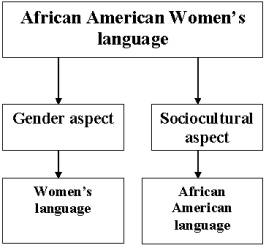
So,
AAWL is two-dimensional phenomenon. It combines two main linguistic tendencies
– sociocultural and gender. Women’s language and African American language are
that very aspects that form such linguistic product as African American Women’s
language in particular.
Література
1.
Bentley R.
H. Black Language Reader / R. H. Bentley, S. D. Crawford. – Scott, Foresman and
Company, 1973. – 245 p.
2.
Burling R.
English in Black and White / R. Burling. – HOLT, RINEHART AND WINSTON, INC,
1973. – 178 p.
3.
Fasold R.
Some Linguistic Features of Negro Dialect / Ralph Fasold // Black American
English : its Background and its usage in the schools and in
literature / edited and introduced by
Paul Stoller. – A Delta Original, 1975. – P. 49–83.
4.
Fishman J.
A. Language and Ethnic Identity / Joshua A. Fishman. – Oxford : Oxford
University Press, 1999. – 468 p.
5.
Haskins J.
The Psychology of Black Language / H. Butts, J. Haskins. – Barnes & Noble
Books, 1973. – 95 p.
6.
Kramasch C.
Language and Culture / Claire Kramasch. – Oxford : Oxford University Press,
2000. – 134 p.
7.
Lanehart Sonja L. Sista, Speak!:
Black Women Kinfolk Talk about Language and Literacy / Sonja L. Lanehart.
– University of
Texas Press, 2002. – 252 p.
8.
Morgan M. “I’m Every Woman”: Black
Women’s (Dis)placement in Women’s language study / Marcyliena Morgan // Language
and Woman’s Place: Text and Commentaries / ed. by Mary Bucholtz. – Oxford University Press, 2004. – 320 p.
9.
Trimmer J.
F. Black-American Literature: Notes on the Problem of Definition / J. F.
Trimmer. – Ball State
Monograph Number Twenty-Two, 1971. – 28 p.
10.
Troutman, Denise. African American women: Talking that
talk / Denise Troutman // Sociocultural and Historical Contexts of African
American English / ed. by Sonja L. Lanehart. – John Benjamins Publishing,
2001. – 371p.