Медицинские науки/ 1. Акушерство и
гинекология
Medical sciences / 1. Obstetrics
and Gynecology
PhD of Medical Science,
A.P., Syusyuka V.G.,
State
Medical University of Zaporozhye
ESTIMATION OF TEMPERAMENT TYPES
of PREGNANT WOMEN AND THEIR CONNECTION WITH ANXIETY
Certain level of anxiety is required for effective adaptation to reality. State of the pregnant woman can have
significant influence on features of the prenate psychological functions which
are being formed and therefore it can considerably determine his life scenario
[2].
According to the scale “neuroticism – emotional stability” anxiety is one
of the measuring parameters of the person which reflect individual reaction on
stress [8]. During short-term presentation subclinical anxiety levels work as
adaptive factors due to psychogogic and general-activating effect which realizes in result of
associated symptomatic adrenal activation. Prolongation of the period subclinical
anxiety state results into fixation and exhaustion of normative modus of psycho-vegetative activation and its change for pathologic one. Analysis of anxiety under
the scale “neuroticism – emotional stability” permits to
determine individual retention of subclinical anxiety levels in case of routine
stress. Estimation of these parameters
is possible due to EPQ questionnaire of H.J. Eysenck. It permits to estimate such psychic properties as neuropsychic lability, extraversion and psychoticism. Also it is possible to derive available
personal features such as emotional-conative stability and belonging to
classical types of temperaments [3, 4, 6].
Object of research: estimate temperament
types of pregnant women and their connection with trait and state anxiety.
Examined group and
methods of research.
392 Pregnant women were examined in ІІ and ІІІ trimesters.
Individual and psychological features of pregnant women and their
psychoemotional state were studied using the complex of psychodiagnostic
methods: Personality Questionnaire of Bekhterev University, Spielberger-Hanin
scale, questionnaire Eysenck EPQ [1, 4, 5, 6, 7]. Variation and statistical processing of results was
performed with STATISTICA 6.0 analysis programs.
Results of researches and
their discussion.
According
to Eysenck Circle, among the main temperament
types, conformity to sanguine
type was found more frequently and was determined in 139 examined pregnant women: it made 35.46 %. Choleric temperament was determined in 94 (23.98 %), melancholic – in 88 (22.45 %) pregnant women and phlegmatic type was determined in 71 (18.11 %) pregnant women (Fig. 1).
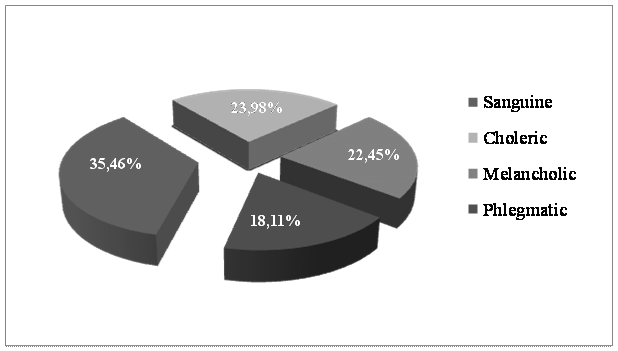 Fig. 1. Temperament
types of pregnant.
Fig. 1. Temperament
types of pregnant.
During estimation of questioning results
by means of Eysenck EPQ, taking into account anxiety
level, there was found that index of neuroticism increased statistically and reliably (р < 0.05) to the level of both trait anxiety (TA) and state anxiety (SA). Above mentioned results are confirmed by
available positive correlation of neuroticism with SA level (r = +0.347, p < 0.05) and more significant correlation with TA
level (r = +0.666, p < 0.05).
Conclusions.
According to results of
performed research the statistically reliable (р > 0.05) difference was determined both under the TA level
and SA level among pregnant women which temperament type corresponded to sanguine
comparing to choleric and melancholic types; and also which corresponded to
phlegmatic type comparing to choleric and melancholic. Comparing sanguine persons to phlegmatic
ones and choleric persons to melancholic ones there was found statistically
reliable (р > 0.05) difference only under TA level.
Literature.
1. Astakhov
V.M., Batsyleva I.V., Puz' I.V. (2010) Psychodiagnostic methods individual
psychological characteristics of women in obstetric and gynecological clinic.
Donetsk: Nord-Press, 199.
2. Dobryakov I.V. Perinatal'naya psikhologiya (2009). Saint Petersburg:
Piter, 234p.
3. Karelin A.A. Encyclopedia of psychological tests (2007). – Moscow: Jeksmo, 416p.
4. Malkina-Pyh I.G. Psihosomatika (2010). Moscow: Jeksm, 1024р.
5. Mendelevich
V.D. Clinical and Health psychology (2008). Moscow: MEDpress-inform, 432p.
6.
Mironova E.E. Collection of psychological tests. Part I. (2005) – Minsk.: Zhenskij
institut JeNVILA, 155p.
7. Rajgorodskij D.Ja. Practical psychodiagnosis (2002). Samara: «Bahrah-M»,
672р.
8. Subbotina L.Ju. Psychological protection and stress (2013). – Kharkiv:
«Gumanitarnyj Centr», 300p.