K.A. Semenov (Candidate of Medical Sciences), D.K. Semenov
The State Establishment “
of the Ministry of Health of
Department of Dentistry, Faculty of Postgraduate
Education PYROMETRIC MEASUREMENTS OF
WORK OF THE MASTICATORY MUSCLES
Abstract
On the basis of pyrometric
study and analysis of the obtained results, individual features of functioning
of the dentoalveolar
apparatus were identified. The risk group included children with a maximum difference in the average value of
pyrometric indicators of chewing muscles at the left and right sides. The
revealed difference of indicators proved the disorder in the relationships of
teeth in upper and lower jaws. This study was a
method of express diagnostics of individual features in the work of the
muscular component of dentoalveolar apparatus.
Keywords: pyrometer, pyrometry, dentoalveolar apparatus, 15-16
year old children.
Emotional, physical tension and occlusive disharmony
are the main causes of disorders in the functional balance of the masticatory
apparatus and adaptive ability of the body. As a result, there occur such
clinical symptoms as pain, tension and fatigue of the muscles, snapping and
limited motility in the area of temporomandibular joints, painful symptoms in
the ear area, abrasion and decay of the teeth as well as significant pressure
on periodontium [1, 2, 3, 4].
The weak link and the most common cause of disorders of
the functional balance within the structures of the temporomandibular joint are
teeth, dentitions and neuromuscular apparatus.
The main guarantor of the functional balance in the
dentoalveolar apparatus is the optimal contact between teeth in the dentition, and,
to a large extent, genetically predetermined, psycho-emotional factors of an
individual [1, 3, 4, 6].
Motility of the lower jaw is controlled by chewing
muscles, which can be overloaded due to the
uneven distribution of the chewing pressure within
the jaw in cases of disorders of occlusal relationships between the teeth of
the upper and lower jaws. This will cause forming of a certain stereotype of
chewing food and closure of the teeth in the dentition, which will lead to
microtraumas of the elements of the temporomandibular joint and its functional
disorders.
The purpose of our work was to conduct
express diagnostics for the identification of individual features in the work of the dentoalveolar apparatus,
based on pyrometric measurements of masticatory muscles and
their comparative analysis.
In order to achieve the
purpose of research the following tasks were set:
1.
To
carry out temperature measurements of work of the masticatory muscles of senior
school age children with the help of a pyrometer.
2.
To
perform a comparative analysis of pyrometric indicators in the study groups.
3.
To
detect individual features of work of the dentoalveolar apparatus, according to
the results of the pyrometric study.
Temperature measurements of different
bodies by contact method are carried out with the help of thermometers. A
conventional mercury thermometer can be found in the medicine cabinet of each
family; expansion thermometers (conductometric thermometer), are actively used
in industry. However, today, there is already a fundamentally new method of
non-contact temperature measurement of different bodies, called pyrometry, conducted
by means of the device called pyrometer.
Pyrometer – is s device
intended for measuring the temperature of almost any body by a non-contact
method at a distance (most often, up to three meters).
Accordingly, pyrometry – is a group, or
a sum of techniques and methods used for obtaining information about the
temperature of heated bodies at a distance. The work of pyrometer is based on
the principle of perception of electromagnetic beams (energy), radiated by any
physical body, wherein the intensity and radiation spectrum of this energy is
direct dependent on the temperature of such physical body.
The first pyrometer was invented in 1731 by
Pieter van Musschenbroek, a Dutch scientist who made a pyrometer to carry out
his experiments on thermal expansion of solids. It was far from the pyrometer, which
we are used to see, however, the very fact of constructing such a device is a
real discovery.
The very term “pyrometry” appeared in the early 20th
century, but an impetus to the development of pyrometry happened only in the
1960’s. It was at that time that they conducted the experiments and made the
discoveries, that made it possible to produce portable pyrometers with high
consumer characteristics on an industrial scale.
The first
portable pyrometer was developed in the bowels of the company Wahl in 1967.
Since then, pyrometers have been improved, and today, thanks to the modern
principles of constructing comparison parallels, when body temperature is
measured based on the received data from infrared receiver, the limits, within
which the temperatures of solid and liquid bodies are measured, are
significantly expanded.
Scopes of application
of this device also expand. In particular, pyrometers can be used in medicine. It is well-known that throughout the world all bodies emit
electromagnetic waves, which, depending on their temperature, are transformed
into heat. The thermal energy and, consequently, the characteristics of the
radiation wavelength, directly depend on the temperature of a body, from which
radiation is emitted. This radiation can be measured and thereby measure body
temperature at a distance without the need for any direct contact. The
mechanism of work of such thermometer is very simple: a sensor located within
the device, reads infrared radiation data of the object, and then converts them
into the usual temperature indicators that we are used to.
Advantages
of pyrometers:
1. It is easy and
simple to use.
2. The ability to
measure temperature at a distance. Often it can exceed
3. Measuring time –
you get the result instantly.
Rules
for using a medical pyrometer:
1.
Carefully read and
follow the manual.
2.
Measurements should be done at 1 minute
intervals.
3.
Two consecutive measurements may yield
slightly different results. In this case, average values should be used (see Fig.
1).
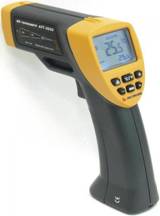
Fig. 1 Pyrometer
The motility of the lower
jaw depends on the well-coordinated work of masticatory muscles, as well as the
positioning of teeth within the dentition and their interrelationships at
closure. When food enters the oral cavity the chewing process takes place on
the side with a bigger number of contacts between antagonist teeth, i.e. at
this moment the teeth work like a press. Where there are point contacts between
antagonist teeth, a piece of food is simply held, and the main chewing load
falls on the opposite side that has a larger number of occlusal contacts. Thus,
over time, a unilateral act of chewing gets formed, and the chewing muscle
hypertrophies. Increase in the volume of the masticatory muscle on one side will
indicate an uneven distribution of chewing load in the dentition, which in turn
will lead to functional disorders of the moving section of the masticatory
apparatus.
There is a certain dependence of a chronic overload of
the muscle group in cases of constrained unilateral chewing, malocclusion,
partial secondary adentium and long period of eruption of wisdom teeth. As a
result, muscle hypertrophy occurs in the working side, which causes persistent
dysfunction of the temporomandibular joint.
Hypertrophied muscle releases more energy, than a
muscle working in a synchronous two-sided mode. This fact became a basis of our
pyrometric measurements, as a method of express diagnostics of the masticatory
muscles.
Material and methods of research
Pyrometric
measurements of twenty 15-16 year old schoolchildren studying in senior classes
were carried out. The children were divided into two groups: the first group
consisted of 10 young boys, and the second group consisted of 10 young girls. Pyrometric
measurements of masticatory muscles at certain points were taken from all of
them. The first point “A” is the area of upper attachment of the masticatory
muscle. It was located one centimeter anterior from the base of the ear tragus.
The second point “B” is the area of the lower distal attachment of the
masticatory muscle (corner of the lower jaw); the point “C” is the area of
anterior edge of the masticatory muscle, which is determined when the teeth are
closed. The point “D” is the midpoint on the protruding surface of the
masticatory muscle with closed teeth. The pyrometer was located at a distance
of
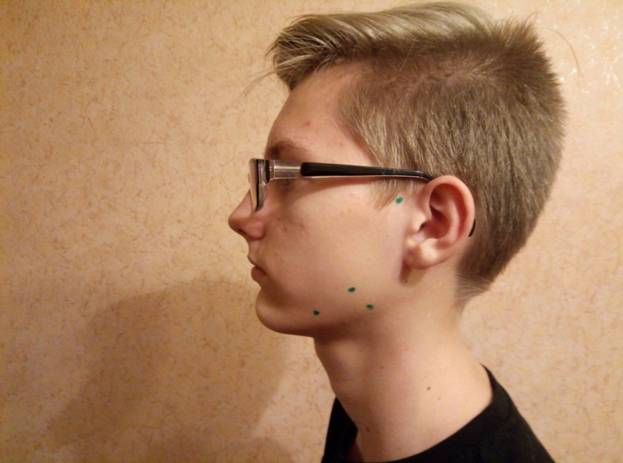
Fig.
3 Measuring
points in the pyrometric study
The
obtained indicators for each side were summed up and the average value of each
student individually and each group separately were calculated.
Statistical
processing of research results was performed as well.
Results and discussion
When comparing the average
values of pyrometric study of masticatory muscles, the readings with
discrepancies between the left and right sides measured as ≥ 1, were
allocated.
A group of schoolchildren
with discrepancies between the left and right sides measured as ≥ 1, included
6 persons, which constituted 30 of all examined people. At the same time, 20%
were boys and 10% were girls.
Discrepancy between the
sides revealed prevalence of a unilateral act of chewing, which in turn is
associated with individual characteristics of the structure of dentition of the
upper and lower jaws. At the same disorder of occlusal relationships between
the teeth of the upper and lower jaws will result in unilateral hypertrophy of
the masticatory muscle, and also can cause changes in the work of the
temporomandibular joint. The schoolchildren with a discrepancy in the average
values of pyrometric indicators ≥ 1 require consultations by a dentist.
Average values of pyrometric
indications of masticatory muscles of the young men and women were 34.3°С and
32.7 °С accordingly. Average temperature reading for boys was 1.6° С higher
than for girls (see Fig. 4).
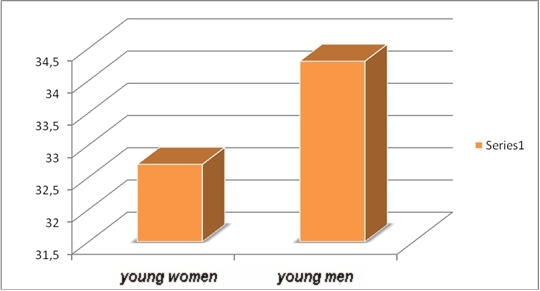
Fig. 4 Average values of
pyrometric study for young men and women.
Pyrometric studies of the
left and right masticatory muscles Allowed determining the difference in
temperatures, which constituted a method of express diagnostics of the
functional features of work of the dentoalveolar apparatuses of senior
schoolchildren.
The advantages of the
pyrometric study are that the method is contactless, sufficiently informative
and easy to use.
Conclusions
1. Based on temperature
measurements performed on the
left-sided and right-sided masticatory muscles of the senior schoolchildren the following values were obtained: 34.3°С for
young men and 32.7 °С for young women accordingly.
2. Comparative analysis of
average values of the pyrometric studies of left-sided and right-sided masticatory muscles allowed to identify a group of
schoolchildren with a discrepancy of temperature indicators ≥ 1.
3. According to the results of
the pyrometric study a risk group that requires additional consultations from a
dentist was defined. This group included 30% of the examined persons: 20% were
young men and 10% were young women.
List
of used references
1. Gross M. D.
Normalization of occlusion / M.D. Gross, J. D. Matthews. – M.: Medicine. –
1986. – 286p.
2. Korzh N. A.
Osteoarthrosis / Korzh N. A., Khvysiuk А. N., Dedukh N. V. – Kharkiv: Golden
Pages. – 2007. – 424 p.
3. Kleinrock M. Functional disorders in the moving parts
of the chewing apparatus / M. Kleinrock. – Lviv: “GalDent”. – 2015. – 256 p.
4. Ralph E. Dentistry of children and adolescents / E.
Ralph, McDonald, David R. Avery. – М.: Medical Dental Agency. – 2003. – 766 p.
5. Robustova T.G. Surgical
dentistry / T. G. Robustova. - М.: Medicine. – 1996. - 688p.
6. Timofeev A. A. Manual on maxillofacial surgery and
surgical dentistry / Timofeev A. A. – Kyiv: LLC “Chervona Ruta-Tours”. – 2004.
– 1062 p.: ill.
7. Timofeev O. O. Maxillofacial Surgery: [textbook] /
Timofeev O. O. – К.: The All-Ukrainian specialized publishing “Medicine”. –
2011. – 512p.
8.
Hvatova
V.A. Clinical gnathology / Hvatova V.A. – M.: Medicine.- 2005. – 312p.