Mukanova Ainur
Eurasian National
university named after L.N. Gumilyov, Astana, Kazakhstan
Using of the modern project
techniques at English lessons
This аrticle dеals with implemеnting prоjеct techniques in the teaching
English as a foreign language. The project
technique is an effective innovative technology that considerably increases
level of proficiency in a language material, internal motivation of pupils, and
a unity of all of them in a class, also the general intellectual development of
learners. The effectiveness of using project
techniques in teaching professional English was demonstrated. The main
principles of project teaching, the technology of its adoption in teaching
process, and some kinds of projects used in studying are reviewed. The reason
of using projects was explained. The article showed that the usage of projects in
training at modern school become more and more actual.
Nowadays a foreign language is realized as the factor
of socio-economic, scientific, technical, and cultural progress of our society.
That is why it is impossible to underestimate the meaning of a foreign language
as a general subject which is useful for the development of personal
professional formation. That is why we are always searching of new pedagogic
technologies. Also it is connеcted with the lack of pupіls’ positive mоtivаtion
in lеаrning English, thоugh in gеnеral the society realizеs its impоrtancе.
This fact nowadays could bе еаsily еxplаinеd, if wе think оvеr the some social
problems.
On the one hand, a pupil of the secondary school
understands the importance of getting higher education (otherwise it’s
difficult to be a success in life without it), but on the other hand, he
comprehends the inaccessibility of it for his family. As a rule, a public
school is full of pupils from the usual families of the middle (or even low)
income. Parents are not able to send their children to study abroad or private
institutions even if the child gets higher education free of charge. These
pupils do not see prospects for themselves; they are not interested in learning
a foreign language, as they do not think it could be useful for their career of
a driver, a plumber or a dress-maker etc. Also some pupils could have no
motivation, because they come across a lot of difficulties when learning a new
language and therefore they can’t acquire it properly (because of their
psychological peculiarities: memory, perception, thinking etc.).
Student-centered education, method of co-operation,
method of projects – all these techniques help in a way to solve the problem of
motivation, to inspire the pupils to learn a foreign language, to open their
hidden potential abilities, for them to acquire a new language with enthusiasm,
to make educational process more interesting.
The method of project is widely used all over the
world mainly because it allows to combine all the learners’ knowledge from
different fields to solve one problem, and it also gives the opportunity to put
these knowledge into practice, producing new ideas at the same time.
According to Polat E.S., a method is a didactic
category, a unity of techniques, of operations, aiming to master some field of
practical or theoretical knowledge, or some skill. It’s also a way of
cognition, a way of organization of the process of cognition. So actually, when
we speak about the method of projects, we mean the way of achieving the aim
through the detailed elaboration of the problem [1] .
The project method originates from Pragmatism, the
philosophical movement that appeared in the middle of the 19th century and
promotes action and practical application of knowledge in everyday life [2] .
The implementation of the project method was based on
the following pedagogical principles, expressed by many progressive educators:
a) promotion of manual activity instead of memorization and verbalism, b)
learners’ active participation in the learning process, and c) exploitation of
facts relating to the immediate reality as a source for learning [3]. The
project method is “a natural extension of what is already taking place in
class”, an open learning process, the limits and processes of which are not
strictly defined, which progresses in relation to the specific teaching context
and learners’ needs and interests [4].
The method of projects is based on the idea, which is
the essence of the concept “project” and on its practical direction at the
result, which can be got when solving any important problem. This result can be
seen, realized and put into practice. In order to get this result, it’s
necessary to teach the children to think by themselves; to find and solve
problems, using knowledge from different fields; to foresee the results and
possible consequences of different variants of solving these problems.
The method of projects can be used while teaching
English at any lesson, devoted to any topic, as the choice of topics in the
curriculum was made taking into account its practical value for the students.
That is one of it’s perfect omnitude peculiarity.
But let’s turn to the special character of the foreign
language. Why should we use the method of projects in teaching a foreign
language and in what way should it be done? What problems can be solved with
the help of this technique?
Sure, the each foreign language is an element of
another culture, which acts within its borders. Consequently, we should be
acquainted with the peculiarities of this culture, and of the language
functions it.
In order for the learners to form the communicative
competence and intercultural communication without real language environment,
it’s not enough to fill the lesson with relatively communicative activities,
which allow solving communicative tasks. It’s important to let the pupils
think, solve the problems, which results in appearance of a great number of
thoughts; dwell on possible ways of solving these problems, in order for the
learners to be more attentive to the content of their speech, to make their
attention thought-centered, to make them use the language in its main function
– to form thoughts.
For the pupils to take the language as means of
interaction between different cultures, it’s necessary not only to get them
acquainted with the regional peculiarities of the country of a given language,
but to involve them into an active dialogue between the cultures, for them to
realize practical value of the language, its peculiarities of functioning in a
close-to-life environment.
So, the main idea of project technique in teaching
foreign language is to move the accent from different exercises to real active
process of thinking, which will demand pupils to acquire some linguistic
skills. The method of projects will perfectly help to solve this didactic
problem, to turn the foreign language lessons into a discussion club, where the
students will think over real, interesting, practically valuable and accessible
problems, taking into consideration the cultural peculiarities of the country
and, if possible, working on the base of interaction between cultures.
Any project is based upon some problem. To solve it,
the students need not only bare knowledge of the language, but a large amount
of different subject knowledge, necessary for solving this problem.
Besides, the learners should possess certain
intellectual, creative and communicative skills. The first ones include work
with information, with a text, digesting of information, generalizing, making
conclusions, and work with various references. To form the majority of skills
listed above is an objective of teaching speaking. As for the creative skills,
the psychologists mention the following ones: producing ideas (this skill
demands deep knowledge in different fields), ability to find a lot of variants
of solving a problem, ability to foresee the sequences of their decisions. And
finally, the communicative skills are: ability to hold a discussion, to listen
to and to hear the partner, to stand for the own viewpoint (supported by proper
arguments), to meet half-way, to express oneself precisely [5].
So, in order to use this technique properly, the
students must be got ready and this process should be carried out within the
whole system of school education (not only foreign languages). And it’s not
necessary to make it before working on a project. Such a preliminary activity
should be regular, done systematically, simultaneously with the work on the
project.
The method of projects is the essence of a developing
student-centered approach. Of course, it’s more suitable in the gymnasiums,
working according to the 2nd and 4th models of education. But to tell the truth
it may be applied at any level (even in the primary school) in any model of
education. The main point is the choice of a problem, which will demand certain
linguistic knowledge and skills to be worked through and solved.
The main requirements while using projects:
- Presence of a problem in a research creative plan,
which will demand a complex of knowledge to be solved (for example, examining
the origin of different holidays in English-speaking countries: St. Patrick’s
Day, Thanksgiving Day, Halloween, Christmas, Mother’s Day etc; organization of
different journeys and trips; a problem of family relations; a problem of the
youth and their leisure etc.);
- Practical and theoretical value of the expected
results (for example, a report about the factors, influencing the environment;
a collective issue of a newspaper; a designer’s plan of a house, a park;
lay-out of an apartment etc.);
- Independent activity of the students at the lessons
and the extra-curricular activities (individual, pair, group);
- Putting the content of the project into a precise
structure (pointing out the stages, the results and distribution of the roles);
- Use of research methods: to define a problem, and
the objectives of a research following this problem; to put the results into
shape; to analyse the data; to make conclusions; to correct the mistakes (for
example, the use of such methods as “brainstorm”, “round table”, creative
reports, defense of the projects etc.) [6].
The classification of the common didactic types of the
projects.
First of all, we should clear out the main criteria,
according to which the types of projects are differentiated:
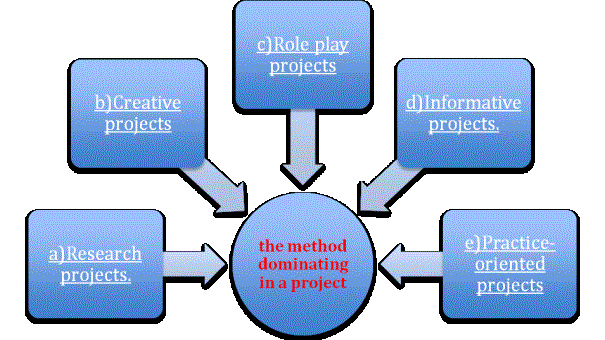
- the activity or the method predominating in the
project (research projects, creative, role play, informative, practice-oriented
projects);
- the subject(s), involved into the project
(monoprojects: within one subject, one field of knowledge; the project, made on
the border of some subjects);
- the character of coordination (open, clear &
vague, imitating the participants);
- the character of the contacts (among the schoolmates,
classmates, the participants from one town, region, country, or different
countries of the world; inner character, regional or international);
- the number of participants (personal, pair or group
projects);
- duration of the project (short-term, middle-term or
long-term projects) [7].
1. According to the method dominating in a project we
may distinguish the following types of projects:
A) The projects of such kind demand a well-planned
structure, clear aims, substantiated actuality of the subject of the research,
precise list of the sources of information, considered methods and results.
They are very close to a real research and have the similar structure. All
these stages should be appropriate to the linguistic level of the pupils,
according to their readiness to participate in such activities.
B) Such projects imply the appropriate design of the
results. As a rule, the structure of the collective activity of the pupils,
elaborating the project, is not worked through in detail. It’s just planned and
develops according to the logic of the process, accepted by the participants.
In this case the expected results and their design should be fixed beforehand
(it may be a newspaper, a composition, a film, acting out, a role play etc.).
The participants may discuss the problems, connected with the plot of any
novel, article, film or with a real-life situation. It may even be a fiction or
a script of a film or a play; a program of a party; a plan of a composition or
an article etc.
C) In the projects of such kind the structure is also
only planned and stays open up to the end of the work. The participants take
certain roles , which can be literary characters or fictional roles, imitating
social or business relations. The participants may also invent some situations
to make the role play more complicated. The results of such projects may be
planned or may appear unexpectedly by the end. The degree of creativity is very
high and the dominating activity is Role Play.
D) The aim of such projects is to collect information
about some object or phenomenon; to introduce it to the participants of the
project; to analyse it; to generalize the facts; to sum up. As well as the
research projects they demand a well-planned structure; and it’s necessary to
have a possibility to make some corrections during the work on the project. The
projects of such kind are often integrated into research projects and can
naturally become their integral part.
E) Their peculiarity is the clear, distinct result,
fixed from the start, which must be directed to the social interests of the
participants (a document based on the results of a research in ecology,
biology, geography, history, literature etc; a program of actions;
recommendation, directed at the abolition of disparities in the Nature, in the
society; the project of the law; some reference; a dictionary etc.). Such a
project demands a considered structure, there should be a script of activity
for all the participants with definite functions of everyone, with precise
results of their activity and everyone’s participation. Coordination is very
important at the stages of discussion, correction, presentation of the project,
putting it into practice and outer evaluation.
2. According to the number of the subjects involved
into the project, there are several types of them:
Monoprojects.
As a rule, they are carried out within the limits of one subject. But then the
most difficult units, the most complicated problems are chosen (for example, in
the course of a foreign language the topics connected with the regional
geography, social studies, history can be taken). But the problem itself
demands philological, linguistic competence, knowledge of
culture. The project of such kind should be properly structured by the lessons;
their aims and objectives should be clearly pointed; we also must not forget
about those skills and knowledge, which are expected to be acquired as a result,
they should also be fixed beforehand.
The work at the lessons should be carefully planned;
the students should be divided into groups (within which the roles are
distributed). Before they start students themselves choose the way in which
they’ll present their work.
Rather often the students continue working on such
projects during their extracurricular activity (individually or in groups).
The projects made on the border of several subjects.
As a rule, they are made at the extracurricular time. They can be of a small
size, dealing with 2-3 subjects, or great long ones, involving the whole
school, aiming to solve any complicated problem, which is important for every
participant (for example, “culture of communication”, at the border of the
centuries” etc).
Such projects must be coordinated by the specialists;
several creative groups are to work in a harmonious unity; they ought to have
clear tasks for a research; their presentations (both intermediate and final)
should be well-worked through.
3. According to the character of coordination we may
distinguish the following types of projects:
The projects with clear, open coordination. Here the
coordinator is the participant of the project, he directs the work
unimportunately, organizes additional stages of the project if necessary, and
plans the activity of every participant (for example, to arrange a meeting in
any official institution, to organize a questionnaire or an interview with
specialists, to collect data for the presentation etc).
Projects with vague coordination. In the projects of
such kind the coordinator is the full member of the project. For example, a
professional geographer, who plays a role of a foreigner. He asks the students
to tell about the geographic peculiarities of different regions.
4. As for the character of the contacts, this
criterion divides the projects into following groups:
Internal, regional projects. They are organized within one school (including one subject or several
ones) or among different schools or grades in a region or in a country.
International projects. Their participants are the
representatives of different countries. Such projects are of great importance,
since to be realized they need some information technologies.
1. By the number of participants the projects can be
also different: personal (between 2 partners from different schools, regions,
countries), pair(between/among the couples of participants) or group projects
(among the groups). And it’s very important to organize group work properly
from the methodical viewpoint (both inside a group of participants, close to
each other and in a group, uniting the members from different schools,
countries etc). The role of a coordinator is especially important in this case.
2. According to the duration of the projects, they can
be short-term (in order to solve one little problem or a part of a more
important problem); middle-term (1 or 2 months) and long-term (up to a year).
As a rule, short-term projects are carried out at the
lessons of one subject (sometimes with the help of knowledge from other
subjects). As for the middle- and long-term projects, they are usually carried
out on the border of several subjects (no matter if they are internal or
international) and are to solve a great important problem or a complex of interconnected
problems. So they may present a complex program. Such projects are usually made
as the extracurricular activity, though their progress may be discussed at the
lessons.
Naturally, in reality we usually deal with combined
types of projects, which may unite the peculiarities of research and creative
projects, or practice-oriented and research ones. Every type has his own way of
coordination, deadlines, stages and number of participants. That’s why, working
on a project we ought to bear in mind its peculiarities and characteristic
features.
Coordination of the projects and organization of the
external evaluation should be emphasized, as it’s well-known, that the best
improvisation is that one, which had been well-prepared. That’s why, if a
teacher decided to use projects while teaching any question of the curriculum,
he is to think everything over thoroughly, to work it out in detail.
We’ve found out that this method is very effective at
the stages of generalization, consolidation and revising of any material, it’s
especially important when realizing the knowledge in practice. The most
significant feature is the influence of the method on the students’ motivation,
since the project techniques let the teacher turn the English language lessons
into a creative research laboratory, where every pupil is involved into an
active creative cognitive process. The pupils develop their speaking and
writing skills, widen their outlook, develop their communicative abilities,
ability to discuss in English. Every child learns to express his thoughts,
opinions and to stand for his viewpoint, to prove it with proper arguments.
Consequently, it was proved that project techniques raise the formation of
foreign competence in the professionally-orientated teaching to a higher level.
References
1. Polat, Y. S. Typology of telecommunicative projects. Science and School, # 4,1997, p. 24-26
2. Frey K. The project method // Thessaloniki, Kyriakidis. (in Greek),
1986, p. 31
3. Crisafidis K. Experiential-communicative teaching. Implementing
the project method in school.// Gutenberg, 2005, p.
4. Stoller F. Project Work: A Means to Promote Language and Content. In
Jack, C. Richards & Willy, A. Renandya (Eds.) // Methodology in Language
Teaching: an anthology of Current Practice (pp.
107-120). Cambridge: Cambridge University Press, 2009
5. Polat, Y. S. Project method at foreign language lessons.// Foreign Languages at School, 3, 2000, p. 16-20.
6. Венедиктова С.Л. Проектированная деятельность учащихся на уроке
немецкого языка // Иностранный язык в школе. №1, 2000 – стр. 11-14.
7. Zimnyaya I. A. Project methodology of teaching English. Foreign
Languages at School,#3, 1997, p. 35-37
8. Fried-Booth D. L. Project work (2nd
ed.). //New York: Oxford University Press, 2002
9.
Richards
J.C. Approaches and Methods in Language Teaching. //New York, 2001
10. Kotti D. Experiential learning from theory to practice. Adult Education 13// Greece, 2008 p.35-41.