Research
supervisor, Ph.D., Sapa Vladimir, student, Assylkhanov Azamat
Kostanay State University A. Baitursynov,
Kazakhstan
The
possibility of using solar dryers in agriculture
One
of the main reasons for the decline of profitability of agricultural industries
in recent years, is to increase the price of fossil fuels - oil, gas, coal,
electricity. Work to reduce energy costs, the development and use of
alternative sources of heat, are now very relevant.
First
of all, reduce energy costs, it is necessary to create processes of climate and
water heating in livestock buildings, greenhouses, cleaning equipment and
milking equipment, when Rearing silkworm cocoon drying and marinating and
others. Therefore, should create the technical means for heating air and water
using solar energy.
Developed
the basic design of electrical installations helio obtained theoretical and
experimental data supporting their effectiveness. Solar systems for heating
water and air (generators solar power) - a container with thermal insulation,
facing south to capture the maximum energy from the sun.
In
agricultural production choices drying method determined by the scale of
production, climatic features of the area, overlooking the material being dried
and the cost of additional energy. The supply of heat to the material from the
drying agent can be by convection or by radiation. Distinguish between
convective and radiative dryers. In convective dryers the product is contacted
with air, heated by solar energy. In radiation dryers product directly
irradiated by the Sun, the temperature in the dryer of this type is 60 ... 75
°C. Can also be used combined dryers. In these involved both types of heat
transfer, but is dominated by convection, and the installation consists of a
heater and the drying chamber with transparent walls.
Natural
drying of agricultural products used everywhere and for a long time. In this
case, the products spread out on the ground, under a canopy suspended or placed
on pallets. When drying in the air unprotected agricultural products have huge
losses due to incomplete drying, pollution as mold, eating birds, insect
damage, acts of precipitation.
The
use of solar installations of the "hot box" increases the drying
efficiency and reduces product loss. Significantly reduces the drying time and
improves the quality of the product, including the preservation of vitamins.
However, the utilization rate helio dryers for agriculture is low. In some
cases, a year may be used only a few weeks. This is not conducive to the
achievement of high economic performance of solar dryers. Currently
economically feasible to use helio dryers for drying hay. The situation is
quite favorable when drying fish.
Solar
drying chamber with forced draft is shown in Figure 1. It includes: the heater,
an oven, a fan.
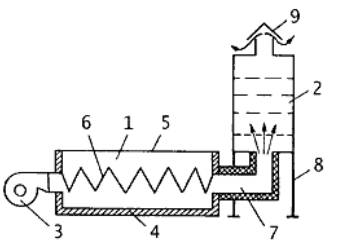
Fig.
4. Chamber solar dryer with a fan and heater corrugated absorber: 1 - heater; 2
- drying chamber; 3 - fan; 4 - insulated housing; 5 - light transparent
insulation; 6 - absorber; 7 - the air; 8 - Bearing; 9 - visor.
In
heat-insulated casing of the heater with a light transparent insulation is
blackened surface absorbs the rays of corrugated metal. Hot air for air ducts
fed into the drying chamber with perforated trays for drying material, which is
mounted on bearings and top covered with a visor.
Energy
consumption during drying of hay using solar energy is less than when using the
dryer on liquid fuel. Flow is approximately equal to the power consumption when
drying air is not preheated. The system is a solar air collector in which the
air temperature rises to 20 °C on a bright sunny day and 1 °C on an overcast
cloudy day. At the same time the humidity of hay is reduced by 5% on a cloudy
day. As a collector of solar energy can be used conventional glazed solar
collector or roof construction itself, which is mounted under the bottom of the
solar collector and a fan blows air.
The
use of solar installations not only replaces scarce fuel, but also prevents
contamination of the environment with harmful emissions using fuel plants. In
remote areas from energy sources solar energy (along with wind energy) is
virtually the only alternative, and can significantly improve the living
conditions.
References:
1.
Yurchenko, A.V.; Savrasov F.W.; Yurchenko V. The real cost of energy - from
resources to consumer // Bulletin of the Tomsk Polytechnic University. - 2009.
- p. 43-46.
2.
Stepanenko, N.I.; Gubin, V.E. Prospects for the use of alternative and
renewable-energy sources in the conditions of Siberia // Modern Techniques and
Technologies: Proceedings of IX Intern. Conf. students, graduate students and
young scientists. - Tomsk, 2003. - T. 1. - P. 47-48.
3.
Lukutin, B.V.; Surzhikova O.A.; Shandarova, E.B. Renewable energy in
decentralized energy supply. - M .: Energoizdat, 2008. - 231 p.