Research
supervisor, Ph.D., Sapa Vladimir, student, Kuttybaev
Serikbolsyn
Kostanay State University A. Baitursynov, Kazakhstan
The
possibility of using solar collectors in agriculture
On
average a year, depending on climatic conditions and latitude, the flow of
solar radiation on the earth's surface is 100 to 250 W / m2, the
peak value reached in the afternoon when the sky is clear, in almost any
(regardless of latitude) location, about 1 000 W / m2.
The
principle of operation of the solar water heater is shown in Fig. 1.
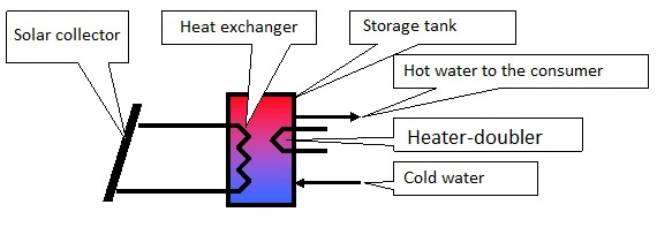
Fig. 1. Diagram of a
year-round solar water heaters.
Year-round
solar water heater (Fig.1) consists of a solar collector and heat
exchanger-accumulator. Through the solar collector circulates coolant
(antifreeze). Heat transfer fluid is heated in the solar collector energy of
the sun and gives then heat the water through a heat exchanger mounted in the
storage tank. In the storage tank hot water is stored until use. He must have
good thermal insulation. In the first loop, where the solar collector can be
used natural or forced circulation of coolant. In the storage tank can be
installed electric or any other automatic. In the case of lowering the
temperature in the storage tank below the (long cloudy weather or a small
number of hours of sunshine in winter) heater-doubler automatically turns on
and heats the water to the desired temperature.
Solar
collector receives radiant energy and transmits this heat the coolant flowing
through the collector. Collectors have a special selective coating surface that
faces the sun. This coating allows you to absorb almost all of the visible and
infrared spectrum of solar radiation. All surfaces of the collector, which are
located in the shadow of a single-layer or two-layer thermal insulation.
Therefore, heat loss through these surfaces are nearly 10 times less than that
supplied from the surface that is aimed at the sun. Modern storage tank also
try to minimize heat loss. Since the selection of the hot water storage tank is
usually carried out from the upper part, to the accumulation tank in this part
with a maximum temperature of water in the tank is set special devices through
which inhibited the maximum vertical height of mixing water tank. Fig. 2 shows
the installation of solar collectors.
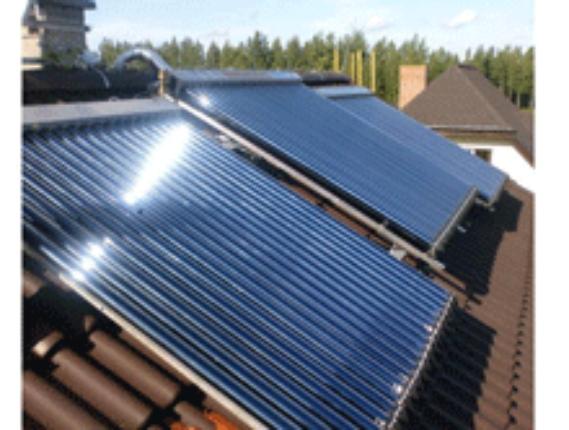
Fig. 2. Solar collectors
on the roof farm
Solar
thermal systems and installations used for hot water and heating in households,
agriculture, low-temperature heating of industrial and household processes,
drying of agricultural products.
Hot
water - the most common form of direct application of solar energy.
Photovoltaic systems can reach 10-15% efficiency, solar thermal systems show
the efficiency of 50-90%. In combination with solid furnaces (with wood)
Domestic hot water demand can be met almost all year round without the use of
fossil fuels.
A
new approach to farming. The use of local renewable energy resources across the
production chain will help to improve access to energy, to diversify the income
of farmers and processing industry, to minimize food waste, reduce dependence
on fossil fuels and greenhouse gas emissions and help achieve sustainable
development goals.
Where
there is good solar, wind, water and geothermal resources and biomass energy,
they can be used as an alternative to fossil fuels in the farm.
References:
1.
Yurchenko, A.V.; Savrasov F.W.; Yurchenko V. The real cost of energy - from
resources to consumer // Bulletin of the Tomsk Polytechnic University. - 2009.
- p. 43-46.
2.
Stepanenko, N.I.; Gubin, V.E. Prospects for the use of alternative and
renewable-energy sources in the conditions of Siberia // Modern Techniques and
Technologies: Proceedings of IX Intern. Conf. students, graduate students and
young scientists. - Tomsk, 2003. - T. 1. - P. 47-48.
3.
Lukutin, B.V.; Surzhikova O.A.; Shandarova, E.B. Renewable energy in
decentralized energy supply. - M .: Energoizdat, 2008. - 231 p.