Ветеринария /1
Lyubov Stepanovna
Kulakova
Kostanay State
University after A. Baitursynov,Kostanay
Diagnostic
and treatment of mastopathy
In science
literature ways of curing mastopathy is very different
In veterinary
“mastopaty” term is controversial, and curing of mastopathy is open question
now. That’s why our researchesis concentrated in surgery treatment of
mastopathy.
Science work was located in “Kostanay State University Veterinary
Clinic” in Kostanay city. Clinical researches, laboratory researches,
mammography, ultrasound and cardiographic examination was completed[8]. Very
important in making diagnosis was cytological researches of mammal gland
tissues, which was taken by biopsy. 20 owners off ill animal agreed on
additional costs. This animals operated by our own methodicThese animals were
observed in one year by veterinarians.
There are some results of our researches. In reception in veterinary
clinic in 2010-2014 years were 175 animals with pathologies of mammal glands.
There are 90 animals with mastopathy (60 cats and 30 dogs), 51,4% of patients
with pathologies of mammal gland.With mammal gland tumors- 32 patients (22 cats
and 12 dogs), 18,3% of patients. First
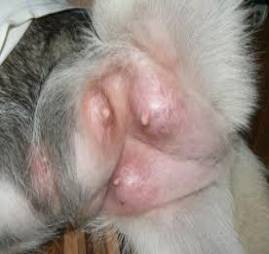
place of mammal gland pathologies occupied by mastopathy (picture 1,2).The
ratio of mastopathy and blastomycotic processes is 2,8:1.
During clinical researches we understood that mastopathy of cats making
them worry: pets was liking affected areas, was lying on cold surfaces. In 5 cases mastopathy started a week ago
estrus, and in case of other 5 cats- after two weeks after estrus. In case of
every dog with masthopathymastopatic links appeared after estrus and
accompanied with pain syndrome.With inspection and palpation we understood,
that mastopathy of pets that younger than one year covers all 5 pairs of mammal
glands in case of dogs, and 4 pairs in case of cats, younger than 3 years – one
pair. In case of pets older than 7 years- 4’th and 5’th pairs of mammal glands.
During the inspection of
affected areas, changes of skin integument were on two cats, othe 8 cats and 10
dogs didn’t have any.9 cats hadn't got mammal gland alocations, and one cat had
little seros allocations. In case of
dogs serosa locations was at 8 cases from 10.Granulation of mammal glands
palpated at 5 cats and 5 dogs.“Lemon pee”l seen at 2 sphinx cats and one
mongrel dog. Venous network strengtheningin mastopatic areas hadn’t place. Pain
with palpation of mammal glands was at 3 cats and 5 dogs. Pets worried, 2 cats
and 1 dog was aggressive and eluded from palpation, 5 cats and 4 dogs “pulled
the paw” at palpated sidesMastopathy links of 20 patients looked like dense
areas with a lot of elastic cystic tumors, bounded from mammal gland tissues.
Pulse was 110-140 beats
in minute. Respiratory rate of 6 cats was 16-20 moves in a minute, of dogs
14-18.
Temperature of 8 cats
was from 38,20 tio 39,0 0С,
of two cats- 37,70 C, in case of dogs-38,60 to 39,2 0С,
Results of laboratory researches showed that in case
of mastopathy, blood metrics is normal. This shows that mastopathyain’t
inflammatory process. Small increases
of leucocytes in group of dogs to13,2-14,7•109/l can be the upper limit of
norm. Analyzing the results of urine inspection, we can say that proteins in
urine can be proteins from genitals.Salts in urine can be explained by
Kostanay’s hard water.
On roentgenogram mastopathy was like loop picture with
a lot of lumens with diameter from 0,3 to 6 centimeters with clear contours.
Results of ultrasound researches showed that mammal gland is linked form of
disgormonal hyperplasia (fibro-cystic mastopathy).
Operation risk in group of cats was: 4-5 points (II
level, expressed) at 5 cats, 6-7 points (III level, big) at 4 cats, 8-9 points
(IV level, high) at 1 cat.Risk in group of dogs was 4-5 points at 3 dogs (II
level expressed), 6-7 points at 7 dogs (III level, big).
During experiments we opened that pets don’t have
other illnesses and contraindications for operation. Pets had hunger diet for
six hours before surgery.The operative field prepared, and used combine
anaestheasia by “Rometar” drug with Kethamin, to 0,15 ml for 1 kg of mass.
After fixation operation started. 1-1,5
cm from middle line of stomach we did slash longer than mastopathic link for
0,2-0,5 cm at both sides.Fixated link and skin with left hand (picture 3).
Fibro-cystotic tumor was separated by blunt way (picture 4). Helping in places of connection with fascia
with lancet or scissors. Masthopathy link was separated before aponeurosis,
diving under mammal gland, and separating all fibro-cystotic tumors. Mastopathy
links have bad connections with subcutaneous tissues, and don’t have vascular,
and easily separate from ambient tissues, operation has very weak bleeding
(picture 5). We used knotted suture.
For preventing pain syndrome five days before surgery at 5 days pets got
katadolon in doses of 20mg/kg two times in a day. Postoperative therapy lasted
7 days. Stitches treated with 5%
iodine, 1 time in a day. Antibiotic treatment lasted before separating stitches
with cephasoline in dose of 0,05g for 1 kg two times in a day. Also we used “Gamavit” 0,1mg/ml one time in
a day.Treatment course was 10 days.Stitches separated at 10th
day.There are was no relapses of illness in one year of control.Mammal glands
worked.This materials can give us that conclusion.
·
Mastopathy is hormonal displazy
bound with ovarian hormones, adrenal
gland, thyroid gland, pituitary gland.
·
For operative treatment of
fibro-cystoticmastopathies we offer our methodic of separating tumors without
mastectomy.
Literature
1
Ричард
А.С., Уайт Р. Онкологические заболевания мелких домашних животных. – М.:
Аквариум, 2003. – 350 с.
2
Зоммер
Р. Лечение опухолей молочных желез. – М.: Аквариум, 2005. – 63 с.
3
Misdorp W. Cancer in small animals.
– Tijdschr. Diergeneesk, 1990. – 395-402 р.
4
Kovacs A., Somogyvari K. Tumours of
domestic animals. – Acta vet. Acad., Sci. Hungaria, 1988. – 399-408 р.
5
Moulton J. E., ed. Tumors of
domestic animals. Bercely, USA, Univ. California Press, 1989. – 455 p.
6
Пульняшенко П.Р. Анестезиология и реаниматология собак и
кошек.- М.: Аквариум ЛТД, 2000. – 13-90 с.
7
Voronin
A. C. Workshop on clinical diagnosis of animal diseases. - M.: Kolos, 2004. -
269 C.
8
Nikolaeva,
Etc., Nonrandom breast // Specialized application "Aesculapius". -
2010. - №5 (101). - 30 C.
9
Gimbatova A. P. fibrocystic disease
of the breast. Topical issues of pathogenesis and treatment// - Valeology.
Health and life skills. No. 2. - 2011 - 60-61 with
10 E. Zinchenko Century, Panshin S. K. the Use of drugs "Cytostat and
Metasep" series "Fitoelita" in the prevention and treatment of
malignant tumors in dogs and cats" LLC "Veda". http://www.vedaved.ru
11 Diagnosis of breast tumors in dogs. http://www.vetcare.ru.
12 Discussion
about results of researches.
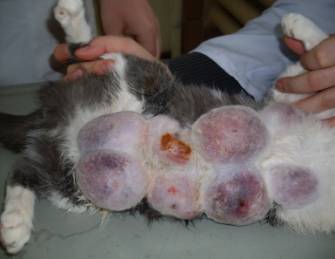
 Picture1- Breast four pairs
Picture 2 – Breast 3 or 4 pairs
Picture1- Breast four pairs
Picture 2 – Breast 3 or 4 pairs
breast
cancer in dogs
mammary glands in cats
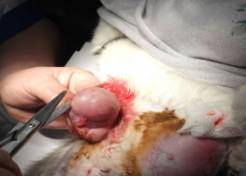
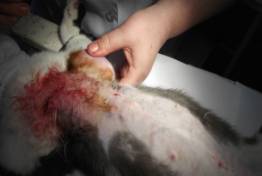
Picture 3- Fixation
of mastubating site Picture 4- Husking of mastubating site
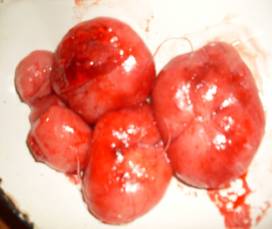
Picture 5- Wilasinee mastopathies nodes