Экономические науки/10.
Экономика предприятия
Solod A.V., Ph.D. Sorokina
L.I.
D.Serikbaev East Kazakhstan
State Technical University
Assessment
of competitiveness of a service providing enterprise by constructing a polygon
of competitiveness
Assessment of competitiveness of an
organization is important for every manager. Knowledge of company’s strengths
and weaknesses gives it the opportunity to make strategic decisions in timely
manner which will allow the firm not only to keep its competitive position but
also to increase its competitiveness.
We can state that some progress has been made in the assessment of the
competitiveness of products and services today. There has been developed quite
acceptable methodology for evaluating the competitiveness of identical products
and services. However, it is more difficult to assess the competitiveness of
companies that provide services for citizens: the universally accepted
methodology for assessing the competitiveness of those type of companies has not been developed yet.
Due to the fact that service industry is
rapidly evolving and improving today, it became quite popular. It tends to
result in a large number of enterprises operating in this field. With each
passing day the competition among service providing enterprises increases and
the management staff has to constantly develop criteria for improving
competitiveness.
We can assess the competitiveness of
service providing enterprises by constructing a polygon of competitiveness.
Facing a big market with many competitors a firm should identify its
strengths and weaknesses, and to secure a level of competence in several
directions simultaneously, which can be graphically represented as a vectors of
polygon of competitiveness. In our research the vectors describe the following
parameters:
1 price of service;
2 type of service in the enterprise;
3 frequency of service;
4 discounts that are offered by the enterprise;
5 reputation of the enterprise.
The choice of parameters is based on the
analysis of a wide set of problems of technical, economic and social nature
with the result that identifies the variables that ensure competitiveness. The
starting point of this analysis is to identify a list of technical and economic
factors of competitiveness, which are treated as a set of criteria for
quantitative assessment the level of competitiveness of the service providing
enterprise.
For estimating the parameters a special
scale used where 0 point is the worst and 100 points is the best (table 1).
Table 1. Assessment of competitiveness’s parameters of the enterprises
|
Parameters of competitiveness |
Assessment of parameters of the objects of comparison, points |
||
|
Enterprise А |
Enterprise B |
Enterprise C |
|
|
1
price of services |
75 |
25 |
10 |
|
2
type of services |
100 |
75 |
100 |
|
3 frequency of services |
75 |
100 |
100 |
|
4
discounts |
100 |
50 |
100 |
|
5 reputation of
the enterprise |
75 |
75 |
100 |
Assessment of competitiveness should
be interpreted as a geometric figure which is a quantitative measure of the
stability of the competitive condition of the enterprise.
The level of competence of each
enterprise-competitor is assessed by vectors. Each vector in its limit value is
the radius of the circle corresponding to the maximum potential of the internal
capacity of an economic entity (ideal variant).
Each direction is indicated on the scale
of vector with the corresponding point (evaluation), and then all the points
are connected by one common. Overlaying the polygons of the enterprises-competitors
on each other, it becomes possible to identify strengths and weaknesses of an enterprise
in relation to another (figure 1).
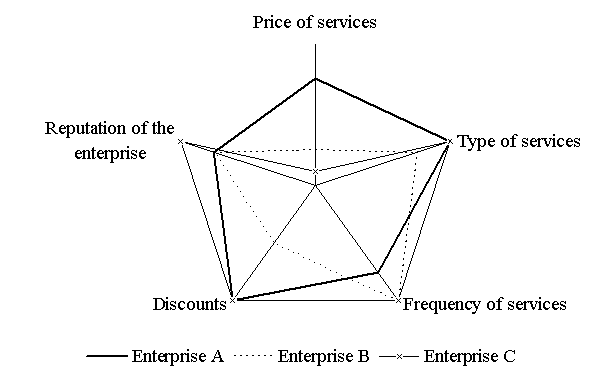 Figure 1. Polygon of competitiveness of the enterprises
Enterprises A, B, and C are located in the East Kazakhstan region (The
Republic of Kazakhstan) and engaged in the provision of recreational and
entertainment services to the population of
Ust-Kamenogorsk. In our research the enterprise A is a direct object.
Figure 1 shows that the enterprise A is the leader in the price of services.
Values for «type of services» and «discounts» of object of
research in line with similar values with enterprise C, but at the same time,
the parameter «reputation of the enterprise» from the object of research has a
small lag. The parameter «frequency of services» of the enterprise A has a lag
from both competitors. As a result of the analysis of estimation of parameters
of competitiveness by constructing a polygon of competitiveness can be
concluded that the company A is competitive enough, but there are reserves for
improvement of competitiveness.
The method of constructing a polygon of
competitiveness has its advantages and disadvantages.
The advantage of the method is the visual
representation of the analysis of competitiveness in all directions of the
research. The analysis of the estimates shows the strengths and weaknesses of
the competitive battle in all directions of competitiveness. Then we can
develop actions to secure the strengths and liquidate the weaknesses.
The disadvantage of the method is that
the reflection of a large number of indicators requires to increase the size of
the scale. If the scale is too small, the marks and lines will worsen the
visual perception of the image. Another disadvantage of the method is the lack
of predictive information about how one or another company-competitor can
improve its performance.
In conclusion, the method of
constructing a polygon of competitiveness can be successfully used to
estimate the competitiveness of service providing enterprises and, despite the
lack of predictive values, can demonstrate the strengths and weaknesses of the
enterprise.
Work cited:
1. Lifits I.M. Theory and Practice of assessment of competitiveness goods and services. - Moscow: Yurait-M, 2005.