COMPANY
VALUE POTENTIAL FORMATION AND ASSESSMENT
Valeriy Shevchenko (Kharkiv National Economic
University)
Summary. Theoretical
approach to defining the economic
essence of the company potential has been generalized. The content of the
company value potential as a reflection of its ability to generalize value
added and transform this value into capital gains has been determined.
Theoretical study of the economic essence and peculiarities of forming the
value constituent of the company potential in the general system of economic
categories has been given. The structure and the content of managerial tasks
being solved in the process of forming the financial strategy of a company have
been identified and characterized. The exact succession of strategic financial
planning in the context of providing the rise in the company value has been
grounded.
Key words: value, potential,
value potential, financial strategy, financial planning.
Introduction. A company appears
to be an open socio-economic system operating in an active environment and
forced to adapt to external transformations. External environment of economic
management, with global and operational surrounding of a company being its
components, can be defined as a complex mix of conditions and factors appearing
outside the company regardless of its activity and is able to influence the
work of the company. The environment can have direct (economic ties and
counterparties of the company, business climate) as well as indirect
(entrepreneurship regulations, general political, economic, socio-cultural,
technological and scientific factors) influence on functioning and development
of a company.
Study of the theoretical and practical aspects of solving the problems
of the company strategic management has been shown in the scientific works by
I. Ansoff [1], O. Batlukova [2], I. Belousova [2], A. Voronkova [3], A. Gradov
[4], Y. Donets [5], Y. Lapyn [6], I. Otenko [7], V. Pastukhova [9], V.
Ponomarenko [8], I. Simenko [2], O. Fedonin [10] and others. Still, many important
problems of methodology and organization of strategic planning in formation and
development of the company potential have not yet been researched enough and
call for detailed investigation. Thus, the necessity to raise the efficiency of
the company development management under present-day conditions puts forward
the demands for quality, timeliness, reliability and completeness of the
strategic managerial decisions taken. Furthermore, many key problems of
managing a company, especially those of the theoretical basis of economic
essence and concepts of the company value potential assessment, demand a more
precise definition.
Problem
formulation. The aim of this research is to deliver theoretical and methodological
recommendations on defining the economic essence and rules of forming the value
potential of a company.
Results of the
research. An extremely high level of diverse and complex contradictions and problems in the socio-economic transformations
of a company, ambiguous and unpredictable changes in the conditions of a
company functioning bring forward a strategic character of managerial decisions
on the company development. In the systems of categories used for defining the
priorities of the company strategic management the leading role is given to the
company potential (business potential, business/company strategic potential,
business/company economic potential). For instance, I. Otenko [7, p. 53] claims
that the company potential is a perfect parameter to show the dynamic state of
a company as well as to reflect the processes of its functioning and
development.
According to the study of the theoretical approaches [1-7] to the
definition of the economic essence of the company potential performed by the
author, there appear to be four main concepts of explaining this scientific
notion (different in the morphological features of resources, reserves,
possibilities, aims). They are:
1) the concept of resources, according to which the company potential is
a generalized complex of the company resources used for solving tasks or
achieving strategic as well as day-to-day goals;
2) the concept of reserves, stating that the company potential embodies
hidden business facilities of solving problems mainly relating to the
production process;
3) the concept of capacities, which claims the company potential to be
the reflection of the maximum available characteristics and potentialities of a
business (technological, organizational, socio-cultural, etc.) reflecting its
unique individual peculiarities and differences from its major competitors
while giving rise to the company’s permanent competitive advantages;
4) the concept of aim, defining the company potential to be a limited
amount of aims of the company functioning and development (alternative,
supplementary or controversial), which can be achieved with the help of the
manufacturing resources available.
According to the author, each of the above mentioned concepts has
numerous assets as well as flaws, making it impossible to regard any of the
approaches as an objective reflection of the notion of the company potential.
Due to the excessive complexity and uncertainty of the nature and origin of the
company potential, resulting in numerous concepts of its essence, scientists
have not come to an agreement on the final definition of types and components
of a potential, as well as on the most important features according to which
the elements of a potential should be grouped. Still, they distinguish the elements
and types of the company potential based on the following features: the sphere
of origin (inner, external, general), the task to be solved by the formation
and assessment of the potential (strategic, current, operational, competitive,
reforming), the object of the research (development potential, functioning
potential), the activity sphere of the
company (production potential, reproduction potential, reproduction funds
development potential), the subject of the research (company potential,
structural division potential, functional operation field potential, individual
worker potential), the nature of the development capacities (financial
productive capacities potential, labor potential, intellectual information
potential), the functional operation field of the company (production,
resources, innovation, organization, value, labor potential).
Each of the types and elements of the company potential is defined by
its specific aims and development conditions, while being affected by and
reacting to the various factors and forces. Complex as well as changeable
combination of the elements of the company potential determines strategic and
alternative tendencies, perspectives or priorities of the development of a
company. The biggest impact on the potential formation is made by the elements
identified by the functional operation field of the company. Huge importance of
these very elements of the general potential formation is proved by the fact
that each of them (production, resources, innovation, organization, value and
labor potential) is in its turn the subject for a detailed study in the
corresponding fields of economic research. Furthermore, the detailed content of
the above mentioned concepts coincides with the evolution of the theoretical
approaches to the definition of the company potential notion.
Value potential
takes a special place in the system of phenomena and processes defining the
dynamics of the company potential formation.
Value potential
reflects the ability of the company to generate value added and transform the
value into the rise in the company capital. The potential level of a company is
defined by its ability to increase the market value (market capitalization,
balance sheet value or any other value indicator of the company’s property
valuation). Assessment of the current level and perspective changes of the
potential is used for defining expedience as well as effectiveness of the
strategic managerial decisions from the standpoint of possible influence on the
value of the assets or the market value of the company.
Detailed research
and generalization of the existing approaches to the economic nature, essence,
origins and development factors of the economic potential of a company lead to
the conclusions on the content and peculiarities of the value constituent of
the company potential in the general system of economic categories.
Firstly, the increase in the company value is a form of a reward for an
entrepreneur who performs any form of activity himself or directly manages the
collective activity of the people hired personally at his peril and discretion.
Such form of income is individualistic in its character and economically
appears to be the easiest to get. This kind of activity, aimed at getting a
certain income, should be clearly distinguished from any other social activity
of a person (political, charities, etc.)
Secondly, the company value reflects the monetary value of the results
in the production, marketing and financial activity while being the marker of
the final financial results of the activity of an entrepreneur and his
employees. In general, any income in the form of the increase in the company
value is the difference of the aggregate income of a certain entrepreneurial
activity and the total expenses needed for its realization. The process of
increase in the value together with its qualitative indices directly depends on
the effective work of all the members of the production process as well as
employer’s ability to ensure the collective activity rational organization.
Thirdly, as a rule the value of the income ready to be distributed and
appropriated by the entrepreneur does not characterize the whole income
received as the result of the entrepreneurial activity, that is, the difference
of the aggregate income and the value of goods and/or services production
costs. Such discrepancy is caused by inability of defining the objective
criteria to determine the resources consumption as those being either
indispensable or excessive. The assessment of the company value potential in
this case is not a problem, while the evaluation of the total expenses
constituents remains totally subjective.
Moreover, the company value is the reflection of the activity final
value indicators in the monetary equivalent. The prevalence of such operational
financial results evaluation method is due to the practice of the generalized
value accounting of all the indices involved – the capital employed, gross
income received, expenses incurred, etc. – as well as the working state
taxation rules of the financial economic relations.
Furthermore, the value potential is not the income guaranteed to the
entrepreneur who has employed his own capital in any type of activity.
Entrepreneur reward might take the form of an income or an increase in the
company value (opposed to the losses or decrease in the company value) in case
of skillful, successful and efficient business activity. On the other hand, an
entrepreneur can not only be deprived of the income expected, but also lose,
partially or completely, the capital employed as the result of either personal
unsuccessful actions or the impact of the external factors. This jeopardy
awaits the capital owners only and is not tangible for the holders of other
resources. Therefore, the income acts as a pay for a risky entrepreneurial
activity or the probability to lose the capital employed. In this case, the
income rate and the entrepreneurial risks (expected capital losses) appear to
be directly interdependent.
Another significant point is that the increase in the company value is
the result of the dynamic condition of the company, its inner reorganization as
well as market environment changes. The entrepreneur’s innovative role in the
income formation can be implemented through creation, search, choosing,
introduction and promotion of innovations, which might lead to increase in the
company effectiveness, that is, visible curtailment of expenses or an intensive
income growth. Here advancing development by means of creating original
competitive advantages leading to income generation, which is not accessible
for the counterparties, or else finding possibilities for the losses reduction
by using the reserves of resources economy may be the source of the company
value growth.
Finally, the increase in the company value is a complex integral
evaluation index of the effective usage of the productive resources needed for
selling goods and services. The company value proves to be a trustworthy basis
for the economic grounding of the managerial decisions as well as an essential
criterion for the optimal choice of the entrepreneurial activity method. Income
dynamics tend to give the objective picture of the necessity to optimize the
production expenses, increase the production and realization rates, expand the
assortment, change the price policy, etc.
Thus, according to the author, the value potential reflects the ability of the
company to generate value added and transform the value into the rise in the
company capital. The potential level of a company is defined by its ability to
increase the market value (market capitalization, balance sheet value or any
other value indicator of a company’s property valuation). Assessment of the
current level and the perspective changes of the potential is used for defining
expedience as well as effectiveness of the strategic managerial decisions from
the standpoint of possible influence on the value of the assets or the market
value of the company.
The company value proves to be a monetary equivalent of the return on
the capital employed which characterizes the entrepreneur’s reward for the
risks of the active economic activity and numerally presents the difference of
the aggregate income and the total expenses of any entrepreneurial activity.
The economic essence of the company value is reflected through the realization
of the complex functions that determine the position of the company value in
the system of the economic relations. One of the highest priorities of the
strategic management appears to be the rational distribution of resources among
different fields of activity and their effective use to achieve the strategic
goals of the rise in the financial results and the company income.
The author claims that long-term orientation, purposefulness providing
the system of the financial goals, achievement of which directly influences the
successful work of the company, the interdependence and subordination of the
general economic strategy goals, balanced financial activity in every function
are the characteristic peculiarities having the role and position of the
financial resources in the system of the company development as well as the
financial strategy in the system of other strategies as their source.
Therefore, based on the defined role and importance of
the value constituent of the company potential in the system of the strategic
development management, it is proposed to regard the financial strategy of the
value growth as a defined long-term operation direction, realization of which
allows the company to solve the complex task of choosing the optimal capital
structure and its management for the rise in the company value potential;
developing the dividend policy meeting the goals of increasing the shareholders
income and providing the company with the funds sufficient for reinvestment;
keeping the physical infrastructure and available actual inventories at a level
able to maintain the constant competitive status of a company.
As the result, while realizing
the financial strategy of the company the executives are forced to balance
between the short-term and long-term effects of the funds used, therefore
certain contradictions in the standard financial goals and strategies are
observed. They include the rise in the internal assets value, the achievement
of the value growth and dividend payment high rates, the reduction of the
external financial sources (higher equity and loan capital ratio), the
improvement of the capital structure (fixed and circulating capital ratio).
The financial
strategy is usually aimed at the growth of the company value according to the
market demands. Strategy main tasks tend to be the research of the character
and nature of the company’s finances formation under the market economy; the
arrangement of the proper basis for the possible financial resources formation
and managerial decisions in case of the company’s unstable crisis financial
condition; the establishment of the financial relations with suppliers,
clients, budgets of all levels, banks and other financial instruments; the
identification of the reserves available as well as mobilization of the company
resources for the rational production capacities, fixed and circulating capital
usage; the provision of the production needed financial resources; the
effective investment of the temporary available funds; the identification of
the best ways of performing successful financial activity and strategic use of
the financial capacities, new production items, thorough personnel preparation
including the rise in their organizational culture and technical equipment
literacy; research and study of the competitors’ financial strategies, economic
and financial capacities; taking measures to improve the financial stability;
the development of ways out of the crisis, methods of personnel management and
coordination in case of the unstable financial conditions.
Inner regulatory framework, which is a successful abroad experience,
proves to be an essential part of the financial strategy. Thus, successful
financial strategy of a company is guaranteed if the financial strategic goals
meet the available economic and financial capacities in case of the proper
strategic financial management able to adapt to the changes in the economic
conditions.
It appears important to mention that to solve
the already mentioned tasks every company should take its specific
peculiarities into consideration while preserving the unified conception
approach to the financial strategy formation and evaluation (Table 1). The
table presents the scheme of a principle-based approach to the succession of
analyzing and planning the financial condition of the company as well as solid
grounding for the managerial decisions in the field of financial activity while
realizing a certain variant of the strategic alternatives of a company.
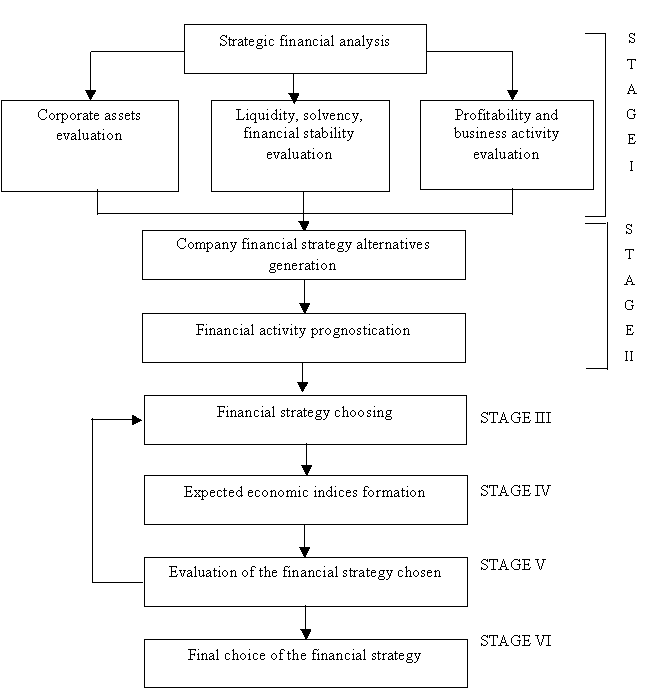 Table1. Strategic financial planning
scheme.
Table1. Strategic financial planning
scheme.
Conclusion. Value potential reflects the ability of the
company to generate value added and transform the value into the rise in the
company capital. The potential level of a company is defined by its ability to
increase the market value (market capitalization, balance sheet value or any
other value indicator of a company’s property valuation). Assessment of the
current level and perspective changes of the potential is used for defining
expedience as well as effectiveness of the strategic managerial decisions from
the standpoint of possible influence on the value of the assets or the market
value of the company. The financial strategy of the company
value growth proves to be a defined long-term operational direction,
realization of which allows the company to solve the complex task of choosing
the optimal capital structure and its management for the rise in the company
value potential; developing the dividend policy meeting the goals of increasing
the shareholders income and providing the company with the funds sufficient for
reinvestment; keeping the physical infrastructure and available actual
inventories at a level able to maintain the constant competitive status of the
company.
Further research tasks. Methodology of the
company value potential is proposed to be further investigated.
REFERENCES
1. Ансофф И. Стратегическое
управление. М.:Экономика, 1989. – 519 с.
2.
Аналіз фінансово-економічного потенціалу
підприємства / Сіменко І.В., Білоусова І.М.., Батлукова О.О. – Донецьк: Дон дует, 2004. –
169 с.
3.
Воронкова А.Э.
Стратегическое управление конкурентоспособным потенциалом. – Луганск: ВНУ,
2000. – 915 с.
4.
Градов А.П. Экономическая стратегия
фирмы. – С.-Пт.: Издательство «Специальная литература», 1995. – 416 с.
5.
Донец Ю.Ю. Эффективность
использования производственного потенциала. – К.: Знание, 1998. – 123с.
6.
Лапин Е.В. Экономический
потенциал предприятия / Е.В. Лапин. – Сумы: Унив. кн., 2002. – 309 с.
7.
Отенко И.П. Методологические основы
управления потенциалом предприятия. Харьков: Изд. ХНЭУ, 2004. – 216 с.
8.
Пономаренко В.С. Стратегічне управління. - Харків: Основа, 1999. – 632
с.
9.
Пастухова В.В. Стратегічне управління підприємством: філософія, політика,
ефективність. К.: Київ. нац. торг.-екон. ун.-т, 2002. – 302 с.
10. Федонін О.С., Рєпіна І.М.,
Олексюк О.І. Потенціал підприємства: формування та оцінка: Навч. посібник. –
К.: КНЕУ, 2003. – 316 с.