Yulia
Lopatnyuk
Specialist
Business Economics
Petro Mohyla Black Sea University
Implementation
of budgeting system in the enterprise
Abstract
This
paper focuses on the effective
implementation of budgeting for domestic enterprises.
For
efficient use of budgeting in the company must decide on the objects budgeting
need implementation of automated systems, range of responsible persons of
budgets, budgeting principles, system monitoring budget execution and others.
Object
of budgeting is a certain activity unit area project, business, etc., for which
the organization be formed budgets will be their implementation and control of
. Their classification is a matter of discussion. If a company produces a
relatively homogeneous products appropriate nomenclature, in such conditions,
you can use the budgeting process operations. However, in our view selection of
individual operations facility budgeting is too detailed and time-consuming
process. When analyzing the holding concern, other associations of enterprises
should be budgeting for facilities to isolate target areas of the enterprise.
But nowadays the most common objects of responsibility is responsibility
centers, which companies distinguish themselves with the peculiarities of
business. Due to the fact that the classification of objects varies greatly, we
propose a new technology to select items budgeting for various businesses. Yes,
every entrepreneur first determined the size of your business, then based on
the size selects the type of budgeting (for projects, operations by
responsibility centers), and then specifies and classifies the selected object.
This technique allows you to create a hierarchy of budgets, have a clear system
of control and track which units "fill" and who "consume"
the budget.
Keywords: Budgeting, paper,
balance, the budget production, Standards, capital budget.
Introduction.
This
paper is organized as follows: First, one of the most important preconditions
for the functioning of budgeting is the development of scientifically sound
principles and their implementation and use in practice. In science outline the
principles of science, complexity, optimality, unity, completeness, accuracy,
ranking, variance, balance, provide feedback, and integration. If the company
will abide by them, the budgeting system will run smoothly and it can be
confidently resist the development of future indicators. Second, in the
development and implementation of the plan should be given to organizing the
process control performance as budgeting without feedback - it wasted time
spent. At this stage, the use of budgeting in the planning system determined
approach to the analysis of the financial performance of the enterprise, the
depth of analysis, regulation and responsible employees. Latest in turn may
form the so-called budget committee - a permanent formal group which is
responsible for the overall coordination of the implementation of budgeting and
completely responsible for this process. Although "the budget office"
along with the leaders of responsibility centers or other facilities budgeting
and cost the company dearly in the hold, but this team provides effective to
achieve the result. Third, also worth noting that in the contemporary economy
budgeting is actively moving towards automation, so the decision by management
on the implementation of integrated management systems
Budgeting
is a complex system of measures and covers the main aspects of the enterprise -
production, marketing, finance and coordinate them. Moreover, taking management
decisions at all levels of management emphasis is on the financial side, which
gives the opportunity to achieve objectives such as costs, maximize profits,
the balance borrowed resources from areas they use as to the extent and in
time, and therefore contributes to overall improvement in the financial
condition of the company.
The
main problem is the difficulty of budgeting management decisions related to
future events and the need of forecasting. The uncertainty of the external
environment can cause the idea of the impossibility of planning.
But there is an inverse relationship: if there is a stable environment, it is
not necessary to plan, because it is in this case a simple process of
transferring evidence in future periods. This uncertainty dictates the need,
complexity and importance of planning.
For the
successful implementation and subsequent operation of budgeting in the company
must comply with the following conditions:
1. improvement of the
organizational structure of the enterprise, which will clearly define the
functions and responsibilities of managers;
2. a clear structure for all processes as those
responsible persons to automate operations and simplify the budgeting process;
3. standardization of
data that will establish their common use by all business units of the company;
4. integration of
budgeting with organizational structure and information technology company that
will improve the effectiveness of the control system.
Thus, when
corrected these deficiencies and establish optimal management organization,
namely in financial planning and budgeting will enable enterprises to manage
and achieve their goals.
Diagram
1. Indicators used in the process of benchmarking
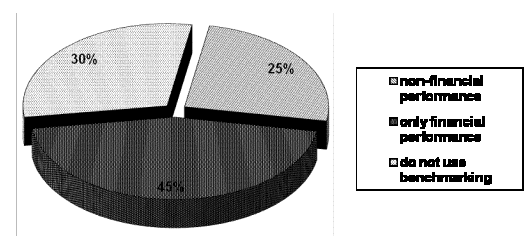
Source. Compiled by the
author
So, in 1995, E. Monkhouse in their studies
found a tendency to use a standard of comparison of financial indicators in
small and medium enterprises.
The
methodology of the development budget in the national economic literature
developed, usually very superficial, is borrowed from foreign literature and
cover only the general procedure of budgeting. Given the above the above, we
consider it necessary to stay in more detail on Budgeting farms.
Diagram 2. Flowchart budgeting of enterprise
Source. Compiled by the author
In our opinion,
must begin to restore the classical scheme of budgeting:
1. Budgets up year by
month;
2. Developing a single
format for all budget tables responsibility centers;
3. The planning costs are divided into fixed and
variable;
4. Expenditure is
planned only for compelling articles, all minor articles grouped and scheduled
one sum;
5. Implementation
planned by groups of products, namely in top positions (positions, share sales
which is 80% of total business), all other realization grouped and scheduled
one sum;
6. List of groups or
senior positions should not be large, so the system was responsive to change.
In our
opinion, in the preparation of budgets should be used documents close to the
accounting documents. This will greatly facilitate budgeting and make easier
the comparison of planned and actual data. Much easier budgeting process also
allow modern computer technology.
Conclusions.
After
some investigation, we concluded that the current budgeting is popular among
medium and large businesses and has many advantages. These include significant
cost savings, the ability to form units and control their operating costs, the
availability of a clear understanding of current and future cash flows and
tools to advance adjustments in case of unforeseen circumstances. Budgeting is
now a universal system, which allows to plan the future activities of the
company and has tools for editing and its control. However, we must pay
attention to the presence of many problems associated with the implementation
and support normal functioning of budgeting. Yes, entrepreneurs are faced with
the problem of selecting objects budgeting, which depend on many factors, both
external and internal environment, with difficulties in radical restructuring
already working systems. Besides buying automated software that provides a
system of budgeting, costs a lot of money, which is not always pays heal on its
implementation. But despite the large number of still unsolved theory and
practice decisions in planning through budgeting, we argue that this line of
business has great chances for the existence and development in the area of
research and applied use in planning business.
References:
1. Monkhouse E. The
role of competitive benchmarking in small-to medium-sized enterprises //
Benchmarking for Quality Management & Technology, Vol. 2, No. 4. – 1995. –
P. 44-45.
2. Needles B.E.,
Powers M, Mills
S.K., Anderson H.R.
“Managerial Accounting” 5th ed. – Boston,
N.-Y.: Houghton Mifflin Company, 1999. -603 p.
3. Anthony R.N., Reece
J.S. «Accounting: Text and Cases» ed./ R.N. Anthony, J.S. Reece. –Illinois:
Homewood, 1989. – 1030p.
4. Cassel C., Nadin S., Gray M.O. The use and
effectiveness of benchmarking in SMEs // Benchmarking: An International
Journal, Vol. 8, No. 3. – 2001. – P. 212-222.
5. Coopers & Lybrand Consultants, Survey of
Benchmarking in the UK. – CBI Manufacturing Council, London, 1993.