3rd course PhD student Ishuova Zh.Sh.
Al Farabi Kazakh National University
Construction
of DSGE model with not absolutely flexible prices and by the National Bank of
Kazakhstan acting according to a Taylor rule
Dynamic stochastic
general equilibrium models for the monetary policy analysis are widely used
among central banks. These models are used to discuss central banks’ behavior
in different economic development scenarios [1]. We model the Kazakhstan’s economy as a small open
economy represented by the unit interval. Since the economy is of measure
zero, its domestic policy decisions do not have any impact on the rest of the
world. Next we describe in detail the problem facing households and firms
located in Kazakhstan’s economy. Variables with an i ϵ [0, 1]
subscript refer to economy i, one among the continuum of economies
making up the world economy.
A typical small open economy
is inhabited by a representative household who seeks to maximize 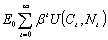 , where Nt denotes hours of labor, and Ct
is a composite consumption index defined by
, where Nt denotes hours of labor, and Ct
is a composite consumption index defined by 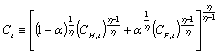 , where CH,t is
an index of consumption of domestic goods given by the CES function
, where CH,t is
an index of consumption of domestic goods given by the CES function 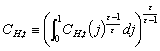 , where j ϵ [0, 1] denotes the good
variety. CF,t is an index of
imported goods given by
, where j ϵ [0, 1] denotes the good
variety. CF,t is an index of
imported goods given by 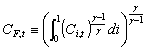 , where Ci,t is,
in turn, an index of the quantity of goods imported from country i and
consumed by domestic households. It is given by an analogous CES function
, where Ci,t is,
in turn, an index of the quantity of goods imported from country i and
consumed by domestic households. It is given by an analogous CES function 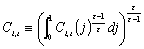 . Notice that parameter ε>1 denotes the elasticity of substitution between
varieties (produced within any given country). Parameter α ϵ [0, 1] is related to the degree of home bias in
preferences, and is thus a natural index of openness. Parameter η>0 measures the
substitutability between domestic and foreign goods, from the viewpoint of the
domestic consumer, while measures the substitutability between goods produced
in different foreign countries [2]. To estimate the model we use quarterly data
for the period from 1992Q1 to 20012Q4. We choose the following seven observable
variables: real GDP, short-run real interest rate, a measure of core
inflation computed by the National Bank of Kazakhstan, the real exchange
rate, nominal exchange rate devaluation, real wages and labor input. We also utilize
series on oil imports and the real price of oil. We discuss the effects of an oil shock – an increase in the real
price of oil – on different domestic variables. We present some impulse–response functions
generated under the preferred model and we compare the outcome with the one
that would have been obtained under different policy rules, and under flexible
wages and prices.
. Notice that parameter ε>1 denotes the elasticity of substitution between
varieties (produced within any given country). Parameter α ϵ [0, 1] is related to the degree of home bias in
preferences, and is thus a natural index of openness. Parameter η>0 measures the
substitutability between domestic and foreign goods, from the viewpoint of the
domestic consumer, while measures the substitutability between goods produced
in different foreign countries [2]. To estimate the model we use quarterly data
for the period from 1992Q1 to 20012Q4. We choose the following seven observable
variables: real GDP, short-run real interest rate, a measure of core
inflation computed by the National Bank of Kazakhstan, the real exchange
rate, nominal exchange rate devaluation, real wages and labor input. We also utilize
series on oil imports and the real price of oil. We discuss the effects of an oil shock – an increase in the real
price of oil – on different domestic variables. We present some impulse–response functions
generated under the preferred model and we compare the outcome with the one
that would have been obtained under different policy rules, and under flexible
wages and prices.
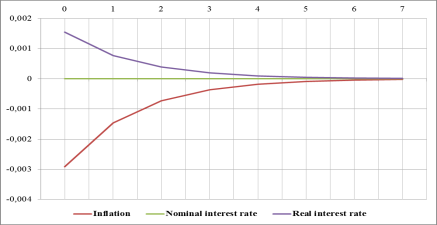

Figure 1. Reaction of interest
rates and inflation on the interest rate shock
In the first version of
monetary policy is assumed that the National Bank will apply the following
parameters of monetary rules: ϕπ=2.5 and ϕy=1. It means that the interest rate will increase by 1.5% if inflation exceeds
its target by 1%.
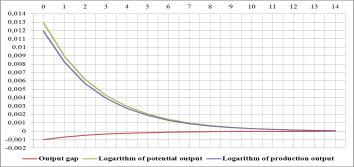
Figure
2. Reaction of the output gap and its components on the technology shock:
Nominal
interest rate, as opposed to the real, after the shock almost unchanged. It is
increased only by 0.01%. Although the initial shock is 1%, this leads to
deflation and the formation of a negative output gap, and hence to the
necessity reducing the interest rate of the National Bank (see figure 1–2). Comparing the analysis of consequences of monetary
policy options for the Republic of Kazakhstan with data for the Russian
Federation and Republic of Belarus in the works of Ivashchenko [3] and
Drobyshevsky [4], we can conclude that monetary policy in the Republic of
Kazakhstan meets the standards adopted in the leading countries: a clear
anti-inflation policy is evident (a growth in inflation by 1 percentage point
results in a rate increase of 0.75%).
References:
1.
Poghosyan
K. and G. Barseghyan. DSGE model of open economy with sticky wages and prices
(the case of Armenia) [Electronic resource]
// CIS Research Network. – URL: http://www.eerc.ru/Selected/Fall_2011/Poghosyan_Proposal.pdf.
2. Galí J. and T. Monacelli. Monetary Policy and Exchange Rate
Volatility in a Small Open Economy // NBER Working paper №8905. –2002 – pp. 1–43.
3. Ivashchenko A.S. Impact of monetary shocks on macroeconomic dynamics
[Electronic Res.] // URL:
http://mmaetst.narod.ru/archieve/251110_seminar_ai.pdf.
4. Drobyshevsky S.M., Trunin P.V., Kamenskih M.V. Analysis of the rules of
monetary policy of the Bank of Russia in 1999-2007. // Institute of the Economy
in transitional period. Working paper №127. – 2009. – 88p.