B.B. Orazbayev- Doctor of Engineering Science, K.N.
Orazbayeva- Doctor
of Engineering Science, B.E. Utenova- PhD, L.T.- Kurmangaziyeva –PhD.
Atyrau Institute of Oil and Gas
Information systems for optimisation and control of sulphur production units
Abstract:
This paper
develops the
structure for
and creates
the basic
functional blocks
for information systems
for the
optimisation and
control of working regimes
for basic
technical system
for sulphur
production
units. The suggested information system
includes complex
modelling algorithms for
interdependent technological systems
and a set
of algorithms for
solving multi-criteria optimisation and
control problems in a fuzzy
environment, as well as an intelligent interface and
using standards of CALS
technology. The
basic results
of the
programme
to implement the model which
has been
worked out
and the
given description of the basic
interface of the information system
for optimisation and
control of working regimes
for sulphur
production units
and sub-system modelling processes for
sulphur production are given.
Key words: information system,
sulphur production units,
interface, sub-system modelling, multi-criteria optimisation, decision maker,
fuzzy data.
I. Introduction
In industrial situations, the
decision maker
(the head
of the
technical installation, process
engineer, operator) frequently finds
him or herself in a situation where
in order
to optimise the
decision, it is necessary to process a large volume
of information, consider a set of alternatives, take
into account
the impact
of various
factors, evaluate the
implications of one or other decision on conditions of uncertainty. The
situation arises,
when it becomes necessary to resolve production problems in the control
of multi-criteria installations, since
oil refining processes are
such, including sulphur
production units
in oil
and gas
refineries.
In order
to resolve
such problems, computer information systems
for optimisation and
control (CISOC)
are always
beneficial, based
on modelling which
allow, in the advice
regime, the
taking of optimal decisions for
management of the installation, and
the processes inherent in the same.
Such systems
bring together modelling methods, optimisation, decision making
and the
possibilities afforded by modern computer equipment, allowing for
significant improvement in a speeding up of the
optimisation and
control process
[1].
II.Problem setting
The aim
of this
research paper is the development of structures and
the formation of basic functional blocks
for information systems
for the
optimisation and
control of working regimes
for technical systems
for sulphur
production units. In order
to increase the
effectiveness of the contents of computer information systems
for optimisation and
control (CISOC), we suggest the
inclusion of the following basic
blocks: a system of algorithms for
decision making
in optimisation and
control tasks,
a modelling system,
a data
and knowledge base,
model identifiers and
a user interface. These
blocks link
the information streams, and
each of them fulfils
its own
function. [2, 3]
The peculiarities of most industrial installations, including sulphur
production units
lie in the fuzziness of their input
data. In such cases,
it becomes
necessary to formulate the
knowledge and
opinion of the person
making the
decisions (the
decision maker),
specialists and
experts
which is characterised by fuzziness and
qualitative in nature. In order
to solve
fuzzy optimisation tasks
such as these, leading
to the
optimal decisions, it is necessary to include in the computer information systems
for optimisation and
control (CISCOC), elements of artificial intelligence allowing interaction in real or professional languages. This
can be made possible by artificial intelligence methods
[4], that
is by including logical
conclusion and
results clarification blocks,
multi-criteria fuzzy
optimisation and
control algorithms in the knowledge base
of the
computer system and also
by having an intelligent interface
[5]
III. Results
The results
of the
research which
has been
carried out,
suggest the
following steps
for the
formation of a computer information system
for optimisation and
control (CISOC):
1. The identification of problem areas,
and the
task to be solved,
contained in the arrangement of the optimisation and
control problem.
2. Formalising of the knowledge of the decision maker,
specialists and
experts of the installation and
task at hand.
3. Formation of a knowledge and
data base.
4. Development of a system
of models
for the
installation.
5.
Arrangement of the
optimisation and
control problems, and
development of algorithms for
their solution.
6. Development of an
intelligent user interface.
7.
An implementation programme for
the models
and algorithms which
have been
developed.
We are
suggesting the
following structure for
information systems
for optimisation and
control for
sulphur production units
based on mathematical models
of the
installation (figure
1).
Let us consider the
functionality of the basic
blocks of the computer information system
for optimisation and
control. (CISOC)
The user – decision maker (in
our situation the
operator or process engineer) selects
a working
regime for
the installation, providing for
the optimal
value of local criteria, such
as economic, ecological and
technological characteristics. The
solution is selected depending on the complexity of the industrial situation, for
example on the product
issue plan,
the composition of the incoming sulphur, production quality
requirements, ecological safety
etc. taking
into account
the relative importance of local criteria and
set limits
(for the
value of control and
regime parameters or local criteria).
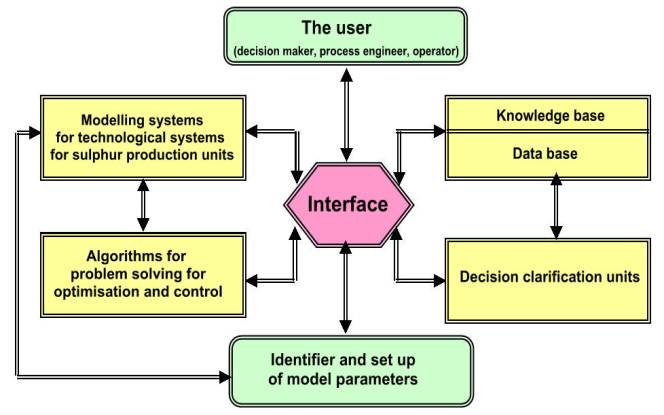
Figure 1 – Structure of Computer Information System for Optimisation and Control (CISOC)
In order
to solve
this problem, the
decision maker
uses a set of models for
technological systems
for sulphur
production units, algorithms for
solving multi-criteria optimisation and
control problems taking
into account
fuzzy input
data, and,
if necessary knowledge and
data bases,
decision clarification blocks
etc. In the configuration and
adaptation of systems to new working
conditions, the
decision maker,
specialist or expert may
fulfil the
role of expert in order to fill the
knowledge base
and implement the
collection and
processing of qualitative indicators
[6].
The block
set of models for
the optimisation and
control of the system
installation contains various
models, including fuzzy
models of each separate element
of the
industrial system,
joined together into
one system,
allowing for
the system
modelling work
of the
installation to be carried
out as a whole.
The function of these models
is to determine (estimate) the
value of local criteria relative to the value
of input
activity.
The set of algorithms for solving the optimisation and control problems, for
example, the
algorithms which
have been
put forward
in research papers
[7,8], the combination of these, and
others are
intended for
the solution of multi-criteria optimisation and
decision making
problems for
the selection of optimal control regimes, including those
in a fuzzy environment. These
algorithms, based
on complex
models, knowledge bases
and decision clarification blocks,
implement the
search for
rational working
regimes for the
installation according to the criteria which
have been
selected and
determine the
recommended values
for the
control activities required to provide for
these working
regimes. The
right to make the
final selection lies,
as a rule, with
the decision maker.
The function of the knowledge and data bases is to store
the formalised knowledge of specialists and
experts, researchers in the said
sphere and
statistical data
concerning production. Information from
these blocks
is used
in the
process of analysing the
basic indicators of the installation and
decision making
for the
drawing up of industrial reports
and the
adaptation of models to new conditions.
The function of the interface is to provide
for a convenient interactive working
regime between
the user
and the
system in control of the installation, and
also in the implementation of a range
of other
functions of the computer information system
for optimisation and
control (CISOC). In the process
of working
with the
system, if necessary the
following are
implemented: output
on the
display of a diagram
of the
industrial installation and
information concerning the
ecological condition of the installation, showing
on the
the screen
the value
of control
parameters and
the results
obtained in the form
of visual
observations of the process
of optimisation of working regimes
of the
installation, input
and correction of the parameters necessary for
optimisation and
the provision of ecological safety
of the
production in a form
convenient for
the user.
The decision clarification blocks implements the
prompting strategy and
clarification of the results
obtained. Clarification of the results
obtained, in a form
which is compact and
convenient for
human analysis, is carried out
by way
of the
fixing of all the
considerations received by the system
in the
event of alternative selections.
In order
to adjust
and adapt
models of technological installations to new working
conditions and
identifier of model parameters is added to the contents of the computer optimisation system.
This block
is in fact a programme which
carries out
the checking of the models
for adequateness, and,
if necessary, allows
for recalculation (identification) of the model
parameters.
The effectiveness of such intelligent computer systems
for the
control of various types
of production is determined by the quality
of the
formalisation and
presentation of knowledge, the
models and
algorithms which
have been
developed for
solving control
problems as well as the user
friendliness of the user
interface.
Thus, in order to increase the
effectiveness of the computer information system
for optimisation and
control (CISOC), a set of algorithms for
modelling inter-related technological systems
and multi-criterial optimisation and
control regimes
for installations based
on CALS
technology, developed in a fuzzy
environment with
an intelligent interface must
be included.
According to the results
of analysis and
comparison of selection criteria, in this
paper we have chosen
to use
Visual Basic
for the
programme to implement the
models which
have been
developed in the field
of sulphur
production. This
brings us to a description of the interface for
the information system
under development. The
main menu
is shown
in figure
2.
As can
be seen
from the
menu shown,
the suggested information system
for optimisation and
control is made up of three
blocks (sub-systems): the
modelling system,
the optimisation system
and the
control system.
In this
paper, the
programme for
implementation of the modelling systems
developed for
processes in the production of sulphur based
on mathematical models
of basic
sulphur production units
for sulphur
production equipment at Atyrau Oil
Refinery has
been worked
out. Let
us give
a more
in-depth description of the subsystem.
Figure 2 shows the
main menu,
where the
System Modelling menu
opens, that
is the
System Modelling menu,
has a sub-menu: System
Modelling of Processes in Sulphur Production; Mathematical modelling of basic system
blocks; Linguistic models
for processes in sulphur production; Adjustment of model coefficients.

Figure 2 – Main Menu of the System being Developed
In selecting the
System Modelling of processes in sulphur production menu,
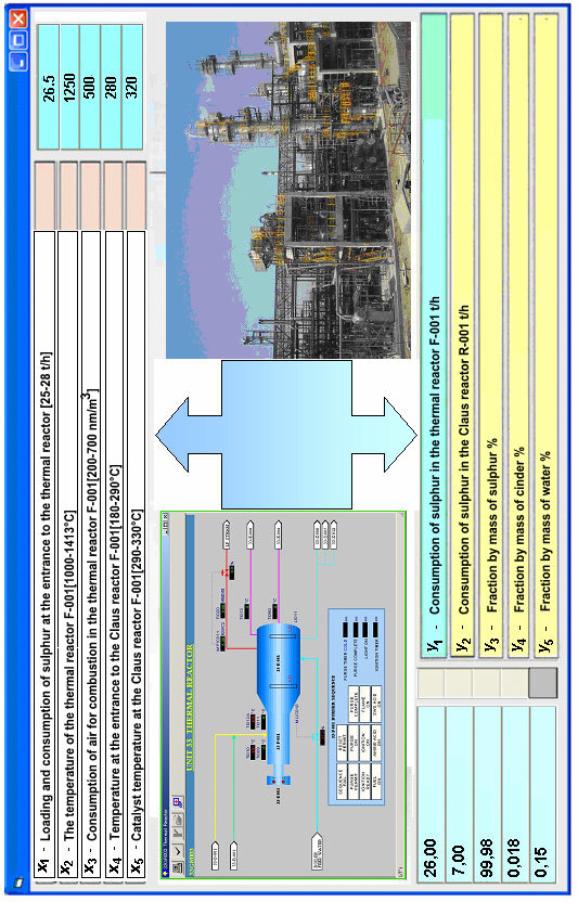
another window
opens (see
figure 3),
in which
the modelling of the process
takes place
directly.
As can
be seen
from figure
3, in the modelling regime,
the names
of the
basic regime
parameters (x1, x2, x3, x4, x5) are
shown in the upper
part for
user-friendliness of the interface. These are then changed
by the
process of modelling and
the search
for an optimal working
regime for
systems of sulphur production units.
The menu
includes change
intervals for
each of the regime
parameters.
There
is a corresponding window on the right side in order to change each of the
parameters x1, x2, x3, x4, x5
 At
the bottom of the window, the results of the modelling – the value of the
output parameters of the process y1,
y2, - the volume of product output from the thermal reactor and the
Claus reactor, and also the quality indicators for the intended product - y3,
y4, y5 – the fraction by mass of sulphur, cinder and
water accordingly are shown. In order to work out the new values of the output
parameters on changing the input parameters, then the button -
At
the bottom of the window, the results of the modelling – the value of the
output parameters of the process y1,
y2, - the volume of product output from the thermal reactor and the
Claus reactor, and also the quality indicators for the intended product - y3,
y4, y5 – the fraction by mass of sulphur, cinder and
water accordingly are shown. In order to work out the new values of the output
parameters on changing the input parameters, then the button -
which is next to the corresponding
yj, j=1,5 must be pressed.
Figure 3 shows the results of the
search for an optimal working regime for the sulphur production unit (a manual
search for optimal working regime).
Thus, with the help of this
sub-system, changing the value of input parameters and determining the
corresponding value of output parameters, that is system modelling of various
working regimes of basic inter-related systems of sulphur production units, we
can find the optimal regime for processes for sulphur production, that is
determine the value of regime parameters which ensure the optimal (critical)
value of output parameters.

The regime described requires the
experience and knowledge of the user, and also time, and so is not convenient
for production workers. In order to make use of this system convenient in
industrial conditions, a system optimisation sub-system is formed, which is
based on the models which have been constructed for technological systems and a
set of inter-active algorithms for the resolution of multi-criteria problems in
the optimisation of working regimes for technological installations, taking
into account the presence of fuzzy input data.
IV Conclusions
Thus,
in this paper the structure of and certain basic functional blocks for
information systems for the optimisation and control of sulphur production
units is worked out, and a sub-system for the modelling of sulphur production
processes is formed. The main results of the programme to implement the
sub-system modelling of working regimes for sulphur production units are given.
At
the present time, a programme to implement various multi-criteria optimisation
algorithms which take into account fuzzy input data, and which in doing so make
use of modification of various compressed schemes for decision making is being
carried out. These algorithms allow the user to solve the optimisation problem
in a user-friendly manner, that is the search for the values of input
parameters which provide for the optimal value of output parameters and
criteria is automatised.
References:
[1] B.B. Orazbayev, New
Information Technology for
Oil Refining, Kazakhstan Scientific News,
issue 5, 1998, pp 51-54
[2] L.A. Zadeh Out line of a new approach to the
analysis of complex systems and decision process//IEEE Trans, on SMC-Vol. 3, N 1.-
1973. - P. 28 44.
[3] K.N. Orazbayeva, Computer Systems
for Correct
Decision Making
using Modelling and
Optimisation in Oil Production and
Oil Chemical Engineering, MNPK
Collection of Research Papers,
The Role
of Scientific and
Engineering Systems
in the
Development of the Oil
and Gas
Industry, - Atyrau, 2010,
pp 71 – 77
[4] G.S. Pospelov, D.A.
Pospelov, Artificial Intelligence – Application Systems, Moscow,
Znanie, 1985,
p. 195
[5] B.B. Orazbayev, Mathematical Methods
for Optimal
Planning and
Management in Industry, - Almaty, Gilim,
2000, p. 200
[6] Dubois D., Prade H. Fuzzy sets and systems. Theory and application. //Acad.
Press. N-York, 1980.
[7] K.N. Orazbayeva, R.G.
Sarmurzina, A.T.
Mukhamedzhanov, The
Arrangement of Multi-Criteria Optimisation Problems for
Technological Processes in the Production of Benzol, and
Methods for
their Resolution Based
on the
Knowledge and
Experience of the Decision Maker.
Scientific Journal
Vestik, NAS
RK, Physics
and Mathematics Series,
2010. No.
2, pp 31-26
[8] A.S.
Rykov, B.B.
Orazbayev, Problems and
Decision Making
Methods. Multi-criteria Fuzzy
Selection, - Moscow, MIS&S, 1995,
p. 124