Копен Н.М.
Національний
університет харчових технологій, Україна, м.Київ
Essence
of strategic planning
All executives know that strategy is
important. But almost all also find it scary, because it forces them to
confront a future they can only guess at. Worse, actually choosing a strategy
entails making decisions that explicitly cut off possibilities and options. An
executive may well fear that getting those decisions wrong will wreck his or
her career.
Formal strategic planning with its
modern design characteristics was first introduced in business firms in the
mid-1950s. Formal strategic planning is the most sophisticated form of
planning. Advocates of planning such as Ansoff, Hax and Majluf, and Thompson
and Strickland argue that formal strategic planning contributes to managerial
effectiveness and, thus, to corporate success.
Strategic planning is important to
an organization because it provides a sense of direction and outlines
measurable goals. Strategic planning is a tool that is useful for guiding
day-to-day decisions and also for evaluating progress and changing approaches
when moving forward. Strategic Planning is a management tool that helps an
organization focus its energy, to ensure that members of the organization are
working toward the same goals, to assess and adjust the organization's
direction in response to a changing environment. Simply put, strategic planning
determines where an organization is going over the next year or more, how it's
going to get there and how it'll know if it got there or not.
It is important to separate the
concept of " strategic planning " of the term " long-term planning
." In
contrast to long-term planning (which begins with the current status and lays
down a path to meet estimated future needs), strategic planning begins with the
desired-end and works backward to the current status.
At every stage of long-range planning the planner asks,
"What must be done here to reach the next (higher) stage?" At
every stage of strategic-planning the planner asks, "What must be done at
the previous (lower) stage to reach here?"
Also, in contrast to tactical planning (which focuses at
achieving narrowly defined interim objectives with predetermined means),
strategic planning looks at the wider picture and is flexible in choice of its
means.
A
strategic plan is: a written document mapping the path to success; the “recipe”
to achieve the vision and mission; a step-by-step guide to reach goals; contain
goals, objectives, measures, and timelines; indicates parties accountable for
accomplishing tasks; usually expressed in 5 to 10 year time periods.
In short, the strategic plan is
systematic plan of envisioning a desired future, and translating this vision
into broadly defined goals or objectives and a sequence of steps to achieve
them.
The strategic plan includes the
goals, objectives, and timelines, as well as the means for measuring progress
for each goal. The plan should also indicate the people who will be held
accountable for accomplishing the tasks. To ensure a focus on long term
success, the governing board should aim at establishing a strategic plan
expressed in five to ten year periods.
There are a variety of perspectives,
models and approaches used in strategic planning. There are different ways to
do that planning, depending on the purposes of the planning, the life cycle or
stage of development of the organization, the culture of people in the
organization, complexity of the organization's environment, the nature of the
organization's leadership, size of the organization, expertise of planners
types of issues the organization is currently facing, and the rate of change in
the external environment of the organization.
Strategic planning starts with
defining a company mission. A mission is important to an organization because
it synthesizes and distills the overarching idea linking its practical
strategies, enabling management and employees to align the specifics of their
actions and decisions with a clearly defined vision and direction.
The nuts and bolts of the strategic
planning process are expressed in measurable goals. Goals should be expressed
in a manner that is understandable and acceptable with some degree of
flexibility. Goals must suitable, relate to the values of the company and must
be achievable for a successful implementation. Companies often use the SMART
acronym to guide the goal setting process. SMART stands for goals that are
Specific, Measureable, Attainable, Research-based, and Time-phased. Measurable
goals are important to an organization because they enable managers and
employees to evaluate progress and pace developments.
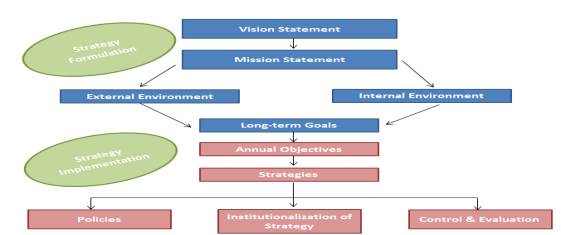
Pic.1. The strategic planning process
This picture illustrates the strategic planning
process. This image is meant to show an organization of the components and the
general flow of the strategic planning process. Strengths and weaknesses are
components of the internal environment at the school. The school has the
ability to change these factors through deliberate or designed action.
Opportunities and threats are external to the school; however, they may
directly influence the school and should be addressed in the strategic plan.
When considering the external environment, the governing board should think
about who their competition is and what the customers desire. The political,
economic, social, and technological influences should be evaluated as well.
Literature
1.G. McManus, J.Saint-Pierre, J.Domonkos; Formal strategic planning, informedness and firm performance: an
empirical investigation // Global finance journal
6(1),2009.
2.Steiner, George A., Strategic Planning: What every manager must know. The free press, New York, 1979, 383 p.