Cand.Econ.Sci.
Kenzhebekova D. S.
Kostanaysky state university of A.Baytursynov,
Kazakhstan
MAIN WAYS AND METHODS OF THE BUDGETARY REGULATION OF
ECONOMY OF THE REPUBLIC OF KAZAKHSTAN
The budgetary regulation is an ensuring deficit-free of budgets which are
a part of the budgetary system of the state.
The purpose of the budgetary regulation - ensuring necessary interaction
of all components of the budgetary system, balancing of each its element and
all system as a whole this mechanism normally functioned and smoothly worked.
The structure of the budgetary system of the Republic of Kazakhstan is
shown in figure 1.
Budgetary system
Republic of Kazakhstan
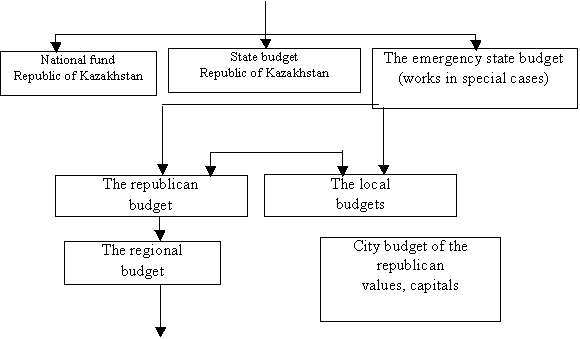

Area budget (cities regional value)
Figure 1. Budgetary system of the Republic of
Kazakhstan
Ways of the budgetary
regulation are:
1 .
distribution of expenses between separate types of the budgets entering
into the budgetary system;
2 .
establishment of constantly specified income for each link of the
budgetary system;
3 . definition of the income
which are transferred from higher budgets in subordinate for balancing of the
last (subvention);
4 .
interbudgetary grant (the budgetary loan);
5 .
interbudgetary crediting;
6 .
budgetary deduction;
7.уменьшение the budgetary expenses, including
sequestering (restriction – the special mechanism which provides a ban on an
expenditure of means in certain limits which is imposed in cases when at an
expenditure of the budget there is an excess of the established level of budget
deficit, or receipts from profitable sources are reduced, as a result there is
impossible a financing of the expenses in full provided by the budget).
For
effective use of set of methods of impact on economy the knowledge of essence
and specifics of each of them follows, to their objectively predetermined
sopodchinennost. Depending on the chosen criteria there are some options of the
corresponding classification. First of all, methods of direct and indirect
influence differ.
Methods of direct influence compel subjects
of economy to make the decisions based not on an independent economic choice,
and on solutions of the state (taxes, legal norms on depreciation charges, the
budgetary procedures on the state investments). Direct methods have huge
efficiency owing to expeditious achievement of economic result.
Methods
of direct state influence are:
a)
identification of strategic objectives of development of economy and their
expression in indicative and other plans, target programs;
b)
the state orders and contracts for deliveries of concrete types of production,
performance of work, rendering services;
c) state support of programs, orders and
contracts;
d)
standard criteria to quality and technology and production certification;
e) legal and administrative
restrictions and ban on release of some types of production, etc.;
e)
licensing of operations on export and import of goods, that is the foreign
trade operations.
Methods
of direct state influence are:
a)
identification of strategic objectives of development of economy and their
expression in indicative and other plans, target programs;
b)
the state orders and contracts for deliveries of concrete types of production,
performance of work, rendering services;
c) state support of programs, orders and
contracts;
d)
standard criteria to quality and technology and production certification;
e)
legal and administrative restrictions and ban on release of some types of
production, etc.;
f)
licensing of operations on export and import of goods, that is the foreign
trade operations.
The
sphere of use of indirect regulation in process of development of market
economy especially extends, narrowing possibilities of direct intervention of
the state in processes of expanded reproduction.
At
indirect influence the state forms only prerequisites to that at an independent
choice subjects gravitated to those options, answering the purpose of a state
policy (indirect taxes, duties, providing information).
Depending
on the purpose of intervention of a measure of economic policy can be broken into
actions which are directed on:
-
activization of capital investments and balance restoration between savings and
investments;
-
preservation of probably maximum employment;
-
price level preservation for ensuring profitability of the enterprises;
-
stimulation of export and import of goods, capitals and labor.
Organizational and institutional
methods.
It
should be noted one more of classifications of methods of state regulation of
economy. Criterion of approach - organizational and institutional. The specified
list includes administrative, economic and institutional methods.
Administrative
methods are a set of administrative levers which cover the actions connected
with providing legal infrastructure. They share on measures of a ban,
permission, coercion.
Economic
measures are those measures of the state influence by means of which the
certain conditions directing development of market processes to the course
necessary to the state (in particular, on cumulative supply and demand, on
level of centralization of the capital, on social and structural aspects of
economy) are formed. To number of economic measures define financial and a
monetary policy, programming and forecasting.
Institutional
methods - system of the organizational issued actions. It actions which are
connected with is rather long the existing phenomena, for example, "right
institute", "property institute".
Statistical
methods.
There
is a variety of statistical methods, however in relation to regulation of great
importance are: method of economic groups, extrapolation method, budgetary
method (method of selective inspection of budgets of house farms).
The
method of economic groups is everywhere used in state regulation. Groups allow to divide difficult sets on the
structure into the groups uniform in any essential sign. The analysis is most often carried out by
means of the structural, dynamic and structural and dynamic groups created on
one sign or a combination several.
The
method of extrapolation can be used mainly when developing initial forecasts,
projections of the main directions, programs. Concreteness of this method of
subjects is more, than it is less period concerning which the method is
applied.
The
budgetary method represents the analysis of budgets of house farms where
statistical supervision over a population standard of living is conducted.
Materials
of the analysis are a source for data acquisition about distribution and
population differentiation on level of material well-being, consumption, cash
expenditures, etc. They provide important information for definition of
structure of consumer expenses in families of various structure, characterize
population differentiation on level of located resources, give the chance to
define dynamics of change of a consumer demand in the house farms which are in
city and rural districts.
Materials of inspection of budgets are
rather widely used by statistics in various economic calculations: consumer
price indexes, the national income, at calculations of the real income of the
population, etc.
Special methods: balance, program and
target, standard.
Balance method - one of significant
when determining economic proportions, coordinations of separate parts of the
state plan in whole.
In the real conditions data of
intersectoral balances can be used for development of forecasts of branch
structure of economy, identification of a role of separate factors, for
example, dependences of economy on power supply or the change in price for
energy carriers, forecasting on the basis of regional balances of volumes of
import and production export out of region limits, etc.
The standard method is used as
independently, and in total with other methods, for example, together with a
program and target method quantitative indices of the purposes and necessary
resources for achievement of these become clear is more whole. The standard
method is used for identification of requirements and possible resources when
developing various balances, detection of the standard of current assets, norms
of depreciation charges, etc. The method assumes finding of a ratio between
various sizes (parameters) at which the best scale of predicted processes can
be provided.
The program and target method can be
applied at the solution of a specific problem which is characterized by the
importance, by impossibility of the decision its other methods, appears on a
joint of branches that demands special approach. For application of a program
and target method important justification of a choice of problems. In a broad
sense the program and target method represents use and deepening of an
integrated approach to a solution.