Economics
/ 3. financial relations
Tanskozhanova D.R.
Karaganda Economic University, Republic of Kazakhstan
The health care system of the Republic of Kazakhstan
Health
- sector of activity of the state, the aim of which is to organize and provide
affordable medical service for the population, preservation and increase of
level of health.
It is a set of measures of political, economic, social,
legal, scientific, medical, sanitary - hygienic, anti - epidemic and cultural
nature, aimed at preservation and strengthening of physical and mental health
of each person, maintaining its long active life, providing him with medical
assistance in the event of ill health.
It should be
noted that Kazakhstan has come a long way in the development of the health
system. At independence in 1991, a legacy of the country went to the health
system, organized by Semashko. This model assumed a tiered health care system,
with clearly differentiated structure of service providers, in which each of
the five levels corresponded to the severity of disease (district, central
district, municipal, provincial and federal hospitals) and they were all united
by an effective system of referral for specialized care. Central to this model
served the local doctor, who was responsible for the provision and coordination
of medical care for his or her site. This model allows you to integrate the
activities of other medical services and was very efficient from an economic
point of view did not require large expenditures, health services could be available
to all and free [1].
In 2004, in the
Republic of Kazakhstan has introduced a program of state guarantees the
provision of free medical care, including the free drugs privileged categories
of the population with an ambulatory care. Since 2005, funding for health care
accumulated at regional level, and regional health authorities act as a single -
payer.
From 2010 to 2012
occurred in Kazakhstan introduction of the Unified National Health System
(hereinafter UNHS), which made health care system patient - centered. One of
the most important tasks of UNHS was a competitive environment in the health
sector, provided the patient the right to choose a hospital, which in turn has
increased the availability of hospital care. With regard to financing, then the
system that lists the medical facility where the patient received the service
and therefore hospitals compete with each other to attract patients is to them.
Besides the stable introduction of UNHS allowed to focus on high - tech
development in the regions. Volume tertiary care services in 2013 compared with
2011 increased by 60 %, with more than half (56%) was provided at the regional
level.
Implementation of
the Unified National Health System to promote the effective use of resources.
Since the beginning of the implementation of UNHS reduced by about 6 thousand
beds, the needs of patients redesigned almost 8.5 thousand beds. Almost 3 - fold
increase in the number of patients treated in hospitals daily resource. As part
of the implementation of UNHS information provision created an online system
for monitoring the quality of health services.
Since 2011,
across the country to introduce a national screening program aimed at early
detection of cancer, non - communicable diseases, screenings covered about 7.7
million people, at about 2 million people improved their health and disease
identified about 600 thousand people. Screening system is one of the directions
of the State Healthcare Development Program "Salamatty Kazakhstan",
calculated for 2011 - 2015 and includes 12 programs : screening for early
detection of diseases of the circulatory system; screening for early detection
of diabetes mellitus; screening for early detection of diseases of the cervix (cervical
cancer); screening for early detection of breast cancer; screening for prostate
cancer; screening for viral hepatitis B and C; screened for tuberculosis -
decreed groups; detection of HIV infection (decreed population); prenatal
screening for fetal malformations and genetic diseases; neonatal screening for
phenylketonuria, congenital hypothyroidism and hearing loss (newborns);
preventive examinations of children; professional examination for glaucoma (
people older than 40 years).
Economic
efficiency of early detection of disease is not in doubt. For example, the
treatment of one patient with breast cancer at 1-2 - stage costs the state 780
thousand tenge, treatment is the fourth stage is already 26.5 million tenge.
And if you reduce the number of diagnosed patients with breast cancer stage 4
from 15% to 5 %, it will save us almost 9 billion tenge for the treatment of breast cancer only four stages. And that's
just one disease [2].
At the moment,
financing of health care organizations in the Republic of Kazakhstan is carried
out from the following sources:
- The state
budget;
- Funds received
for medical services on a fee basis;
- Other sources
not contrary to the laws of the Republic of Kazakhstan.
Financial support
of non - governmental organizations at the expense of public health:
- The state
budget for the provision of guaranteed free medical care;
- By health
insurance;
- Funds received
for medical services on a fee basis;
- Other sources
not contrary to the laws of the Republic of Kazakhstan.
In
2005, the Ministry of Health of the Republic of Kazakhstan initiated the
development and implementation of the integrated Health Information System.
Main the goal of a
unified Health Information System as an information and a technological
platform defined creation of
information structures of health of the Republic of Kazakhstan, corresponding to the level of economic, social,
technical,
technological development of society and
ensuring rational use of resources of
health with better quality the
provision of medical services to the population. Direct beneficiaries The unified
Health Information System are health managers at all levels, as well as health care workers who should be exempt from
having to manually doing part of the
accounting and reporting documentation and
in addition, access to certain information about
patients' health. The unified Health Information System includes 6
components aimed at automation
different processes of health, and 1 component
internal communication:
1. Medical - statistical system;
2. The resource
management system;
3. The system of
quality management of medical services;
4. The financial
management system;
5. System management
of drug supply;
6. The monitoring
system of the sanitary - epidemiological situation;
7. A complex of tasks for ensuring interaction
information
systems.
Affordable health
care financing was reintroduced in Kazakhstan in 1999 after a failed attempt to
introduce a system of mandatory health insurance.
In 2000, approved
the list of medical services provided to the public free of charge in public
organizations. One of the goals of the State Reform and Development Program of Health of the Republic of Kazakhstan for 2005
- 2010 was the introduction of SBP (State free health care).
This program
formed the basis of the following principles: compliance with the financial
capabilities of the state, social justice and access to health care, and the
division of responsibility of the state, the employer and the citizens for the
preservation and promotion of health (Ministry of Health of the Republic of
Kazakhstan, 2004).
After the
decentralization of health financing to the district level in 2000 -2003, and
since 2004 has introduced a new system of financing, which included the
consolidation of health care resources at the regional level, the creation of
regional health departments with functions of a single - payer health care and
improving the mechanisms of buying medical services through new methods of
financing medical organizations. Beginning in 2010, the financial resources of
hospital care included in the SBP are consolidated at the national level.
SBP includes
medical services, which are periodically reviewed and approved by the relevant
regulatory acts and are paid from the national budget.
Service package
includes SBP emergency medical services, inpatient and outpatient care; it
provides for revision every two years. Payment patient services included in the
SBP is illegal, can be paid for only those services that are not included in
the SBP. Medical services not included in the SBP, citizens pay either from
personal funds, either by the employer or from other sources.
One of the
sources of health financing are of - pocket payments. Currently, hospitals and
other health organizations have the right to formally charge a fee for services
not included in the SBP. Payment for goods and services provided by public
health agencies, was legalized in 1995. Regional executive authorities have the
right to determine the size of these payments and many of them were price lists for services not included in the
SBP. These price lists provide full payment of services not included in the
list of vital, such as services of cosmetic surgery and some dental services [3,
p. 51].
The main burden
of financing health care in Kazakhstan is on the budgets of all levels and a
faster pace growing state budget expenditures. This is due primarily to the
expansion of programs for the population of expensive high - tech medical care,
targeted programs, as well as the direction of funding for medical science,
education and Reimbursement of certain categories of citizens.
Over the past
years, the country has increased funding for the health sector. During the
period from 2006 to 2013 from the national budget was spent 2169 466.60 million
on this area, while the local budget expenditures amounted to 123 561 400 000
tenge. Below are details about the costs of national and local health budgets
from 2006 to 2013:
The cost of the Republican and local budgets on health
care
million tenge
|
Year |
Republican budget |
Local budget |
|
2006 |
80011,5 |
9700,0 |
|
2007 |
100 788,10 |
13101,4 |
|
2008 |
115 581,20 |
14437,8 |
|
2009 |
176 799,60 |
16829,4 |
|
2010 |
367 185,50 |
14366,5 |
|
2011 |
376 704,00 |
14349,7 |
|
2012 |
453 001,50 |
17659,3 |
|
2013 |
499 395,20 |
23117,3 |
|
According to the Ministry of
Finance of the Republic of Kazakhstan |
||
Dynamics
of the Republican and local budgets in the field of health financing are
presented in the following graph:
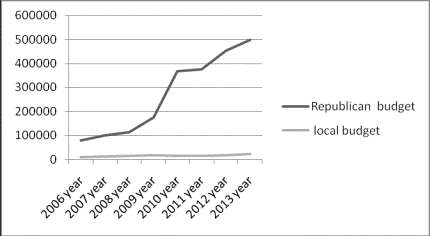
In
this graph we see that the cost budgets were increased from year to year, due
to increased the gross domestic product. The most part of regional budgets (60%)
is spent on drug benefit and 40% are costs not included in SBP. Expenses
on forming healthy lifestyle in the regional
budgets health care is extremely low -
0,17%. The largest three articles of expenses in the regional budgets on health accounted for wage cost of social security payments and health workers
(47%), purchase medicines and food
(21%) and investments in fixed capital (15%).
Currently,
in the Republic of Kazakhstan actively continues the work on improving the
availability and quality of medical services to the population, including
through effective use of computer technology. For these purposes at the end of
2013 adopted the "Concept for the development of e-health of the Republic
of Kazakhstan by 2013 - 2020". A key element of e-health will be the
electronic health passport that provide a logical structure to store and share
key data on health as a tool for implementing the objectives of the health
system aimed at improving the availability and quality of medical services and
improvement of the management at all levels. In the framework of this Concept
in the allocation of funds will be used the principle: "who gets the money
on anything, he decides how to use them, but at the same time he is responsible
for this decision and for the result", which in turn will provide greater
independence for health organizations, but also increase their responsibility
for the provided medical services.
Financing
policy and quality control will remain with the state. The Ministry of health
of the Republic of Kazakhstan will develop regulations and legislative acts
which define the model of financing and responsible, who will monitor the
quality of the results. One of the regulations will determine who will monitor
quality. This regulation will provide quality criteria, rules of monitoring and
quality assessment, measures for quality management.
The
Ministry of health of the Republic of Kazakhstan reserves the right investment
in such important components and activities of e - health, which define
national standards, interoperability, security, protection of the rights of
patients, and other common for the whole country elements. The General rule is
the following: at the national level will be financed, and develop only those
components that are required for all systems, and also those necessary to the
Ministry, and the rest will be transferred to the regions and local authorities.
Will
be introduced incentive mechanism with bonuses for those
companies that successfully implement e - health.
This is necessary
to overcome the inertia of the Medical
institution during the implementation of the systems. For this will be developed criteria, according to which a decision about
stimulation will be made. The incentive mechanism fairly well developed in
The Ministry of Health of the Republic of
Kazakhstan to the process of providing medical services. This mechanism will be
tested and processes for e - health. As a
guide to the elaboration of criteria
for promotion will be used experience
Appropriate use of Information and Communication
Technologies (Meaningful use) in the USA. For incentives will be provided a pool of funds [4, p.56].
The
level of health status of the people determines the extent of social -economic,
cultural and industrial development of any country. From the point of view of
sustainable and stable growth of welfare of the population the health industry,
which is a single - developed, socially oriented system, designed to ensure the
availability, timeliness, quality and continuity of medical care, is one of the
main priorities in the Republic of Kazakhstan.
The country still faces issues and challenges that must be addressed, including
the uneven distribution of funding by area, further implementation of state
programs, improving the quality of services provided and monitoring the
improvement of health spending.
Literature:
1. http://dx.doi.org/10.2471/BLT.13.030513
"A thorny path from the Semashko system to a new model of health".
2. http://info - health.kz/index.php/ru/sotsialno -
znachimye-zaboleavaniya/16-v-kazakhstane-usilyat-skriningovye-issledovaniya-sotsialno-znachimykh
-zabolevanij-minzdrav-rk
3. A. Kazaga, M. Kulzhanov, M. Karanikolas, B.
Rechel "Kazakhstan. Overview of the health system" // European
Observatory on health systems and policies. Health systems in transition vol
14, no 4, 2012
4. The concept of e - health of the Republic
of Kazakhstan for 2013 - 2020, Astana 2013.