R.N.
Ivanova, O.A. Maslova
National
Research Irkutsk State Technical University
Irkutsk,
Russia
Structural
peculiarities of Albazinskoe deposit
(Khabarovskiy
kray)
Abstract: Ores of
Albazinskoe gold deposit were formed due to hydrothermal vein and hydrothermal
metasomatic processes. From the position of the tectonofacial analysis ore
bodies and adjoining rocks belong to typical mesozonal formations [1]. The
degree of rock deformity on the deposit has predetermined the character of its development.
Key words: ore formation,
tectonofacies, degree of rock deformity, alpine hydrothermal veins.
Albazinskoe gold
deposit is located in the area named after Polina Osipenko in Khabarovskiy
kray. From the structural point of view the deposit is situated in Ulbanskaya
structural-formation zone of Amuro-Okhotskaya fold system of the fold area,
which is represented by complex dislocated Jurassic terrigenous and in a less
degree volcanogenic-siliceous structures. On the given territory there could be
defined three structural levels based on structural-material parameters of
geological complexes.
The lower structural level
consists of strongly dislocated sedimentary deposits of Triassic-Jurassic age.
They are represented by four units (bottom-up): siliceous and sandstone strata,
Demyanovskaya and Elgonskaya suites.
Siliceous stratum
is composed of two layers. The lower one is made by siltstones and argillites
with isolated thin (1-5 cm) interlayers of fine-grained sandstone. The upper
layer of the stratum is more mixed by composition and is made of siliceous and
siliceous-clayey materials, siltstones and spilites. Alteration of siliceous
materials and siltstones is every 1-10 cm, thickness of spilite interlayers varies
from 2 to 20 meters.
Sandstone stratum
is more homogenous and composed mainly of dark-grey fine-grained sandstone,
more rarely of medium-grained materials. Single interlayers of siltstones up to
1 (seldom more) meter thick are strongly attached to the bottom of the stratum
where thin interlayers of sediment breccias could be found as well.
Demyanovskaya suite
is 60-70 % composed of thin- and medium-grained sandstone of distinctive
pinky-grey color with thin interlayers enriched with phytodetritus. Siltstones
and clay shales could be found as bundles of rhythmic alterations with
sandstones.
Elgonskaya suite
consists of three layers.
The lower layer
is 720-900 meters thick and is composed of roughly alternating medium- and
coarse-grained sandstones, gravelites and fine-pebbly conglomerates.
The middle layer
of the suite is composed by fine-grained sandstones and siltstones rhythmically
alternating every 5-20 cm. Siltstones distinguish themselves by presence of
unclear stratification and “stirring-up” structures. The middle layer of the
suite is 450-500 meters thick.
The upper layer
of the suite is mainly composed of sandstones; in its lower part bundle of
gravelites and fine-pebbly conglomerates could be found while in upper parts
gravelites are located as thin (up to 2 meters) single interlayers.
Terrigenous
sediment deposits of the region are crushed into the folds of north-eastern
sublatitudinal trend (azimuth 60-80°) which in whole form the structure of the
first order, and namely host-anticlinal fold. The limb spread of smaller folds
is from 100 to 500 meters.
The middle structural level is represented by late cretaceous and Eocene sediments which take up to
20% of the area. Three complexes of magmatic rocks could be defined:
1. Late cretaceous
andesite-rhyolite complex which is
represented by volcanic and subvolcanic rocks;
2. Late cretaceous
granodiorite complex;
3. Eocene basaltic
complex which is represented by single basalt
dykes.
In most cases
dykes of rhyodacites of late cretaceous complex are hydrothermally modified
into sericite-quartz metasomatites. Hydrothermalites of later periods are veins
of quartz and calcite 1-10 (seldom more) mm thick. Zones of silicificated rocks
are located both in metasomatites and sediment rocks. More seldom vein
silicification could be found in endocontact parts of microdiorite dykes. The
thickness of zones of modified rocks is from several up to 100 meters. Industrial
ore bodies of Albazinskoe deposit are spatially connected with fracturing zones
within the limits of propagation of late cretaceous andesite-rhyolite complex.
The upper structural level
is composed of Quaternary loose depositions. The following modern and late
Quaternary alluvial depositions are represented: shingles, sands, silts, and
clays.
Based on the
results of exploration works Albazinskaya ore-bearing structure is clearly
defined. With different detail degree the structure is traced to the distance
of 5 km within the stripe of 500 meters wide. The structure has north-western trend
(azimuth 330-350) and north-eastern dip at an angle of 30-60 degrees.
Hydrothermally
altered rocks with which mineralization is connected are developed on
sandstones, rhyodacites, dacites and more rarely microdiorites. Zones of
altered rocks are from 20 to 100 meters thick. Sandstone and siliceous layers
are bearing strata for dykes. Industrial ore bodies are mainly located in the
sandstone layer.
Ore bodies are
made of different hydrothermally and tectonically altered rocks and have 400
meter trend and 180-230 meter dip. Detailed petrographic mapping of ore zones has
identified as follows: tectonic breccias of mixed composition consolidated by
sericite-carbonate-quartz aggregate (“drags”); brecciated and streak-silicificated
sericite-carbonate-quartz metasomatites on rhyodacites;
sericite-carbonate-quartz metasomatites on rhyodacites; fine streak-silicificated
sandstones or siltstones, sometimes with thin zones of brecciation and more
intensive silicification; brecciated silicificated sandstones.

“Drags” with
imposed streak silicification have the richest content of gold. In general
“drags” and brecciated silicificated metasomatites are characterized by average
content.
Ore genesis
resulted from hydrothermal vein and hydrothermal metasomatic processes.
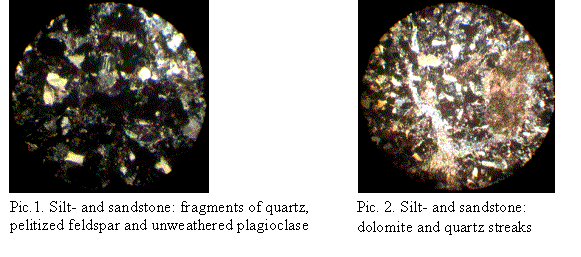
Petrographic analysis of samples has shown that all of them were touched by
hydrothermal process: hydrothermal
metasomatic and hydrothermal vein. Hydrothermal metasomatism appears as
spacious pelitization and sericitization of aluminum silicate and silicate
rocks (pic. 1). Hydrothermal vein process resulted in juxtaposition of quartz,
dolomite on the rocks altered by metasomatism (pic. 2).
Main ore minerals
are as follows: pyrite and arsenopyrite, more rare - gray copper ore,
chalcopyrite, pyrrotin, galena (gold in crush samples). The size of sulfide
extractions doesn’t exceed a fraction of a millimeter, rarely – 1-2 mm [2]. The
overall quantity of sulfides is 1-5%, rarely up to 10%.
Vein minerals are
represented by two generations of quartz (chalcedonic and crystal), carbonates
(ankerite and calcite), feldspar. Judging by the composition of ore bodies and
their mineragenic characteristics, Albazinskoe deposit is a typical
representative of poor-sulfide quartz-gold-ore-bearing formation of mineralized
zones.
Disjunctive
dislocations are wide spread in the deposit area and play an essential role
both in distribution of products of magmatic activity and ore bodies and post-ore
deformations.
The majority of disjunctive
dislocations are long-living ones; they were laid in the time of folding and
more than once renewed in the period of magmatic activity.
Industrial ore
bodies are attached to disjunctive dislocations of north-western submeridional
trend. Mineralization is also connected with dislocations of north-eastern
trend, though they are insufficiently studied.
Post-ore
deformations are most clearly registered on disjunctive dislocations of
north-eastern sublatitudinal trend. Slips on small-scaled breaks which are
often healed by granite-porphyry make up 3-20 meters. Slips on larger faults of
north-eastern trend reach the first hundreds of meters. Based on these
dislocations the territory of the deposit is divided into the number of
elementary blocks of horst or graben type. Ore bodies in these blocks are
characterized by different level of erosion.
On the southern
side in the area of limiting north-eastern fault a disjunctive dislocation was
found which deforms the ore-bearing zone. The disjunctive dislocation has
north-western trend (azimuth 290-300) with north-eastern dip at an angle 45
degrees. Displacement on horizontal plane makes up 10 meters. Shatter zone is
5-10 cm thick and made by tectonic clay gauge. To the south of this dislocation
there were detected several crevasses of sublatitudinal trend displacing dacite
dyke located to the west of microdiorite dyke. Displacements on these crevasses
on horizontal plane are 1-2 meters.
From the position
of tectonofacial analysis ore bodies and adjoining rocks of Albazinskoe deposit
belong to typical mesozonal formations [1, 3]. It is indicated by insignificant
level of metamorphism not exceeding the initial stage of green shale facies development
[2]. The following types of formations are widely-spread on the deposit: alpine
hydrothermal veins and streaks; multiple brecciation zones often representing
rich ore bodies.
By the degree of
rock deformity deposit formations belong to the lower (A) and medium tectonic
structures (B), tectonic facies of III to VI.
From the regional
point of view the degree of rocks deformity on the deposit has mainly predetermined
the character of its formation – pre-ore structural workup displayed in the
formation of adjoining rocks fracturing zones allowed concentrating of ore
substance whose source is late cretaceous andesite-rhyolite complex of
magmatogen structures of the deposit.
References:
Ivanova R.N.,
Kochnev A.P. Tectonofacies of Olkhon crystal complex: monograph.- Irkutsk: ISTU
publishing house, 2012. – 130 p.
Maslova O.A.,
Semeikin I.N. Geology, mineral exploration, methods of geological research:
proceedings of All-Russian scientific and technical conference “GEOSCIENCES”
dedicated to the 80th anniversary of the faculty of geology,
geoinformatics and geoecology. – Issue 10. – Irkutsk: ISTU publishing house,
2011. – p. 107-112
Patalakha E.I.
Tectonofacial analysis of Phanerozoic folded structures (grounds, methodology,
application). – M: Nedra, 1985. – 169 p.