Политология/2. Политическая конфликтология
PhD in
Political Science Polyakov E.M.
Voronezh State University, Russia
Terrorism and structural
violence in post-soviet Russia
The concept
“structural violence” was proposed by J. Haltung 45 years ago [1, 168-187]. Two years later
together with T. Høivik he described the structural violence (hereinafter – SV) as a situation “whenever
people die, are injured or have other deprivation due to poverty and injustice
of social, economic and political institutions, systems or structures”. [2,
73-76]. They also proposed to measure the structural violence relying on data
on life expectancy.
Other
scientists, G. Köhler and N. Alcock, proposed two models of measuring the
magnitude of SV [3, 343]. They specify a null-model which represent a
hypothetical state of affairs without SV, what required an answer for question:
how many deaths would be avoided, if all countries enjoined the same living
conditions as Sweden (the “Swedish model”) or if the currently available global
wealth had been equally distributed around the world (the “Egalitarian model”)?
G.
Köhler and N.Alcock proposed the following formula to give an answer to a
question, according to the Swedish model:
V1 = Pn / En –
Pn / Es (Equation 1),
where Pn – the country's population N, En –
life expectancy for country N, Es – Swedish life expectance [3, 345].
Based on this
methodology and official statistics [4], we should try to calculate the
proportion of SV in post-soviet Russia and compare the number of deaths, caused
by SV with the number of deaths, caused by political terrorism. As model
regions we should take the Republic of Dagestan and Republic of Ingushetia, because
their population has the highest life expectancy from 1990 until 1999 and from
2000 and until now, respectively. But in our analysis we will use data for two
decades only, i.e. 1990-1999 (Dagestan as model region) and 2000-2009
(Ingushetia as model region). All empirical data you may find in Appendix at
the end of this article.
Substituting
shown in Tables 1a and 1b data in Equation 1, we obtain the loss in population
from structural violence in Russia during 1990-1999 and 2000-2009, presented in
Table 2a and 2b, respectively [5, 25].
We can note
that in the early 1990s, the ratio of losses from structural violence and the
general population in Russia was approximately 0.77 per thousand inhabitants.
As destabilization in the North Caucasus (primarily because of the Ossetian-
Ingush conflict) and the beginning of the first Chechen war (1994-1996), the
ratio changed to 1.2 – 1.4.
Between
military campaigns (1996-1998) it has decreased, reaching the beginning of the
decade – 0.72. Basayev's invasion of Dagestan in the ratio jumped to 1.01, and,
since the 2000s, has continued to grow, reaching a peak of 2.0 in 2004. Then
again we are seeing a downward trend, with the result in 2009, nearly the same
in 1999, namely 1.03 and a gradual increase in the early 2010s to 1.38 (see
Figure 1).
On the other
hand, we can note a decrease in the number of crimes related to violence in the
first place, murder and attempted murder. In 1990 number of such crimes was 15.6
thousand; in the next five years their number has doubled and remained at this
level virtually unchanged for decade [6, 299]. Only since the mid 2000s, we are seeing a reduction
in the number of murders; by 2010 their number was reduced to 1990 level (see
Figure 2).
Also shows
the contradictory dynamics terrorist activity. According to G.Hahn, the number
of terrorist attacks for 5 years (2008-2012) ranged from 373 to 583, first
gaining and then cutting, without any apparent logic. Number of victims of
terrorist attacks and was within a few hundred people [7, 23].
According to
a Russian official data, the peak of terrorist activity occurred in 2005 (203
cases), followed by the number of attacks has dropped by almost an order of
magnitude, up to 25-30 cases per year [8, 180]. Thus, we can say that in modern
Russia the approximate ratio of population loss of structural violence, armed
violence and terrorist attacks is 2000:200:2.
Appendix.
Figure 1.
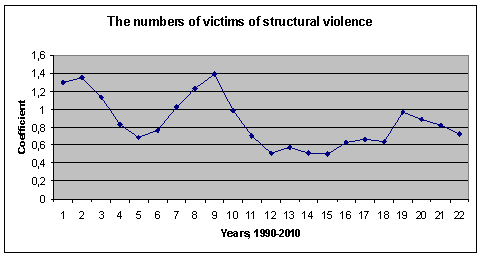
Figure 2.
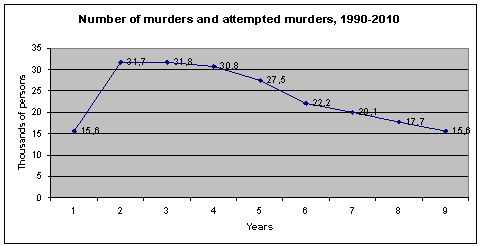
Table 1a.
Life
expectancy in 1990–1999 years.
|
|
1990 |
1991 |
1992 |
1993 |
1994 |
1995 |
1996 |
1997 |
1998 |
1999 |
|
Russia |
69,2 |
68,9 |
67,8 |
65 |
63,9 |
64,5 |
65,8 |
66,7 |
67,1 |
65,9 |
|
Dagestan |
73,1 |
72,6 |
72,1 |
70,5 |
70,5 |
70,4 |
70,3 |
70,5 |
70,5 |
70,6 |
Table
1b. Life
expectancy in 2000–2009 years.
|
|
2000 |
2001 |
2002 |
2003 |
2004 |
2005 |
2006 |
2007 |
2008 |
2009 |
|
Russia |
65,3 |
65,2 |
65 |
64,9 |
65,3 |
65,4 |
66,7 |
67,6 |
68 |
68,8 |
|
Ingushetia |
72 |
74,8 |
74,4 |
74,4 |
74,6 |
73,5 |
73 |
75,2 |
76,1 |
74,1 |
Table
2a. Magnitude of structural violence in Russia, 1990–1999 years.
|
|
1990 |
1991 |
1992 |
1993 |
1994 |
1995 |
1996 |
1997 |
1998 |
1999 |
|
Population,
millions |
147,7 |
148,3 |
148,5 |
148,6 |
148,4 |
148,5 |
148,3 |
148,0 |
147,8 |
147,5 |
|
Victims
of SV, thousands |
113,9 |
109,7 |
130,6 |
178,3 |
217,3 |
192,9 |
144,3 |
119,6 |
106,2 |
149,0 |
Table
2b. Magnitude of structural violence in various areas, 2000–2009 years.
|
|
2000 |
2001 |
2002 |
2003 |
2004 |
2005 |
2006 |
2007 |
2008 |
2009 |
|
Population,
millions |
146,9 |
146,3 |
145,7 |
143,5 |
144,2 |
143,5 |
143,2 |
142,9 |
142,7 |
142,7 |
|
Victims
of SV, thousands |
209,3 |
284,6 |
276,2 |
281,8 |
288,8 |
245,1 |
227,2 |
212,6 |
222,3 |
147,5 |
References:
1. Haltung J.
Violence, Peace and Peace Research // Journal of Peace Research, 1969, No 6.
2. Haltung J., Høivik T. Structural and
Direct Violence: A Note on Operationalization // Journal of Peace Research,
1971, No 1.
3. Köhler G.,
and Alcock N. An Empirical Table of Structural Violence // Journal of Peace
Research, 1976, No 4.
4. The
data of life expectancy in the Russian regions have been taken from
Rosstat. Date Views 21.11.2013 http://www.gks.ru
5.
Demograficheskiy Yezhegodnik Rossii (Russia’s Demographic Yearbook). – Moscow:
Rosstat, 2009.
6.
Rossiyskiy statisticheskiy yezhegodnik (Russian Statistical
Yearbook). – Moscow: Rosstat, 2011.
7. See: Hahn G. Getting the
Caucasus Emirate right / A Report of the CSIS Russia and Eurasia Program. –
Washington, DC: CSIS, 2011.
8. Rossiya v
zifrakh (Russia in Figures). – Moscow: Rosstat, 2013.