Ph.D., docent Sabirova L.B., undergraduate Jandarbekov N.T.
Kazakh National Technical
University after K.I.Satpaev
Kazakhstan, Almaty city
RESULTS OF EXPERIMENTAL STUDIES
APPLICATION OF SELECTION DEMULSIFIERS
Oil slime (sample №6) was
heated in a bath at 70 ° C in a conical glass flask of 100 ml during 30-40 min.
by periodic hand mixing. Average sample of slime is dispensed into glass-graded
sediment tube of 50 ml. One of the samples is considered to be as a test sample
(it is not dosed a reagent). The other are dosed the following reagents:
- sediment tube №2 - Daufaks
BB - dosage of 1000 g / t;
- sediment tube №3 - Hercules
1017 – dosage of 1000 g / t;
Reagents were selected by HF
dielkometric method (pp. 2.6.).
Then, every sediment tubes are
hand mixed during 1 min., and their contents are transferred to the centrifuge
tubes.
Experiments were conducted in
two series: in the first series before centrifugation all samples were treated
in a microwave oven (operating frequency is 2.4 MHz, power 800 W, during 1
min.). Field processing time is chosen so that the sample is not boiled up in
order to avoid the negative effect of SHF field. After the SHF of EMF
(electromagnetic field) treatment, the tubes were centrifuged at 3000 rev / min
during 10 minutes. In the second series, the tubes were centrifuged without
field processing.
Because of centrifugation in
the tubes, there are formed three coating: oil, sediment (mechanical
impurities), water. Thereafter the oil and water are carefully transferred into
corresponding separator funnels. To maintain the temperature of the treated
product and a better separation of the water the separator funnels are placed
in a water bath (at 80° C) for 10-15 min.. Settled water is drained. In the oil
water content is determined (GOST 2477-65, Dean and Stark method) and
mechanical impurities (GOST 6370-83).
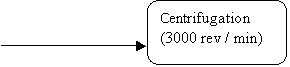
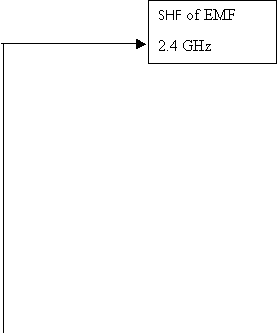
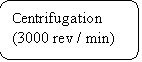
The scheme and the
experimental results are presented in Figure 1 and Table 1. From the presented
results it is shown that the maximum efficiency was achieved by SHF treatment
of oil slime with the addition of the reagent "Hercules 1017" (1000 g
/ t) with the following separation in centrifugation (3000 rev / min).
It should be noted
that the results for the two studied demulsifiers are not very different from
each other (Table 1), so
demulsifiers
"Daufaks DF" can also be recommended as an enough effective demulsifiers
Demulsifiers
1000 g/m3


Demulsifiers
1000 g/m3
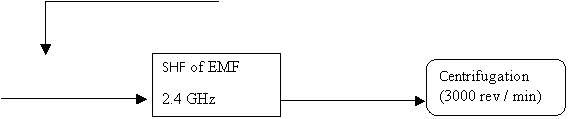
Figure 1 – The
scheme of the laboratory experiments.
Table 1
|
|
Without of SHF treatment |
With SHF treatment |
||
|
Demulsifiers |
Content of irreducible water, % |
Mechanical impurities, % |
Content of irreducible water, % |
Mechanical impurities, % |
|
Daufax DF |
5D |
0,470 |
2,6 |
0,22 |
|
Hercules1017 |
4,3 |
0,40 |
2,0 |
0,20 |
When oil slime treating by SHF
of EMF without adding the reagent, the water content in treated products was
9.5%.
Further work was
carried out to study the optimal dosage of reagents "Hercules 1017"
and "Daufax DF", as well as the selection of the initial temperature
of the oil slime treatment. Results of the studies are presented in Figures 2
and 3.
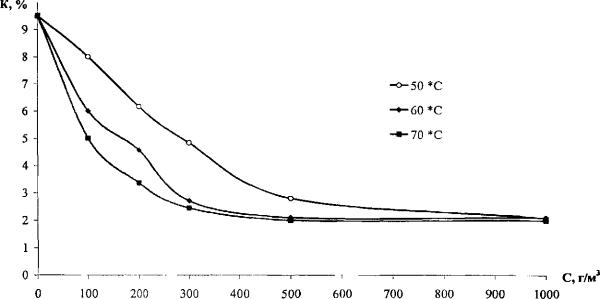
Figure 2 - The
dependence of the water content in processed products, depending on the dosage
of the reagent "Hercules 1017" with different initial temperature of
the oil slime treatment.
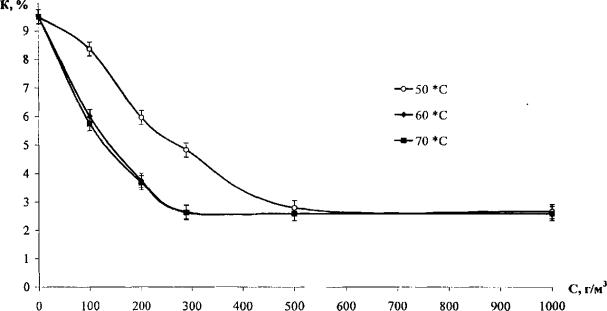
Figure 3 - The
dependence of the water content in processed products, depending on the dosage
of the reagent "Daufax DF" with different initial temperature of the
oil slime treatment.
According to the results, it
can be argued that the optimal dosage of reagents is 300 g / t, and the
temperature of the initial treatment can be recommended 60° C
The list of references:
1. Sayakhov F.L., Zinnatullin
R.R., Sufyanov R.R. and others. High-frequency dielectric spectrometry for the
selection and performance evaluation of inhibitors application of the ARPD in
the production fields of "Archangelskgeoldobycha" // Petroleum
Engineering, 2002. №2. - P.27 -31.
2. The selection method of
potentially effective reagents for the prevention and removal resin paraffin
deposits. Sayakhov F.L., Zinnatullin R.R., Sufyanov R.R. and others. // Patent
for an invention RU №2186202S17E21V 37/ 06. – Published in B.I. 2002 №21.