Технические науки
Nurushev
S , Ph.D.
Koctanai state University. A.Baitursynov
Justification of milling modes for surface treatment
of solonetzes.
Annotation
The
analysis was carry out according to processing technologies above
solonetsz layer, there is method of determining the limit
modes milling at fallow and half fallow processing systems .
Creating facilities for the growth and development of grass on solonetz
lands , along with other factors depends on the structure of the soil layer
above solonetz created as a result of
tillage impact their working bodies ,
wheel implements tractors. Here
with soil clods break into smaller. Spray the soil , are known to adversely
affect its properties agro-physical , a Northern Kazakhstan conditions leads to
the wind erosion . Above solonetz humus layer is the most valuable plants and
therefore requires careful handling during processing. With this particular
relevance and importance is the mode selection milling machine [1].
As the main constraints milling modes , must obviously be taken
thresholds quality processing , in particular , the degree of crumbling of soil
erosion and the content of hazardous particles. Studies on the identification
and justification of these indicators in northern Kazakhstan has not previously
been conducted.
However, in-depth studies of the dynamics of the structural units of
above solonetz layer soil destruction
after basic processing taking into account the factors listed in SpbIME
held on solonetzes Baraba lowland in 1970 ... 1973. [1 ] . In particular,
proved the high efficiency at this milling operation on agrotechnical , energy
and economic indicators compared with disking and recommended the following
limits on the degree of crumbling soil treatment at the main content of soil
fractions to 50 mm should be in the system a couple of 40.5 ... 54 1, half
fallow - 58.6 ... 68.8 % , fractions of 20 mm - 34.0 , respectively 41.0 and
53.0 ... 61.0 ... %.
Dynamics of changes in the soil structure in the system of fallow and
half fallow, according SibIME [2] , clearly characterizes the subsequent
mechanical impact : treatments. In the area for a couple of Baraba after
primary treatment is carried out before sowing three operations , while the
total number enucleating sixfold and reconsolidation one track - only ten
passes aggregates. On half fallow be four operations , including a sixfold
shelling , five times harrowing , and rolling in one track - a total of 12
passes aggregates.
For an area of Kazakhstan has three operations : crop field into a
single track, double treatment steam harrow BIT- 3 and double disking plow
harrow LDH -10 - just five passes aggregates [3].
From these data it is evident that the total number of treatments in
this area is less than 2 times or more, which is mainly due to the difference
in the soil. In our conditions, the soil surface layer sod is weak , prone to
dusting .
In addition to the technology options SibIME not considered the impact
on the structure of the soil layer over solonetz operations deep treatment after milling, in which the wheels of
the tractor ripper , its working bodies also lead to changes in the original structure
of the soil. It acquires special importance in relation to the basic -block
tools for processing with wheel tractors "Kirovets" .
Analysis on the effect of milling quality tillage indicates identity
patterns obtained under different conditions. According SibIME , mill feed is
recommended on the knife within 7 ... 10 cm to provide the desired degree of
crumbling soil and minimum spray []. When using these modes in our conditions
observed excessive spraying soil , a large amount of erosion-prone particles.
However, given the limits of crumbling soil are achievable when milling with a
larger serving knife, i.e more forward speed of the machine. It is necessary to
seek and to reduce the circumferential speed frezbarabana . This requirement is
an analytical and experimental study . As it is known , the degree of crumbling
soil ( K) , the circumferential velocity milling reel (Vo) and serve on the
knife (S) with other fixed parameters are interrelated by the following
empirical equations [4] :
(1
)  %,
%,
(2 ) 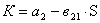 %,
%,
Where in A1, A2 , B1, B2 , C - coefficient obtained by approximation .
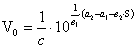
Since
the degree of influence on the circumferential speed of the crumbling of the
soil and feed on the knife difference find the relationship of equations (Vo)
and (S):
(
3)  ,
,
When processing of virgin sod solonetzes in Kostanai region , for
example, milling reel diameter of 450 m with four knives in bilateral
translational speed of 2 m / s formulas and coefficients are as follows:
A1= 24.1 %
: a2 = 123.1 % ; в1 = 96.8 % ; в2 = 6.65 % / m , с= 1 с / m
Putting these values into equation (3 ) yields the
relationship (Vo) and (S), from which it is seen that by increasing feed blade
at a constant forward speed can reduce the circumferential velocity . And the
supply on the knife optimized degree of crumbling soil
( 4)  ,
,
( 5)  ,
,
|
|
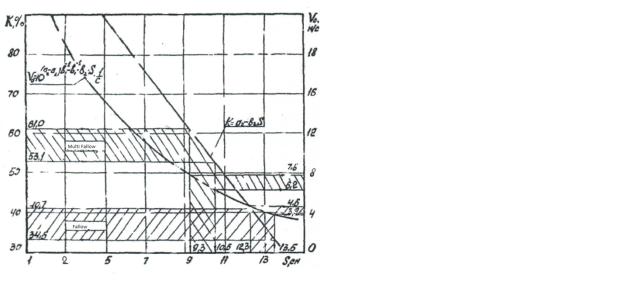
Interconnection
raising soil crumbling and milling modes with m / s ; DF = 0.45 m
Plotting these curves (see Fig. ) And overlaying limited by crumbling
soil by raising the optimal feed value on the knife , and then feed on the
knife - the values of the circumferential speed milling reel .
Point
of interconnection regimes and the quality of the cutter will be taken as a
basis for our ongoing studies to substantiate the basic design parameters of
the milling machine.
literature
1.
Zhulamanov K, S Nurushev. Using rotary instruments for continuous processing of
soil . - In the book . . Mechanization of production : processes in crop
production of Northern Kazakhstan . Alma- Ata , 1981, p.111 ... 115.
2
. Kulebakin N. Waterline machining solonetzes Baraba lowland . Nauka,
Novosibirsk, 1980, p . 88 ... 101.
3
. Methodological guidelines for soil reclamation research and development of
land reclamation projects solonetz in the Kazakh SSR . Alma- Ata , 1980, p.74
... 101.
4
. Zhulamanov K, K Nikonov , A. Terpilovsky Milling sod alkaline soils in the
Northern Kazakhstan. - Scientific and technical bulletin VIM vyp.28 , M. , 1976
, p.27 ... 29.