Ph.D., associate
professor Belyakov M. V., student Kharitonova D.A.
The Branch of National Research University
"Moscow Power Engineering Institute" in Smolensk,
Russia
Research of galega orientalis seeds with luminescent methods during scarification
Before sowing the galega orientalis (fodder galega or eastern
galega) seeds are
scarified by breaching the integrity of the shell. Such superficial shell
damage allows seeds to absorb water and swell better and also grow faster.
Scarification can increase the germination rate from 10 to 90%, but it should
be carried out not earlier than 3-4 weeks before sowing, because scarified
seeds lose their germination quickly [1].
In this research we carried out measurements of excitation and
luminescence spectra using the hardware-software complex consisting of
multifunctional spectrofluorimeter "Fluorat-02-Panorama", a computer
with installed «Panorama Pro» software and an external camera for the testing
samples.
In the first experiment the mechanical scarification
of 200 galega orientalis seeds was made with the sandpaper. Wherein the
intensity of this scarification was different: 100 seeds were slightly scarified, 100 –
strongly scarified.
The technique involved the following steps:
1. Preparation of the installation.
2. Visual analysis and seed samples selection.
3. The excitation spectrum measurement of unscarified seed.
4. The luminescence spectrum measurement of unscarified seed.
5. Seed scarification with sandpaper.
6. The excitation spectrum measurement of scarified seed.
7. The luminescence spectrum measurement of scarified seed.
8. Tracing and averaging of excitation and luminescence spectra and its
general analysis (Fig. 1).
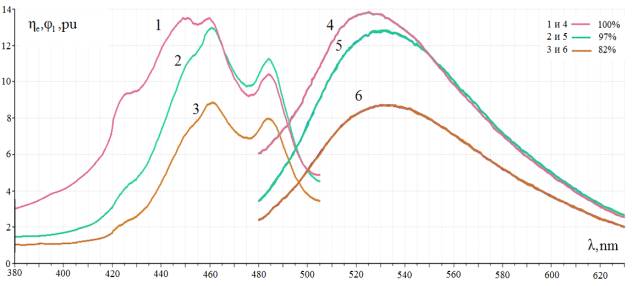
Fig.1. - The excitation and luminescence spectra of galega orientalis seeds: 3, 6 - unscarified; 2, 5 – slightly scarified;
1, 4 – strongly scarified
The germination results of galega orientalis were obtained and placed in Table 1. Besides, for the
mathematical processing in «PanoramaPro» integrals under the curves of
excitation and luminescence and their average value were calculated (Table. 1).
The integral under the curve of the luminescence spectrum has the physical meaning
of the luminescence flux. The integrals under the curves of excitation were
calculated for the two parts of the spectrum: 380-475 nm, and 475-505 nm to
determine the relationship between the humps.
Table 1
Luminescent
specification of galega orientalis seeds of different germination
|
Scarification |
Germination, % |
Excitation |
Luminescence |
|
|
Нav., pu |
Фav., pu |
|||
|
380-475 |
475-505 |
|||
|
Strong |
100 |
1202 |
212 |
1282 |
|
Slight |
97 |
680 |
292 |
1194 |
|
Absence |
82 |
340 |
165 |
833 |
Operating range of the excitation spectrum: 380-505 nm; the major
maximum at unscarified and slightly scarified
seeds is 461 nm, while strongly scarified
seeds have two major peaks: 450 and 460 nm; supplementary peak of all three:
485 nm. Also strongly scarified seeds
have additional supplementary peak at a wavelength of 425 nm. Operating range
of the luminescence spectrum: 480-630 nm. Curve of luminescence spectrum
reaches a maximum in the range from 527 nm to 535 nm. And, for strongly scarified seeds that range is
displaced to the left: 520-530 nm.
In addition, the Figure 1 shows that due to the scarification maximum ηe
of bimodal excitation spectrum has increased with respect to the excitation
spectrum of unscarified seed: for slightly scarified
by 32% and for strongly scarified by 34%.
The position of the maxima in the spectra of unscarified and slightly scarified seeds has not changed, but
the ratio of their intensity has changed: at unscarified the intensity of the
first maximum is 0.9 pu greater than the second maximum, and at slightly scarified - 2 pu. If we take the two
main peaks of strongly scarified seeds as
a one, the ratio of their intensity maxima differs by 3.1 pu. Change of the
intensity of the luminescence spectrum is similar to the change of the
excitation spectrum: intensity increased by 32 and 34%, respectively.
In the second experiment we carried out the time dependent research of luminescent specifications
of 30 galega orientalis seeds during scarification. We measured: excitation
and luminescence spectra of unscarified seeds, spectra measured immediately
after the scarification, spectra measured one day after the scarification and 7
days after the scarification. Moreover, tracing and averaging of excitation and
luminescence spectra was made (Figure 2).
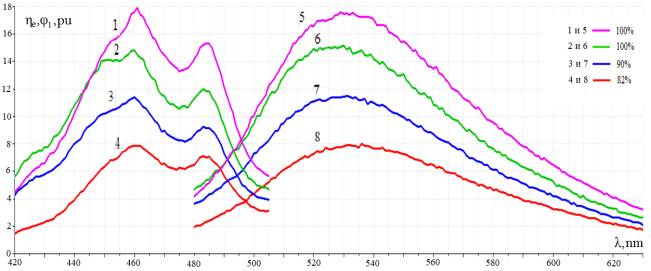
Fig.2. - The excitation and luminescence spectra of galega orientalis seeds: 4, 8 - unscarified; 3, 7 - measured immediately after the scarification; 2, 6 - measured
one day after scarification; 1, 5 - measured 7 days after scarification
We obtained the
germination results of galega orientalis
and placed them in Table 2. Integrals under the curves of excitation and
luminescence and their average value were calculated (Table 2).
Table
2
Luminescent
specification of galega orientalis seeds of different germination seeds depending on the time after
scarification
|
Seeds |
Germination,
% |
Excitation |
Luminescence |
|
Нav., pu |
Фav., pu |
||
|
Unscarified |
82 |
362 |
724 |
|
Measured immediately after the scarification |
90 |
556 |
1056 |
|
Measured one day after scarification |
100 |
808 |
1362 |
|
Measured 7 days after scarification |
100 |
896 |
1590 |
Operating range of the excitation spectrum: 420-505 nm; the major
maximum at unscarified, measured immediately after the scarification and one
day after the scarification - 460nm, while measured after 7 days - 461 nm.
Operating range of the luminescence spectrum: 480-630 nm. Curve of luminescence
spectrum reaches a maximum in the range from 527 nm to 535 nm. And, for the
seeds measured after 7 days that range is displaced to the left.
Figure 2 and Table 2 shows that after scarification relative
luminescence flux continues to grow: in a day – by 29%, after 7 days - by 16.7%
more from the previous measurement. Hence, it is recommended to make
scarification a week before the sowing.
In the third experiment the kinetic
specifications of luminescence
were measured. The scanning of five unscarified and scarified galega orientalis
seeds was held by duration and by delay (Fig. 3). Measurements were carried out
by delay at τdur = 4.45μs and by duration at τdel = 0.75 μs, λe
= 534 nm, λr
= 461 nm (previously obtained by measurement of the excitation and luminescence
spectra).
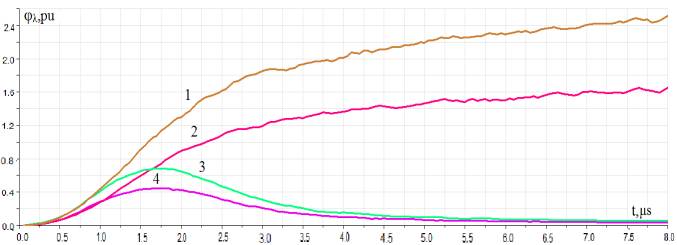 Fig.3. - The results of the kinetic
specifications of luminescence
measurements of galega orientalis
seeds: 4, 2 – unscarified by delay (4) and duration (2); 3, 1 - scarified by delay
(3) and duration (1)
Fig.3. - The results of the kinetic
specifications of luminescence
measurements of galega orientalis
seeds: 4, 2 – unscarified by delay (4) and duration (2); 3, 1 - scarified by delay
(3) and duration (1)
Measuring the of galega orientalis
seeds’ kinetics of growth, we
find out that up to 0.4 μs signal is very small, then begins to rise
sharply to 2.6 μs, then grows more slowly and from 4.0 μs almost
unchangeable.
Measuring the of galega orientalis
seeds’ kinetics of decay, we
obtained that the signal is maximum from 1.2 to 2.0 μs.
References:
1. Vozdelyvanie
kormovyh kul'tur. Galega vostochnaya. Podgotovka semyan k sevu, posev [Digital
resource]. – Access mode: http://agrobelarus.ru/content/podgotovka-semyan-posev-galegi-vostochnoy. Date of application: 12.02.2016.