Ph.D in Economics, Associate Professor Fatenok-
Tkachuk A. A.
Lecturer, department of Accounting and Auditing,
Lesya Ukrainka Eastern European National University,
Ukraine
Hrab O. B.
4 course Student in accounting and auditing
Lesya Ukrainka Eastern European National University,
Ukraine
Reconciliation
of financial statements of domestic entities for the purposes of foreign
contractors
Ukraine has widely developed
industries such as: agriculture, power engineering, information technology,
engineering, coal and chemical industry, its quality in engaging the
cooperation many companies and in turn contribute to the development of foreign
economic relations, not only from the Middle East such as Japan China, Egypt,
Israel, Tunisia, etc .., but also from Europe. Such cooperation
makes the Ukrainian export-oriented enterprises have accessible and transparent
financial reporting. Since Ukraine is guided by NP(S)1, which has significant
differences from IFRS, have had difficulty in understanding the financial
statements for exporters.
Benefits of financial
reporting according to international standards is undisputed for most users of
financial statements since IFRS can be regarded as a tool of economic
globalization and the world economy. The principles laid
down in the procedure of reporting according to IFRS, make it adequate and able
to reflect the true financial status and performance of the organization. In this regard the
value of IFRSs is important not only for international but also for domestic
investors. This has confirmed the need and usefulness of IFRS
implementation process for all sectors of the economy of Ukraine [1].
It should be noted that today
there are certain contradictions that it would be appropriate to remove. Specifically,
questions arise as to reflect other operating and other income and expense
classifications of activities aiming components of other comprehensive income,
the presentation elements operating expenses. The positive change
of NP(S)1 is mandatory reporting of other comprehensive income. Value of
comprehensive income as an indicator of changes in the assets of the company
are very informative because the underlying decision making investors and
creditors.
Since January 1 st 2012,
according to the Law of Ukraine «About accounting and financial reporting in
Ukraine » ( ch. 2, Art. 121) public
joint stock companies, banks, insurers and companies that conduct business
activities for species listed determined by Ukrainian government, regardless of
affiliation to the classification group entities (small, medium or large
business) have prepared financial statements in accordance with IFRS.
The use of IFRS is accompanied
by some difficulties, because they involve the use of judgment for the
recognition, measurement and disclosures in the financial statements. Law of Ukraine
«About Accounting and Financial Reporting in Ukraine» № 996 for entities
provided the opportunity to establish the feasibility of international standards
for financial reporting. In addition, the need for IFRS reporting may be due to
investor entities with foreign investment. In these cases, Ukrainian financial
statements should be transformed [1].
In the years 2013-2014 has
undergone significant changes form number 2 «Income Statement», which received the second
name «Statement of comprehensive income». The main changes
can determine input indicator «Total Income» and excluding extraordinary
items of income and expense that this report has brought to IFRS.
After analyzing the legal
documents on the formation of financial reporting potential partner countries,
namely IAS 1, US GAAP, GAAP Estonia and NP (S) 1, we can conclude that our
report recalls a similar Statement of profit or loss and other comprehensive
income.
Despite the fact that IAS 1
permits an alternative to providing information on other comprehensive income,
the developers of the national reports suggested no alternative hybrid
presentation of financial results - only report two separate sections (one - to
reflect the financial performance, the other - for the formation of other
comprehensive income) [1].
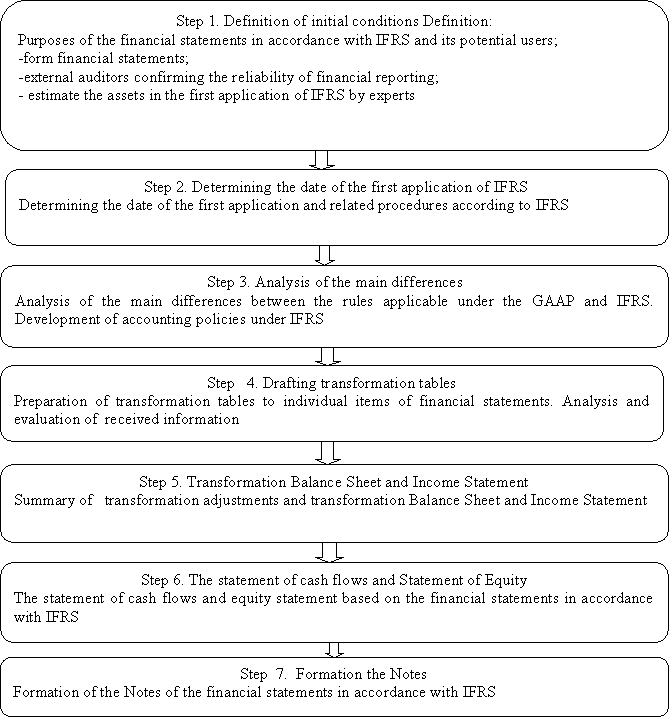
After analyzing
the highly specialized work and guidelines for the formation of the financial
statements can be identified stages of transformation of financial statements
(Figure 1).
After the transformations
indicators Income statement becomes un
Fig. 1 Stages of transformation of financial statements
Source: [2]
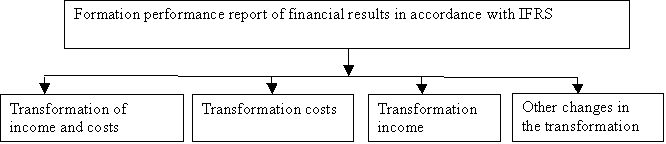
As the Balance Sheet and Income Statement are
reflecting income of the company, consider the transformation of data reporting
in accordance with IFRS (Figure 2).
Show separate item Income (loss) from discontinued operations Information about other operating income and costs items should be included in "Other
Income" and "Other Expenses" respectively Income and costs from Equity should be displayed in separate article Remove from the administrative expenses amortization of goodwill and
include the amount of the value of goodwill in the balance In the article "Income Taxes" should indicate the amount
of income tax payable under the law, adjusted for changes in the deferred
tax assets and deferred tax liabilities as defined in IAS 12 Within the articles "Other income" and "Other financial
expenses" should be deleted and displayed separate article: Cost of
financial investments, income or expenses from revaluation of financial
investments; exclude borrowing costs relating to qualifying assets and to
include the cost of qualifying assets Include the cost of doubtful and bad debts in the cost of sales of
their previous exclusion from the "Other operating expenses"

Fig. 2
Areas of reform indexes in the preparation of the income statement according to
IFRS
Source: [1]
After the
transformations indicators, Income statement becomes understandable to foreign
users, but the biggest concern of foreign investors following the clash between
generally accepted (Ukrainian
GAAP) accounting principles with the International Financial Reporting
Standards (IFRS)2 which require the most urgent
attention [3]:
1.
Ukrainian GAAP has no explicit requirement that parent companies must
present consolidated financial statements (compared to IFRS 27). The absence of
an explicit requirement to consolidate financial statements allows companies to
hide their debts from potential investors.
2.
Ukrainian GAAP contains no specific regulation on whether part of the cost
of an acquisition may be attributed to acquired research and development
(compared to IFRS 22.27). The absence of requirement makes the financial
statements of Ukrainian companies incompatible even with the statements of
other companies in the country.
3.
Ukrainian GAAP has inadequate standards regarding the translation of the
financial statements of subsidiaries in hyperinflationary economies (compared
to IFRS 21.36). Inadequacy of the standards on this matter leads to
incompatibility of the financial statements with those of foreign companies
and, more importantly, to inaccurate or misleading financial reporting.
4.
Ukrainian GAAP imprecise requirements for impairment reviews (compared to
IFRS 36.6-14). Absence of precision in these requirements allows companies to
reflect outdated assets at higher values.
5.
Ukrainian GAAP includes no rules for the fair values of financial assets
and liabilities (compared to IFRS 32.77). Absence of such reporting rules
allows companies to report their assets at higher values and their liabilities
at lower amounts.
6.
Under Ukrainian GAAP, trading, available-for-sale, and derivative financial
assets and liabilities are not recognized at fair value (compared to IFRS
39.69, 39.93). Under these conditions, if the values of such assets change
during the year the financial statements of the company will be misleading to
the financial statement users.
After analyzing the domestic legal documents, it is worth noting that to
this day remain a mismatch of accounting for international and national
standards, leading to statements incompatibility. A reconciliation statement of
comprehensive income will attract additional investment resources from both
domestic and foreign investors.
References :
1.
Vojnarenko M. P., Lopatovs'kyj V. H. and Tarashevs'ka O. V. (2015), «Sutnist' ta znachennia zvitu pro finansovi rezul'taty v umovakh transformatsii finansovoi zvitnosti », Visnyk Khmel'nyts'koho natsional'noho universytetu. Ekonomichni nauky, vol. 4(2), pp. 30-35,
available at: http://nbuv.gov.ua/UJRN/Vchnu_ekon_2015_4(2)__8
2.
Hrybovs'ka Yu. M. (2015), «Transformatsiia
finansovoi zvitnosti ta perekhid na MSFZ», Poltavs'kyj Visnyk, pp. 113-122, available
at: http://Vkhdtusg_2015_162_16.pdf
3.
Eldar Maksymov and Dr. Earl K Stice (2014) «Ukrainian
Financial Reporting: The Need for Change», The
Journal of Undergraduate Research Brigham young university. -
Available
at: http://jur.byu.edu/?p=9624