Master student Tsyplakova D.D.,
Ph.D.Dyakov I.A.
Tambov State Technical University, Russia
Calculation
of power losses in transformers
Power losses in transformers are composed of
the losses of active and reactive power. Active power losses are, in turn, from
loss on heating of the windings of the transformer depending on the load
current, and losses of heat in the steel, independent of the load current.
Active power losses is expressed by the following formula:
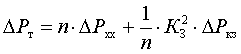 , (1)
, (1)
where - power
loss short-circuit of the transformer (losses in the windings) at rated load,
kW;
- power
loss short-circuit of the transformer (losses in the windings) at rated load,
kW;  - power
losses transformer no-load (iron loss), kW;
- power
losses transformer no-load (iron loss), kW; – the
load factor of the transformer, n-is the number of transformers.
– the
load factor of the transformer, n-is the number of transformers.
Loss of reactive power is also composed of two components: losses
induced by the scattering of the magnetic flux in the transformer and depending
on the square of the load current, and the magnetization losses of the
transformer, independent of the load current and the load currentIхх.Loss of reactive power is
determined from the following expression:
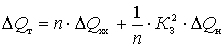 , (2)
, (2)
where - loss
of reactive power in the transformer, kVAr;
- loss
of reactive power in the transformer, kVAr; - loss
of reactive power in the transformer at idle (losses on remagnetization), kVAr;
- loss
of reactive power in the transformer at idle (losses on remagnetization), kVAr;
 - loss
reactive power dissipation in the transformer at full load, kVAr.
- loss
reactive power dissipation in the transformer at full load, kVAr.
In turn:
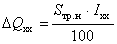 , (3)
, (3)
whereSтр.н–
nominal transformer capacity, kVA; Iхх– no-load current of the
transformer, in %.
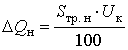 , (4)
, (4)
whereUк–the thermal short-circuit voltage of the transformer, in %.
Power taking into account power losses in the
transformers required for further calculations (for example, if you select
cable lines) is determined as follows:
 , (5)
, (5)
whereРп – the active power taking into account power losses in transformers,
transmitted by cable lines, kW; P –
active power, kW.
Similarly, find the reactive power transmitted on the cable line (CL):
 , (6)
, (6)
The total power is calculated by the formula:
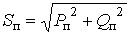 . (7)
. (7)
Example of calculation of power
losses in TP
For
Example: Sтр.н=400 (kVA), КЗ =
0,93 ;  ,
,  ,
,  ,
,  , P = 232,78 (kW), Q = 282,15 (kVAr).
Then by (1) to(7) we
get:







Compensation
of reactive power in transformers
Most of the receivers in the process
consumesfrom the network in addition to active power reactive. The transfer of
a significant amount of reactive power on the lines through the transformers of
the power supply system is disadvantageous because of occurrence of additional
losses of active power and energy in all its elements, and also due to
additional voltage losses.
The optimal value of the power factor in the
enterprise is produced by reactive power compensation as the natural action (by
improving modes of operation of the receivers), and by installing compensating
devices in the respective points of the power supply system.
The capacity of the compensating device Qк is
defined as the difference between the reactive load of the enterprise QS and maximum reactive power provided to the
grid company by the condition of its mode Qэ:
 , (8)
, (8)
where - the
tangent of an angle conforming to the enterprise the conditions for obtaining
power.
- the
tangent of an angle conforming to the enterprise the conditions for obtaining
power.
Compensating devices installed on the 10 kV
side of the enterprise.
Reactive power after compensation is defined
as:
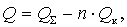 (9)
(9)
wheren-is the number of capacitor units.