Agriculture / 4.Technologies
storage and processing of agricultural products.
Mahacheva E.V.
Siberian University of Consummer Co-operatives (SUCC), Russia
Effect
of cold storage on the quality indicators of minced meat products
Minced
meat products are multicomponent and active systems, in which both are
microbiological and physico-chemical reactions which have a significant effect
on the taste, texture and shelf life of the product. Reduced quality of
semi-finished and finished products of minced meat is mainly due to lipid
oxidation and microbial growth, which can get into the product at any stage of
the process.
The
rate of oxidation of lipids is dependent on the temperature of storage
products, exposure to oxygen, and the chemical composition of the initial state
of the raw materials used, heat treatment. Obviously, most are highly
susceptible to oxidative damage of minced meat products that contain a lot of
moisture and fat.
Therefore,
the aim of this study is to obtain data on the physico-chemical and
organoleptic parameters culinary multi minced meat products prepared according
to «Cook and Chill» technology, and change these parameters during cold
storage. «Cook and Chill» technology is defined as a catering process whereby
meals or meal components are fully cooked, then cooled by controlled chilling
and subsequently stored at a temperature above freezing point (i.e.≤3
°C), prior to regeneration and/or service.
As
objects of study selected four minced products with different combination of
meat ingredients and different fillings, made on «Cook and Chill» technology: №1 - minced chicken (70%), white bread
(9%) and other components (21%); №2
- minced chicken (30%) + minced pork (40%), boiled eggs (20%) and other
components (10%); №3 - minced
chicken (55%) + minced beef (40%) and other products (5%); №4 - minced chicken (22%) + minced beef
(18%) + minced pork (20%), boiled rice (10%) and other components (30%).
Cooling
temperature of the samples was 4±2°C, regeneration products was carried out in
Rational Combi Steamer Mode Self Cooking Center (SCC) «with termokernom"
to the temperature in the center of the product 65 º C. The studies were
conducted by standard methods: peroxide value - by oxidation of hydriodic acid
peroxides contained in the fat, acid number - Titration of free fatty acids in
the ether-alcohol solution of an aqueous alkaline solution of fat. Organoleptic
evaluation minced culinary products at the control points (0, 24, 48, 72 h) was
carried out according to GOST 9959-91 on a 9-point scale (appearance, color,
the cut, smell, taste, texture, juiciness), 1-4 - negative quality minced meat
product, 5-9 - positive.
In
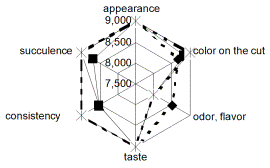
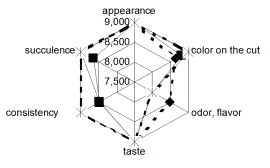
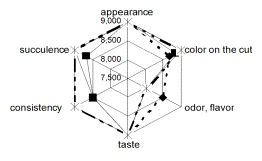
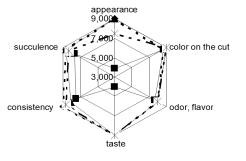
Fig. 1 shows the results of sensory evaluation of samples during storage.
a b
c d

Fig.
1. Profilograms sensory evaluation minced meat products: a - freshly cooked
product, b - recovered product after cooling; c - recovered product in 24-48
hours of storage; d - the product recovered after 72 hours of storage
Found that in the range of 0-48 hours of storage organoleptic changes
are observed. After 72 hours of storage for your reference (formulation number
2 and number 4) is different from the freshly - has moist crumbs form, in a few
places is peeled from the product; consistency - less juicy. Smell and taste
for all products, except for prescription number 2 - peculiar to them. In item
number 2 there is a weak non-specific product fresh flavor.
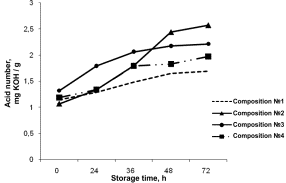
In Fig. 2 shows the results of determination of the peroxide and acid
number of lipid chilled minced meat food products during storage.

a b
Fig.
2. Peroxidation (a) and acid (b) number of lipid chilled minced meat food
products during storage
In chilled culinary products number 1, 2 and 4,
peroxide value slightly increased, not to exceed the recommended standards. In
the samples prepared according to a recipe number 3, after 72 hours of storage
has been a sharp increase in this index, not going beyond the level of normal
(Fig. 2a).
In all of the products in storage, an increase in the
acid number of fat due to the hydrolysis process and the accumulation of free
fatty acids. This change is especially pronounced in the recipe number 3 (after
36 h acid number has increased more than 2-fold) (Fig. 2b). On
organoleptic changes are not affected. Perhaps the intensity of hydrolytic
processes can be associated with humidity of products and a ratio of fat
components in the formulation.
Thus, the results of studies lead to the conclusion
about the possibility of the production and storage of prepared multicomponent minced
meat products prepared according to «Cook and Chill» technology, with no
significant change in the quality of the source within 48 hours (t=4±2 ºC).