Petrenko Yu.V. Nychyk
O.V. Salavor O.M.
National University of Food Technologies
Environmental audit of a bread-baking plant
In general sense environmental audit is a tool helping
to ensure self-control of an enterprise in the area of its environmental
activities allowing not only to response timely to events that may result in
adverse changes in the environment, but to avoid them as well.
Bread-baking production as the object of environmental
impact is deemed to be the least dangerous for the atmosphere and water
resources, but as the object of environmental audit of an enterprise is shall
carry out its activities on the basis of the established legislative and
regulatory documents.
Proper organization of production of baked goods and
prudent use of resources in bread-baking is the priority task, achieving which
influences the quality of products and reduction of their self-cost, and
consequently the growth of profits of bread-baking plants, their
competitiveness, possibility to implement new innovative equipment into
production and enter new consumer
markets.
The goal of environmental audit is gathering
trustworthy information on production activities of an enterprise, and drawing
respective conclusions regarding actual environmental audit of the object. In
other words, environmental audit aims at identifying any existing or potential
problems an enterprise may face in respect to compliance with environmental
requirements.
Simultaneously with carrying out environmental audit
at a bread-baking plant an integrated assessment of an enterprise shall be
performed, which assessment shall
include the climate and nature
characteristics of the territory, raw materials quality control, study of
technologies and production equipment, assessment of finished products quality
and the mechanism of environment
protection organization.
The climate and nature characteristics include
geological, hydrogeological conditions, climatic regime, soil fertility and
availability of surface water resources.
Raw materials quality control includes gathering and
preparation of raw materials, which are used according to the recipe. The
quality of raw materials is assessed in compliance with requirements of valid
regulatory documents relative to the
certain type of raw materials, physical and chemical, organoleptic indicators.
Study of production technologies consists in complete
studying all technological processes and establishing compliance with all
effective norms of bread production.
Definitions of physical and chemical, organoleptic
indicators and product safety indicators in accordance with established
regulatory documents are to be combined in the finished products quality
assessment.
An obligatory part of environmental audit is defining
the mechanism of organization of environment protection at an enterprise:
control over atmospheric emissions and discharge waters, as well as assessment
of disposal of solid household wastes. A bread-baking plant shall have
approvals and fixed limits of emissions and wastes agreed with sanitary
authorities. Bread-baking production as any industrial activity is not a
waste-free one that is why measures used at an enterprise to avoid air
pollution with gas-dust emissions, type of waters (reserve waters from wells or
water from city sewerage network) used and preliminary purification of discharge waters shall be controlled. Disposal of solid wastes with adherence to
sanitary and environmental standards with the purpose of further use as
secondary raw materials shall also be controlled.
Conduct internal environmental audit as one of the
mechanisms of environmental enables not only minimize the negative impact on
the environment and thus reduce environmental payments, but also increase the
efficiency of the overall system management.
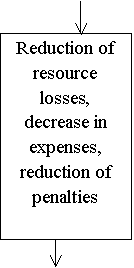
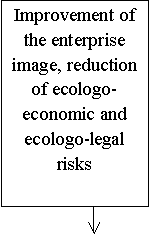
In Fig. 1 shows the basic workings and results of
internal environmental audits
Internal environmental audit is an independent,
systematic, comprehensive, documented process of study, analysis and evaluation
of various environmental aspects of the company. This process is in accordance
with the goals, objectives and criteria defined in this case bakeries. Based on
the results of internal environmental audit recommendations designed to improve
both ecological and main production enterprise.



 Tools of internal
Environmental 
 audit
audit

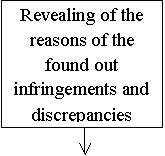
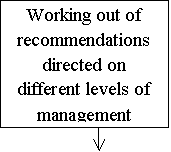


 Results of
internal
Results of
internal



 Environmental audit
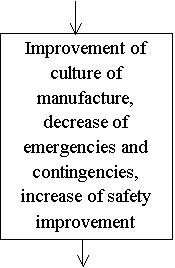
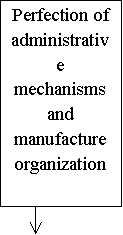
Increase of efficiency of the basic industrial
activity and rates of the enterprise development with minimization of its
influence on environment
Improvement
of the enterprise image, reduction of ecologo-economic and ecologo-legal
risks
Fig.1 Basic mechanisms of internal environmental audits
It is important to emphasize that the development
activities in the field of environmental auditing and management will not only
solve specific economic and environmental problems that are posed to the
individual companies and entire countries, but also to encourage the untapped
potential of Ukraine (including cultural, intellectual, entrepreneurial) in
addressing national and global environmental problems.
Literature:
1.
 Про екологічний аудит: Закон України від 24 червня 2004 р, №
1862 – IV. – Уря-довий кур'єр. –
2004, № 150
Про екологічний аудит: Закон України від 24 червня 2004 р, №
1862 – IV. – Уря-довий кур'єр. –
2004, № 150
2.
Екологічний аудит:
Посібник з екологічного менеджменту і екологічного аудиту /Шевчук В.Я.,
Саталкін Ю.М., Навроцький В.М. та ін.. – К.: Символ-Т, 1997. – 221 с.;
3.
Юрченко Л.І.
Екологія. – К: Видавничий дім «Професіонал»,
2009. – 201-265с.
4.
Внедрение внутреннего экологического аудита Макаров С.В., Бирюкова Н.В., Лапенкова Е.С.
// Экология производства. – М.: Отраслевые ведомости, 2009 №10. – 35-54с.
5.
Процедура
внутреннего экологического аудита на промышленных предприятиях. Макаров С.В.,
Лапенкова Е.С. Бирюкова Н.В. // Экология производства. - М.: Отраслевые
ведомости, 2009 №12. – 36-42с.