Syurin
S.A., DrMedSci.
Kola Research Laboratory for
Occupational Health (Kirovsk, Russia)
OCCUPATIONAL PATHOLOGY IN APATITE ORE MINERS OF THE KOLA HIGH NORTH
Introduction. Most
apatite ore miners of the Far North have unhealthy working conditions due to cooling
workplace microclimate, vibration,
noise, physical overload, work in forced and awkward positions, dust and gas
mixtures [1, 2]. Adverse
impact of the above production factors significantly increases the risk for developing disorders of musculoskeletal,
nervous, cardiovascular and respiratory systems, hearing and visual impairment [4].
The aim of the study was to examine the prevalence, structure and features of formation of occupational diseases in the Kola High North apatite
ore miners.
Materials and methods. Data on
occupational diseases of Kola High North
apatite ore miners for the years
1964-2012 were obtained from archival documents stored at Kola Research Laboratory for
Occupational Health (Kirovsk, Murmansk region). The character of miners'
working conditions was determined by the results of workplace certification based on their severity and intensity,
the parameters of the microclimate, physical,
chemical and dust factors.
MicroSoft Excel 2007 and Epi Info, v. 6.04d were applied for statistical
analysis of the collected data with determination of Student's t-criterion, Pearson´s
correlation coefficient (r), criterion of consent χ2, relative risk (RR) and its 95% confidence
interval (CI). Numerical data are presented as mean
and standard error (M ± m). Differences are considered reliable at p<0.05.
The results. We found information
on 1150 cases of occupational diseases
newly diagnosed during the period 1964-2012 in 663 apatite miners (1.73
± 0.05 cases per employee).
Among them there were 662
men (99.8%) and one woman (0.2%)
with an average age 45.9 ± 0.4 years
and the experience of work at the enterprise 20.1 ± 0.3 years. In recent years there has been a steady upward trend in the detection of occupational diseases in apatite ore miners (employees of JSC “Apatite"). Thus,
67 patients were identified in 2001-2003,
80 patients – in 2004-2006, 113 patients - in 2007-2009
and 115 patients - in 2010-2012.
The ratio
of underground and surface mine workers
among patients with occupational health disorders was 3.9:1 (529 and 134
patients), whereas the average ratio of miners employed under and above the ground was only
2.2:1. Occupational diseases were most
frequently diagnosed in tunnellers, drillers and blasters. They were
much less prevalent in drivers of various vehicles (heavy
trucks, excavators, electric
locomotives, scoop trams), timber-men
and workers in other professions (see
Figure).
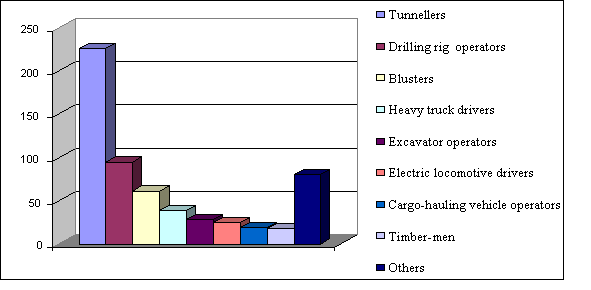

Figure. The
incidence of occupational diseases among workers of different
professions (number of cases).
According
to the hygienic assessment of working
environment factors, working conditions of tunnellers
(hand and mechanized excavation), hole drillers
and drilling rig
operators were defined as harmful of third - fourth
degree (3.3 - 3.4). Working conditions of blusters, timber-men, breakage face workers, drivers and operators of various
cargo-hauling vehicles and mechanisms
are rated as harmful of first - second degree (3.1-3.2).
The structure of occupational
pathology of apatite ore miners was dominated by diseases of
the musculoskeletal and peripheral nervous systems, vibration disease and neurosensory hearing loss. Together, they accounted for 95% of all cases (Table 1). The shortest length of service prior to the development of occupational
pathology was observed in tunnellers and drillers and it was
shorter (p<0.05-0.001) than that of heavy truck
drivers, timber-men and cargo-hauling
vehicle operators.
Table 1
Structure of occupational pathology
in apatite ore miners
|
№ |
Type of health disorders |
Structure |
|
|
Number of
cases |
% |
||
|
1 |
Diseases of musculoskeletal system |
384 |
33.4 |
|
1.1 |
Humeroscapular periarthrosis |
136 |
11.8 |
|
1.2 |
Deforming osteoarthrosis |
96 |
8.3 |
|
1.3 |
Humeral epicondylitis(osis) |
64 |
5.6 |
|
1.4 |
Antebrachial myofibrosis (pathosis) |
65 |
5.7 |
|
1.5 |
Myofascitis |
20 |
1.7 |
|
1.6 |
Other diseases |
3 |
0.3 |
|
2 |
Vibration disease |
225 |
1.6 |
|
2.1 |
Vibration disease (first stage) |
89 |
7.7 |
|
2.2 |
Vibration disease (first – second stage) |
61 |
5.3 |
|
2.3 |
Vibration disease (second stage) |
75 |
6.5 |
|
3 |
Diseases of nervous system |
271 |
23.6 |
|
3.1 |
Chronic radiculopathy
(cervical-thoracic and lumbosacral levels) |
102 |
8.9 |
|
3.2 |
Angioneurosis (angiotrophoneurosis)
of upper limbs |
53 |
4.6 |
|
3.3 |
Reflex syndromes of the
cervical and lumbar levels |
89 |
7.7 |
|
3.4 |
Vegetative (autonomic-sensory)
polyneuropathy |
24 |
2.1 |
|
3.5 |
Other diseases |
3 |
0.3 |
|
4 |
Neurosensory hearing
loss |
212 |
18.4 |
|
5 |
Cataract |
24 |
2.1 |
|
6 |
Diseases of respiratory system |
25 |
2.2 |
|
6.1 |
Chronic brochitis |
16 |
1.4 |
|
6.2 |
Pneumoconiosis |
4 |
0.3 |
|
6.3 |
Bronchial asthma |
3 |
0,3 |
|
6.4 |
Diseases of
upper respiratory tract |
2 |
0,2 |
|
7 |
Diseases of other
organs and systems |
9 |
0,8 |
The greatest number of diseases diagnosed in one worker was registered in
timber-men and underground mine
workers, which was higher than that of loading and haul equipment
operators (p<0.05), heavy truck
drivers (p<0.02), tunnellers (p<0.01 ) and blusters (p<0.05) (Table 2). The highest risk of
health problems was observed in tunnellers and drillers, which
include, respectively, 38.6% and
16.0% of all patients.
Table 2
Specific features of
occupational pathology in apatite ore miners
|
Group of workers |
Length of service |
Number of cases per worker |
Health disorders ( % ) |
||||
|
Musculo-skeletal system |
Nervous system |
Vibration disease |
Hearing loss |
Others |
|||
|
Tunnellers |
16.7±0.4 |
1.46±0.05 |
31.1 |
12.7 |
42.0 |
13.0 |
1.2 |
|
Drillers |
17,7±0.7 |
1.81±0.09 |
44.1 |
24.7 |
15.9 |
12.9 |
2.4 |
|
Blusters |
19.8±1.1 |
1.57±0.10 |
38.5 |
15.6 |
1.0 |
19.8 |
25.0 |
|
Timber-men |
23.2±1.1 |
1.94±0.14 |
58.8 |
13.2 |
7.3 |
19.1 |
1.5 |
|
Cargo-hauling vehicle
operators |
22.3±0.8 |
1.59±0.07 |
26.9 |
27.5 |
9.0 |
32.9 |
3.8 |
|
Heavy truck drivers |
24.0±1.4 |
1.53±0.08 |
17.2 |
44.8 |
6.9 |
27.6 |
3.4 |
The nature of occupational diseases of apatite ore miners was largely determined by the peculiarities of their
professional activity. Vibration disease was the most
frequent health disorder in tunnellers (42.0%) with the risk of
its development being higher than
that in all other miners (RR
= 4.69; CI 3.46-6.36;
χ2 = 135.8; p = 0.0000001),
including drillers with similar working
conditions (RR =
2.33, CI 1.73-2.86; χ2 = 35.6; p = 0.0000001). The
timber-men and underground mine
workers are at higher risk of developing diseases
of the musculoskeletal system (RR
= 2.25; CI 1.69-2.99; χ2 = 17.9; p
= 0.00002). The heavy truck driver are most
likely to suffer from disorders of peripheral
nervous system, primarily chronic
lumbosacral radiculopathy (RR = 3.36; CI 2.68-4.20;
χ2 = 53.4; p = 0.0000001) as compared to other
miners.
Neurosensory hearing loss was most common among cargo-hauling
vehicle operators and heavy truck drivers (p<0.05-0.02) with high risk of development
in comparison with all other workers of the mine (RR = 3.36;
CI 2.68-4.20, χ2 = 53.4; p = 0.0000001). Cataract developed almost exclusively (23 of 24 cases) in the blusters due to the impact of toxic components of explosive materials.
Severity of occupational health problems of miners increases with length of service. At a length of up to 10 years,
one employee was diagnosed to have 1.21
± 0.07 cases of occupational diseases. At the experience
of 10-19 years, their number increased to 1.55 ± 0.05 cases (p<0.02),
and at the experience of 20 years and more reached the highest level of 1.77 ± 0.06 cases per worker (p<0.05). The severity
of symptoms of vibration disease intensified with increasing duration of exposure to harmful factors: the first degree of the disease was diagnosed at the experience of 15.1 ± 0.6 years, and the second – 20.6 ± 0.9 years (p<0.001). There
was a direct correlation of
pathological changes in vibration
disease with the length of service
(r = +0.25, p<0.01).
Discussion. The
current conditions in the
extraction of apatite ores in the
Far North predominantly contribute to the development
of diseases of musculoskeletal and peripheral nervous systems, vibration disease and neurosensory hearing loss. The above health disorders
are more prevalent among employees
of underground mines as compared to workers employed at open
pit mines. The formation of work-related health problems
is mainly determined by the influence of physical factors: vibration, cooling
microclimate, noise, adverse ergometric
parameters. Toxic chemical substances
and dust which may cause cataract and respiratory diseases are of much less
importance. The risk of
developing pathological conditions in apatite ore miners
and their severity are directly related
to an increase in length of
service.
The structure of identified
occupational pathology in general
is consistent with previous studies
[3, 4]. In recent
years, there has been a steady trend towards increased prevalence of
occupational diseases among apatite ore miners of the Kola High North. In all
probability, this fact can not be explained by the deterioration
of miners´ health but can be attributed to more qualified periodic medical examinations.
Conclusions. The
findings suggest the need to improve working conditions of apatite miners
and, above all, those of
tunnellers and drilling rig operators. Special
attention should be paid to the development of more
effective prevention of locomotor system
disorders, vibration disease and
hearing loss.
References
1. Skandfer M., Øvrum A., Syurin S., Talykova L., Nikanov A. Miners exposed to hand-arm
vibration in Northwest Russia: Prevalence of vibration disease and different
diagnostic methods. Barents Newsletters
on Occupational Health and Safety. 2009; 1: 23-27.
2. Skripal B.A., Nikanov N.A. The role of
professional and industrial risk
factors in the formation of morbidity
rates in underground miners in the Kola North. Ekologiya
cheloveka. 2005; 5: 10-13 [in Russian].
3. Skripal B.A. Occupational morbidity, its features on enterprises of
mining and chemical complex in Kola Polar region. Ekologiya cheloveka. 2008;
10: 26-30 [in Russian].
4. Syurin S.A., Rocheva I.I., Burakova O.A. General and occupational
morbidity in apatite ore miners in Kola Polar region. Zdravookhranenie
Zapolyariya. 2010; 1: 34-38 [in Russian].