POSSIBILITIES OF APPLICATION OF THE COMPLEX INDEX AT
THE STOCK MARKET STATISTICAL PREDICTION
The concept
"stock market" from the point of view of the subjects operating on
it, is aggregated, compound, including in the structure the numerous types of
indexes, which ultimate goal of the analysis is to describe the predicted cash
flow. In our opinion, exactly the forecast of the cash flow is the fundamental
purpose, as in the creation of mathematical models of the stock market, and at
the prediction of its separate indexes. The above mentioned purpose is fully
answered by the descriptive statistics technique, and in particular the
dispersion analysis. It is also possible to refer the comparative ease of
carrying out the analysis to the advantages of this technique at the small span
time and availability of the software to the data set analysis. The dispersion
analysis is the invariable component when carrying out the fundamental analysis
and the analysis of portfolio risks.
But as it is
known, the analytical information in itself does not carry any amount of the
significant advantage without interpretation, or explanation according to the
purpose of carrying out such-like researches. At the same time, the specifics
of the stock market itself always carries in itself such lines as risk and
indeterminacy which are quite difficult for predicting at the application of
the formalized statistical models.
Unreasonable and
as a result the improper choice of the mathematical apparatus, generally leads
to an inaccuracy of the created mathematical models, receiving insecure results
in the process of their application and, respectively, there is a mistrust to
the received results, and conclusions on their basis are ignored.
Therefore, for
the efficient and targeted carrying out the analysis it is necessary to define
those mathematical criteria which influence on the accuracy of the predicted
cash flows.
It is also
apparent that the requirement of the input data determinacy is the unjustified
simplification of the reality as any complex index is characterized by a set of
factors of indeterminacy: indeterminacy of the input data, indeterminacy of the
environment, indeterminacy connected with the character, options and model of
the market participants. Factors of the indeterminacy define the investor risk
that is danger of loss of the resources. In the analysis of the long-term
prediction indexes, including on the basis of the statistical data, it is
necessary to analyze a condition of the large number of indeterminate
parameters of the market conditions for the long-lived period of time and
therefore the absolutely precise forecast at the high dispersion cannot almost
be received.
The logic of carrying out the
analysis with the use of complex indexes method means carrying out the
sequential stepwise analysis (picture 1).
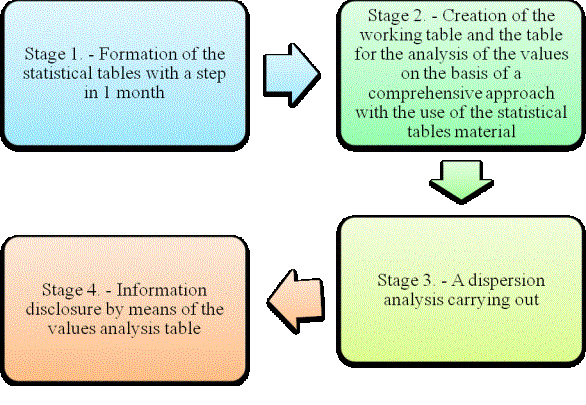
Picture 1 - Algorithm of the stock market forecast model creation on the
basis of a comprehensive approach of the input data for the dispersion analysis
choice
At the first
stage it is necessary to create the criteria tables, for example profitability
of assets on the groups. And, if there is an opportunity to reveal the forecast
and actual indexes of last periods, it is expedient to use both types of the
criteria.
At the second
stage on the basis of the chosen criteria the complex index that will be
considered in more detail further is formed. Data on the index for the period
are also formed in the table, at the same time, the table with recommended, or
desirable values, and also permissible variations is formed.
At the third
stage the immediately statistical analysis is carried out. It is expedient to
carry out this procedure in the MS Office applications, or Statistics, first of
all from the point of view of accuracy and speed of the receiving result.
At the fourth
stage the comparison of the analysis results to the table data for the analysis
is carried out, the result is interpreted and the research summary is
concluded.
As for the
complex index choice, in the matter it is necessary to be guided by a method of
expert estimation with after-treatment of data by the indistinct and interval
method.
The
given method is actual for using of the statistics indicators first of all due
to that it is more applicable to the indeterminacy conditions when the
boundaries of values of the analyzed parameter within which it can change are
reasonably precisely known only, but at the same time there is no quantitative
or qualitative information on the opportunities or probabilities of realization
of its various values in the given interval. According to this method, the
input variables are set in the form of the intervals whose membership functions
are classical characteristic functions of a set, therefore further the direct
application of rules of the indistinct mathematics for receiving a resultant
efficiency factor in an interval kind is possible. In the interval method it is
offered to take the value of the maximal damage per the unit of indeterminacy
for the risk degree [2, page 25]:
, 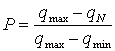 (1)
(1)
where is the parameter’s desired value;
 is the minimum parameter’s value;
 is the maximum parameter’s value;
 is the risk degree, or the ratio of
the distance from the requiredvalue to
its minimum or maximal one to an interval between its maximal and minimum
values.
is the risk degree, or the ratio of
the distance from the requiredvalue to
its minimum or maximal one to an interval between its maximal and minimum
values.
Below the main
advantages of the given approach to the creation of statistical arrays in
dispersion analysis are listed:
1. The given
approach allows to formalize in the indivisible form and to use all the
available non-uniform information that increases reliability and quality for
the choice in the strategic decisions;
2. The given
method similarly to the Monte-Carlo method forms the total spectrum of possible
scenarios of the stock market development, and not just the lower and upper
limits of the indexes fluctuations, thus the investment decision is made not on
the basis of two estimates, but on all set of the estimates.
3. The given
method allows the value of the negative results from investment activity - the
risk degree;
4. The method
does not require absolutely precise set up of the membership functions as
unlike the probability methods, the result received on the basis of the
indistinct and interval method is characterized by the low sensitivity to the
change of the membership functions type of the initial indistinct numbers that
in the actual practice of the poor quality of the initial information of the
domestic companies activity on the stock market and derivatives, does the
application of this method more attractive;
5. Usually, the
initial information about the investment domestic companies as well as about
the dynamics of the market as a whole is represented quite poor that compels to
carry out the prediction model operation with the small statistical selections.
Calculation of the indexes on the basis of the indistinct and interval method
is efficient in the situations when the probabilistic estimates cannot be
received that always takes place at the preliminary estimate of the long-term
tendencies and is rather often — in the subsequent perspective analysis which
is carried out in the absence of sufficient informational base.
Thus, the
algorithm of carrying out the preparation directly to a statistical analysis is
resulted to the following view (picture 2).
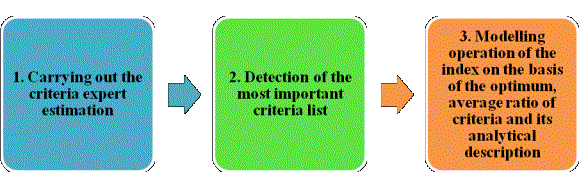
Picture 2-Step-by-step technique of receiving a
complex index for carrying out a statistical analysis
As a result of
carrying out the above-named step-by-step selection the matrix of complex
indexes is formed (table 1).
Table 1 - Analytical matrix of the
complex indexes for further statistical processing
|
Name of
the index characteristics |
Data set ups analysis levels |
|
|
Criteria level |
According to actual data |
According to the predicted
data |
|
Rating assessment |
||
|
Index components |
||
|
Necessary economic effect
(profitability and risk ratio) |
||
If to consider
from the practical application point of view, the given method despite the
apparent complexity in view of its multi-staging has the indisputable
advantage.Consideringnotseparatecriteria, butthe complexindexes,
bymeansofthistechniquetheinitialtargetindexesfromapositionofthefinancialeffectincludedinabasisoftheforecastare
combined. Further it is estimated, as an example by a method of F-test or by
the complete toolkit of the descriptive statistics a number of the cumulative
criteria from a point of view of their influence on this or that individual
criterion, that is the procedure of model prediction actually becomes more
simple, and the models received as a result can have as point-wise descriptive
character, and to describe the ratios of the separate indexes on the complex and
vice versa. Therefore, having worked to analyze the criteria from the point of
view of their efficiency for the research object, it is possible to reduce the
process of carrying out model prediction and essentially to increase its value
for the subsequent analysis, thus without using the specialized analytical
platforms.
Thus, the given
method allows to receive the total indicators with that set of the
characteristic which better answers to the purposes of the conducted
statistical research, to build multi-variant model and does results as much as
possible useful to further analytical work.
REFERENCES:
1) Watsham T. J. Parramore K. The quantitative methods
in the finance: Trans. from Engl. – M.: UNITY. Finance, 2009
2) Kochovich E. Financial mathematics. – M.: Finance and statistics,
2012
3) Druzhinin N.K. Mathematical statistics in the economy. – M.:
Statistics, 1971